Summary: Who Should Take Which Course?
- For ambitious beginners and professionals aiming for deep, career-transforming AI skills like automation and workflow design, Heicoders’ GA100 course is a good choice. It offers a complete, structured journey from basic prompting to advanced implementation.
- For absolute beginners who only want a brief, surface-level introduction to AI tools for personal productivity, InfoTech’s shorter courses are a suitable starting point.
Your Guide to Choosing a Suitable Generative AI Course
You’ve seen the headlines. AI is no longer a futuristic concept; it’s a present-day reality reshaping industries and redefining job roles.
For the ambitious Singaporean professional, the question isn’t if you should upskill in Artificial Intelligence, but how. A quick search reveals a dizzying array of options, each promising to make you “AI-ready.”
This leads to a crucial dilemma: do you opt for a single, comprehensive course that promises a complete journey, or do you piece together your knowledge from multiple, shorter, more specialised modules?
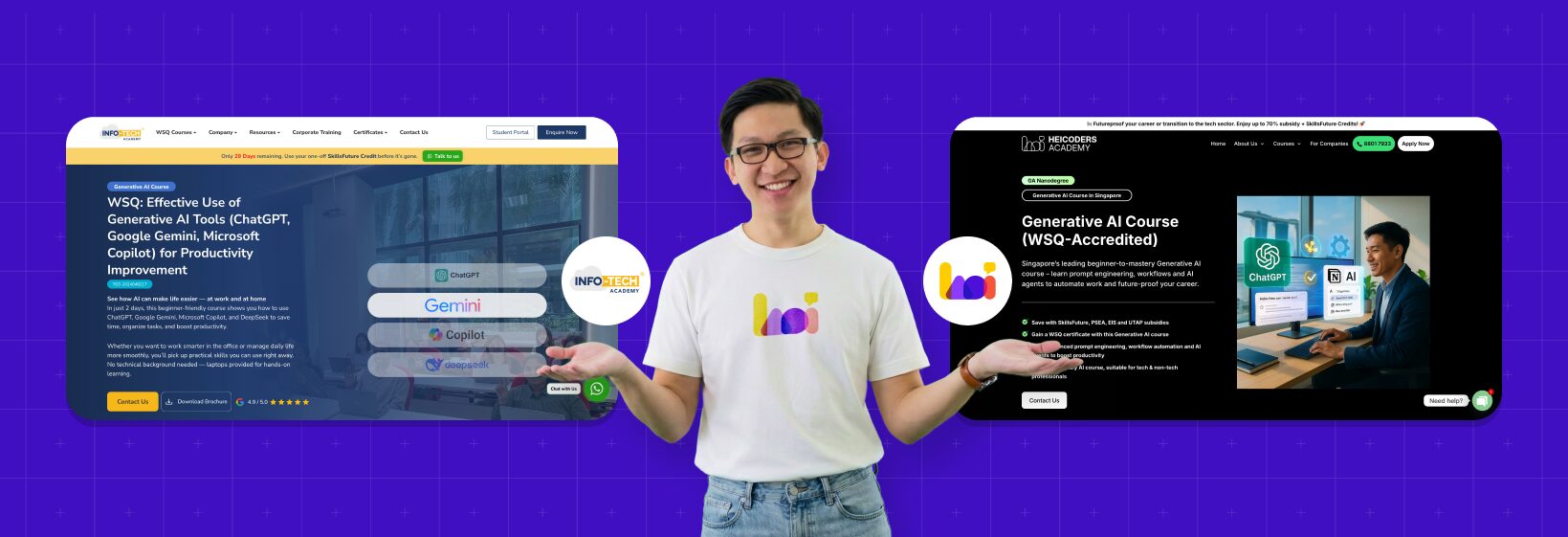
This is the exact choice many face when comparing two of Singapore’s prominent training providers: Heicoders Academy and InfoTech Academy. Both are WSQ-accredited and SkillsFuture eligible, making them seem comparable on the surface.
Heicoders offers its flagship GA100 Generative AI Course, a single, structured programme designed to take you from a beginner to an advanced practitioner. In contrast, InfoTech provides a portfolio of shorter, distinct AI courses, each catering to a specific need or audience.
This article is designed to be your definitive guide through this decision. We’ll dissect both approaches, moving beyond the marketing slogans to compare the fundamental differences in course structure, curriculum depth, instructor credentials, learning outcomes, and the true, all-in cost.
Our goal isn’t to declare a “winner,” but to provide you with a clear, honest framework to help you decide which path aligns with your personal and professional ambitions.
By the end of this analysis, you’ll understand which of these two distinct educational philosophies will genuinely equip you for the next phase of your career.
Before Comparing Courses: What Do You Actually Want from AI Training?
Before we delve into a side-by-side comparison, it’s essential to look inwards.
The “best” AI course is entirely relative to your personal and professional objectives. A course that proves transformative for a marketing manager aiming to automate their entire department may be overkill for a retiree who simply wants to understand the technology their grandchildren are using.
Answering the following questions honestly will provide you with the clarity needed to evaluate which option is the right fit for you.
Are you seeking basic AI literacy or a fundamental career transformation?

First, distinguish between awareness and ability.
Basic AI literacy involves understanding what Artificial Intelligence is, knowing how to use tools like ChatGPT for daily tasks such as drafting emails or summarising documents, and generally feeling comfortable with the technology. It’s about enhancing your current productivity.
Career transformation, on the other hand, is about acquiring the skills to build, implement, and manage AI systems. This involves not just using AI as an assistant, but deploying it to automate complex workflows and create new value, potentially leading to new roles and responsibilities.
Do you want to enhance your current role or pivot to an AI-focused position?
Consider whether your goal is to apply AI within your existing job description or to transition to a role where AI is the core function.
Enhancing your current role might mean using AI to analyse data more efficiently or to generate reports faster.
Pivoting to an AI-focused position, such as an Automation Specialist or an AI Implementation Manager, requires a much deeper and more technical skill set, including the ability to design and build the systems that your colleagues will use.
Are you looking for quick wins or long-term capability building?
Your timeline and desired learning curve are also critical.
Are you looking for quick wins—practical tips and tricks that you can apply immediately to save an hour or two each week?
Or are you interested in long-term capability building—investing in a foundational skill set that will remain relevant and adaptable as AI technology continues its rapid evolution?
The former provides immediate gratification, whilst the latter offers sustained career growth and resilience.
What is your level of ambition?
Finally, be realistic about your ambition, not just your starting point. It’s not about your current technical skill, but about your desire to learn.
Are you content with learning the basics of prompting and stopping there? Or are you ambitious and curious, excited by the prospect of learning how to build real automation and workflows, even if you’re starting from scratch?
Some courses are designed to provide a gentle introduction and leave it at that. Others are designed to welcome beginners and guide them, step-by-step, all the way to advanced, powerful concepts.
Your responses to these questions will form the lens through which you should view the offerings from Heicoders and InfoTech.
There’s no right or wrong set of answers, but aligning a course’s intensity and depth with your personal goals is the most critical step in making a successful educational investment.
The Fundamental Difference: One Journey vs. Multiple Stops
The most significant distinction between Heicoders and InfoTech lies in their fundamental educational philosophy.
Heicoders champions a single, integrated journey designed for comprehensive skill acquisition, whilst InfoTech offers a collection of shorter, modular courses that can be taken independently.
Understanding this structural difference is key to aligning a provider with your learning objectives.
The Heicoders Approach: A Single, Cohesive Journey for All

Heicoders’ GA100 Generative AI Course is structured as a single, linear programme that takes any learner—from an absolute beginner to someone with some experience—to an advanced practitioner level in one continuous journey.
It’s designed like a guided expedition, where each stage methodically builds upon the last, ensuring a deep and interconnected understanding of the subject matter. The course welcomes beginners, starting with the absolute basics before moving on to more powerful concepts.
The curriculum is intentionally sequenced across six distinct lessons, totalling 18 hours of instruction.
Lesson 1: Foundation — The journey begins with the fundamentals of Generative AI and the core principles of prompt engineering, accessible to everyone.
Lesson 2: Refinement — Learners then move to advanced prompting techniques, mastering methods like chain-of-thought to produce more reliable and sophisticated outputs.
Lesson 3: Expansion — The course expands beyond simple prompting to introduce the concepts of multi-step AI workflows and autonomous AI agents.
Lesson 4: Automation — Here, learners get hands-on with building agentic workflows using professional automation platforms like n8n, with no prior coding experience required.
Lesson 5: Integration — The focus shifts to real-world application, teaching Retrieval-Augmented Generation (RAG) to connect AI with proprietary business data.
Lesson 6: Implementation — The final lesson covers advanced deployment concepts like the Model Context Protocol (MCP) and the critical frameworks for managing AI risk and governance.
This structured progression is deliberate. A learner cannot effectively build an automated workflow (Lesson 4) without first mastering advanced prompting (Lesson 2). The course is designed to ensure that even a complete beginner can reach the final lesson with a holistic skill set.
The InfoTech Approach: A Modular Collection
InfoTech, in contrast, provides a portfolio of shorter, distinct courses, each designed to be a self-contained learning experience.
This approach is akin to taking a series of day trips rather than a single expedition. A learner can choose the specific module that seems most relevant to their immediate needs.
The portfolio includes courses such as:
- AI for Beginners — An 8-hour introduction to AI foundations and basic tools.
- Understand Generative AI using ChatGPT — An 8-hour course focused specifically on using ChatGPT for workplace tasks.
- Effective Use of Generative AI Tools for Productivity Improvement — A 16-hour course covering various AI tools for general productivity.
- AI for HR and AI for Business Management — Specialised courses tailored to specific professional roles.
In cases where there are multiple modules, we encourage learners to research on the individual topics within the modules to ensure that the differences are not largely the same content repackaged under different titles.
Comparison at a Glance
| Aspect | Heicoders GA100 | InfoTech Academy Portfolio |
|---|---|---|
| Structure | Single, progressive 18-hour course | Multiple, separate 8-16 hour courses |
| Progression | Linear: Beginner → Intermediate → Advanced | Modular: Beginner level in each course |
| Content Overlap | Minimal, as each lesson builds on the last | Potentially significant, with basics repeated |
| Learning Path | A clearly defined, structured journey | A self-directed, mix-and-match approach |
| Completion | One certificate representing a full journey | Multiple certificates for fragmented skills |

The Honest Assessment
If your goal is to achieve a deep, functional understanding of how to implement AI solutions, the comprehensive, structured approach is unequivocally more efficient.
It eliminates redundancy and ensures that you’re constantly building on your knowledge base.
However, if you’re an absolute beginner who only wants to test the waters with a short, low-commitment introduction, InfoTech’s modular approach offers that flexibility.
For the serious professional—beginner or otherwise—the cohesive journey is the more strategic path to mastery.
Curriculum Depth: Surface-Level Prompting vs. Real Automation
Beyond the overall structure, the most critical differentiator is the depth of the curriculum.
Both Heicoders and InfoTech start with the basics of prompt engineering, but their end goals are fundamentally different.
InfoTech aims to make you a more efficient user of AI tools, whilst Heicoders aims to make you a builder of AI-powered systems, regardless of your starting point.
The Prompting Plateau
Across InfoTech’s various courses, the core skills taught are centred on immediate productivity gains.
You’ll learn to understand the basic concepts of Artificial Intelligence, write effective prompts to get better answers from tools like ChatGPT, Gemini, and Copilot, use AI to assist with daily office tasks such as drafting emails, creating presentations, and writing reports, and perform simple data analysis by uploading files to an AI chatbot.
These are undeniably valuable skills. For any professional who hasn’t moved beyond casual experimentation with AI, these courses will deliver a tangible boost in efficiency.
However, this approach has a ceiling—what we call the prompting plateau.
You learn to become a better assistant to the AI, but you’re still manually driving every task. You prompt, you copy, you paste, you edit.
It’s productivity enhancement, not workflow transformation.
Heicoders’ Journey Beyond the Plateau
Heicoders’ GA100 course begins at the same starting line—prompt engineering fundamentals—but it’s designed to take you far beyond it, guiding you every step of the way.
The curriculum is explicitly structured in three levels of increasing sophistication:
Level 1: Mastering the Prompt (Lessons 1-2) — This foundational stage ensures you have a complete command of prompt engineering, including advanced techniques like chain-of-thought and few-shot learning to achieve consistent, high-quality outputs.
Level 2: Building Workflows (Lessons 3-4) — This is where Heicoders diverges significantly. The course moves from manual prompting to designing multi-step, automated workflows. You’ll learn to use professional automation platforms like n8n—powerful tools that are taught with a step-by-step, no-code-required approach.
Level 3: Deploying AI Agents & Systems (Lessons 5-6) — The final level focuses on advanced implementation. You’ll learn to build Retrieval-Augmented Generation (RAG) systems, which allow AI to work with your specific company data. You’ll also work with advanced AI agents like Manus AI, which can be delegated complex, multi-step projects, and learn about the governance required to deploy these systems safely.
The Real-World Difference
Let’s say you’re in marketing and need to create social media content weekly.
InfoTech approach: You learn to prompt ChatGPT effectively. Each week, you open ChatGPT, write prompts, generate content, copy-paste to your tools, edit, and post. Time saved: 30-40%.
Heicoders approach: You build an n8n workflow that monitors your content calendar, automatically generates posts based on your brand guidelines (using RAG with your company data), creates accompanying images with Midjourney, and queues them in your social media tool. You review and approve. Time saved: 80-90%.
That’s the difference between productivity enhancement and automation.
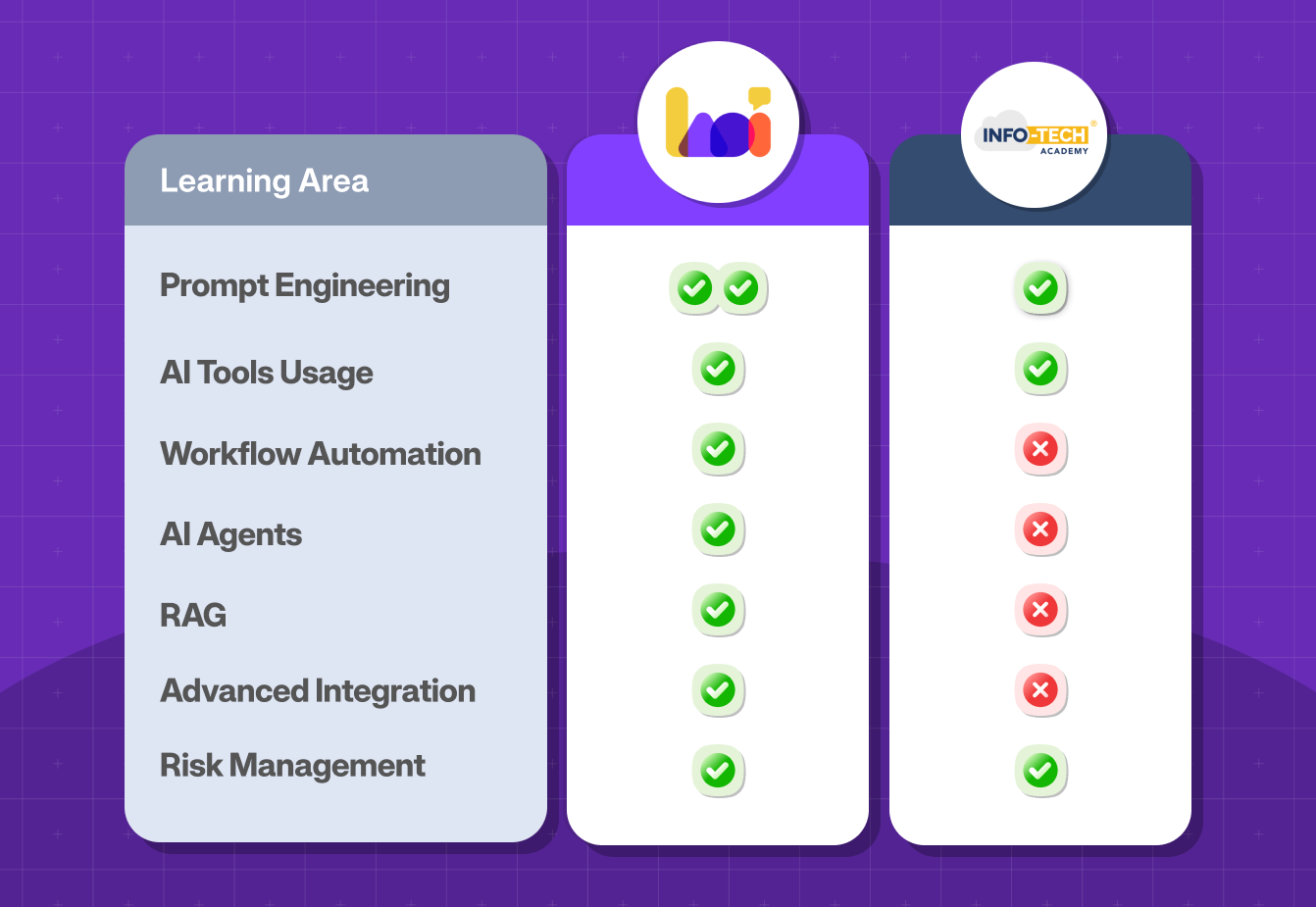
Curriculum Depth at a Glance
| Learning Area | InfoTech Coverage | Heicoders Coverage |
|---|---|---|
| Prompt Engineering | ✅ Basic prompts | ✅ Basic + Advanced techniques |
| AI Tools Usage | ✅ ChatGPT, Gemini, Copilot | ✅ ChatGPT, Copilot, Midjourney, n8n, Manus AI |
| Workflow Automation | ❌ Not covered | ✅ Full module with n8n (no-code) |
| AI Agents | ❌ Not covered | ✅ Building and deploying agents |
| RAG (Business Data) | ❌ Not covered | ✅ Full lesson on implementation |
| Advanced Integration | ❌ Not covered | ✅ MCP and system integration |
| Risk Management | ✅ Basic ethics | ✅ Governance frameworks |
Who Needs What?
Choose InfoTech if:
- You’ve never used AI tools and want a gentle, one-off introduction.
- Your goal is only personal productivity (emails, documents, presentations).
- You want quick wins and have no ambition to learn automation.
Choose Heicoders if:
- You’re a beginner who wants a course that will take you from the basics all the way to advanced.
- You want to automate business processes, not just speed up manual tasks.
- You’re looking to implement AI solutions at work, regardless of your current technical skill.
- You understand that real AI value comes from automation, not just prompting.
Instructor Credentials: Learning from Tech Practitioners vs. Training Professionals
When you’re learning cutting-edge technology, instructor background matters enormously.
Are you learning from people who build AI systems daily, or from people who teach about AI?
The InfoTech Approach: The Professional Trainer
InfoTech’s instructors are seasoned professional trainers with strong credentials in adult education, corporate training, and Human Resources.
Their expertise lies in pedagogy—the art and science of teaching. They’re skilled at creating structured, accessible learning environments and making complex topics understandable for absolute beginners.
Their backgrounds are heavily rooted in HR Management Systems (HRMS), project management, and employee training, and they’ve been equipped to teach the subject of AI effectively.
This approach is highly beneficial for learners who are new to technology and may feel intimidated. A professional trainer excels at building confidence and providing the step-by-step guidance needed to overcome initial learning hurdles.
The Heicoders Approach: The Industry Practitioner
Heicoders, by contrast, draws its instructors directly from the front lines of the tech industry.
The instructor pool for the GA100 course consists of data scientists, software engineers, solutions architects, and product managers from Singapore’s most influential technology companies, including Grab, Shopee, Meta, Google, Stripe, GIC, and GovTech.
These individuals aren’t professional trainers; they’re active practitioners who are building, managing, and scaling AI and data systems as their day job.
They teach what they do.
This provides learners with a direct line to current industry best practices, real-world challenges, and the practical wisdom that can only be gained from hands-on experience.
They can tell you not just how a system is supposed to work, but how it actually performs under the pressures of a live production environment.

The Analogy
To use an analogy, learning from a professional trainer is like learning from a culinary school teacher—they’re experts in technique and can teach you the recipes perfectly.
Learning from a practitioner-instructor is like learning from a Michelin-starred chef during their restaurant’s dinner service—they teach you not only the recipe but also how to handle the heat, adapt to unexpected problems, and deliver excellence under pressure.
Instructor Background at a Glance
| Aspect | InfoTech Academy Instructors | Heicoders Academy Instructors |
|---|---|---|
| Primary Expertise | Adult Education, Corporate Training, HRMS | Software Engineering, Data Science, AI/ML |
| Day Job | Professional Trainers and Consultants | Practitioners at top tech firms (Google, Meta, etc.) |
| Teaching Style | Pedagogically structured, focused on accessibility | Application-focused, rich with real-world examples |
| Key Insight | How to teach AI concepts effectively | How to build and deploy AI systems in production |
The Honest Assessment
For a learner seeking basic AI literacy, the professional trainers at InfoTech offer a safe and effective environment. They’re experts at demystifying technology for a non-technical audience.
However, for any professional—beginner or expert—who aims to implement AI solutions or pivot into a tech-focused role, the value offered by a practitioner-instructor is unparalleled.
Learning from someone who has already navigated the challenges you’re preparing to face provides a significant competitive advantage and a deeper, more practical understanding of the subject matter.
Tools & Technology: The Difference Between a User and a Builder
A course is only as good as the tools it empowers you to use.
Here, the distinction between the two academies is stark. InfoTech equips you to become a power user of consumer-facing AI applications, whilst Heicoders trains you to become a builder, using professional-grade automation and integration platforms.
InfoTech’s Tool Focus: Mastering the Chatbot Interface
InfoTech’s courses centre on the suite of popular, publicly available AI tools that have captured the world’s attention.
ChatGPT (from OpenAI), Google Gemini, Microsoft Copilot, and other emerging chatbots like DeepSeek and Meta AI.
These are primarily prompting interfaces. The mode of interaction is conversational; you ask questions, you receive answers, and you use those outputs in your work.
The curriculum is designed to make you highly proficient at this interaction, turning you into an expert at conversing with AI.
This is a valuable skill, but it keeps you firmly in the role of a user.
Heicoders’ Technology Stack: The Automation Ecosystem
Heicoders covers the popular chatbots but treats them as just one component in a much larger ecosystem.
The course quickly moves beyond the chat interface to the professional tools used for automation and integration, teaching them in a beginner-friendly, no-code manner.
Automation Platforms (n8n) — You’ll learn to use powerful open-source workflow automation tools like n8n. This is the equivalent of learning not just how to use a single app, but how to connect multiple apps together to create a seamless, automated process that runs without your intervention.
AI Agent Platforms (Manus AI) — The course introduces you to advanced AI agent systems that can be delegated complex, multi-step tasks, moving beyond single prompts to autonomous project execution.
Advanced Integration (RAG & MCP) — You’ll learn the techniques required to build systems that can reason over your own proprietary data (Retrieval-Augmented Generation) and integrate deeply with other business systems (Model Context Protocol).
This is the difference between learning to drive a car and learning to build an engine.
InfoTech teaches you how to operate the finished product masterfully. Heicoders teaches you how to assemble the components to build your own custom machine.
The Practical Difference at a Glance
| Technology Tier | InfoTech Academy Coverage | Heicoders Academy Coverage |
|---|---|---|
| Chatbot Interfaces | ✅ ChatGPT, Gemini, Copilot | ✅ ChatGPT, Copilot, Midjourney |
| Automation Platforms | ❌ Not Covered | ✅ Core module on n8n (no-code) |
| AI Agent Platforms | ❌ Not Covered | ✅ Hands-on with agentic systems |
| Data Integration | ❌ Not Covered | ✅ RAG for custom data |
The Honest Assessment
Learning to use ChatGPT effectively is a 2024 skill. Learning to build automated workflows that leverage AI is a 2025-and-beyond skill.
If your goal is to remain competitive and valuable as AI technology matures, you must move beyond the chat window.
Whilst InfoTech provides a solid grounding in using today’s popular tools, Heicoders provides the more durable and strategic skill set by teaching you how to build with the underlying platforms that power true automation.
Learning Outcomes: What Can You Actually Do After the Course?
The ultimate measure of any educational programme is what it empowers you to do.
When we compare the learning outcomes of InfoTech and Heicoders, we see a clear distinction between achieving personal productivity and enabling organisational transformation.
InfoTech Outcomes: The Efficient Professional
Upon completing one or more of InfoTech’s AI courses, you’ll be equipped to be a highly efficient and AI-literate professional.
- You’ll be able to enhance daily productivity by confidently using AI tools to draft emails, write reports, and create presentations in a fraction of the time it took before.
- You’ll generate content such as marketing copy, blog posts, and other written materials with AI assistance.
- You’ll analyse simple data by using AI chatbots to interpret spreadsheets and provide quick data summaries.
- You’ll champion AI adoption by explaining AI concepts to your colleagues and creating simple plans to encourage the use of these tools within your team.
On your resume, you could confidently list “Proficiency in ChatGPT, Google Gemini, and Microsoft Copilot.”
This is a valuable skill set that will make you more effective in your current role. However, as AI becomes more ubiquitous, these skills are rapidly becoming the baseline expectation rather than a key differentiator.
Heicoders Outcomes: The AI Implementer
Heicoders’ GA100 course is designed to produce a different kind of graduate—one who can not only use AI but can build and implement AI-powered solutions, regardless of their starting point.
Upon completion, you’ll be able to automate business processes by designing and building end-to-end automated workflows using platforms like n8n, connecting multiple applications to run tasks without human intervention.
- You’ll deploy AI agents, moving beyond simple prompting to delegating complex, multi-step projects to autonomous AI agents.
- You’ll build custom AI systems by implementing Retrieval-Augmented Generation (RAG) to create chatbots and knowledge systems that are trained on your own company’s data.
- You’ll lead AI initiatives with the technical understanding and governance knowledge to manage AI projects, mitigate risks, and scale solutions from a prototype to production.
- On your resume, you could list tangible, high-impact achievements such as, “Designed and deployed an automated AI workflow for [business process], resulting in an X% reduction in manual effort,” or “Implemented a RAG system to create an internal knowledge base, improving information retrieval times by Y%.”
These are the outcomes that lead to promotions, career pivots, and a significant competitive advantage in the job market.
The Portfolio Difference
Perhaps most critically, the project-based nature of the Heicoders course means you won’t just leave with knowledge, but with a portfolio of completed projects.
You’ll have built actual workflows and deployed real systems. This portfolio serves as concrete proof of your abilities, which is far more powerful in an interview than simply listing a certificate.
The Honest Assessment
InfoTech will make you a better user of AI. Heicoders will make you a builder of AI-driven solutions.
If your goal is to enhance your current role, InfoTech is a valid choice.
If your goal is to transform your career and become a leader in the application of AI, the outcomes from Heicoders are demonstrably more aligned with that ambition.
The Competency Gap: 40th vs. 80th Percentile
Let’s quantify the difference. Completing a course from InfoTech will likely place you at the 40th percentile in terms of real-world AI competency. You’ll know the basics, but you won’t stand out.
Our GA100 course is designed to get our average student to the 80th percentile. For our more motivated students, the 90th percentile is well within reach. This isn’t just about a certificate; it’s about achieving a level of mastery that makes you a top-tier talent in the job market.
Cost Analysis: The True Price of Comprehensive Learning
Whilst the quality of education should be the primary concern, the financial investment required is a practical and important consideration for any professional.
At first glance, InfoTech’s modular courses may appear more affordable, but a deeper analysis reveals a more complex value equation.
The Sticker Price vs. The True Cost
Let’s compare the subsidised costs for Singaporeans.
- InfoTech’s Courses: A single 1-day course is typically priced around $195, whilst a 2-day course is approximately $390 after government subsidies.
- Heicoders’ GA100 Course: The fee is $643.50 for Singaporeans aged 40 and above (with the 70% subsidy) and $973.50 for those below 40 (with the 50% subsidy).
To achieve a semblance of comprehensive knowledge with InfoTech, a learner would need to enrol in at least two or three courses.
A realistic path would involve taking their 2-day “Effective Use of Gen AI Tools” course and adding a specialised 1-day module, bringing the total investment to approximately $585.
Even at this price, this combination would not cover the advanced topics of workflow automation, AI agents, or RAG that are standard in the Heicoders curriculum.
Therefore, the comparison isn’t between $195 and $973.50, but between spending $585 for a collection of intermediate skills versus $643.50 – $973.50 for a complete, beginner-to-advanced journey that includes professional-grade automation and implementation skills.
The Return on Investment (ROI)
The more strategic way to evaluate cost is to consider the potential return on investment.
An investment in InfoTech’s courses will undoubtedly yield a positive ROI in the form of enhanced personal productivity. The time saved on daily tasks will quickly justify the course fees.
An investment in Heicoders’ GA100 course, however, offers a different class of ROI.
The skills acquired—automation, workflow design, and systems implementation—are those that enable career transitions and promotions.
The ability to lead an AI initiative or to automate a core business process carries a far greater financial value than personal efficiency gains.
The potential for salary increases and new career opportunities makes the higher initial investment a demonstrably more strategic long-term decision.
The Honest Assessment
If your budget is strictly limited and your goal is simply to gain basic AI literacy, InfoTech’s low entry price is attractive.
However, for the serious professional, the marginal additional cost for the Heicoders course buys a disproportionately larger set of valuable, career-transforming skills.
It’s the difference between buying a tool and investing in a factory.
Who Should Choose Which: An Honest Recommendation
To make this as practical as possible, let’s outline the ideal candidate for each academy.
You should choose InfoTech Academy if:
- You’re an absolute beginner who only wants the basics. If you want a gentle introduction and plan to stop there, InfoTech’s modular courses are designed for that purpose.
- You’re a senior professional or retiree whose goal is to stay current with technology for personal use rather than career advancement.
- Your budget is the primary constraint. If you can only afford to spend around $200 and need a quick overview, InfoTech’s introductory courses offer the best value at that specific price point.
You should choose Heicoders Academy if:
- You’re a beginner with ambition. You want a course that starts with the basics but doesn’t stop there, guiding you all the way to advanced, powerful skills. The GA100 course is designed for you.
- You’re a mid-career professional serious about future-proofing your skills. If you’re in your 30s or 40s, you need skills that are durable. Heicoders provides the depth required for long-term relevance.
- Your goal is to automate work, not just accelerate it. If you’re tired of repetitive tasks and want to learn how to build systems that run themselves, Heicoders’ focus on automation platforms is directly aligned with your ambition.
- You value learning from those who build, not just those who teach. If you want to understand how AI is being applied in Singapore’s top tech firms, learning from Heicoders’ practitioner-instructors is the only way to get that direct insight.
- You’re looking for the highest long-term return on your educational investment. If you view upskilling as a strategic investment in your future earnings potential, the comprehensive, career-transforming skills from Heicoders offer a demonstrably higher ROI.
The Choice That Will Define Your AI Journey

Ultimately, there’s no single “best” AI course, only the course that is best for you.
InfoTech Academy serves a valuable purpose in the educational landscape, providing an accessible and affordable entry point for absolute beginners, seniors, and those who require only a surface-level understanding of AI. It effectively gets you on the field.
However, for the ambitious professional aiming not just to participate but to lead, the game has changed.
Basic AI literacy is rapidly becoming a baseline expectation. The skills that will define careers in 2025 and beyond aren’t in using AI, but in building with it.
The ability to design automated workflows, to deploy AI agents, and to integrate AI with proprietary business data is what will create lasting value and command a premium in the job market.
This is the territory that Heicoders Academy’s GA100 course is designed to conquer.
Its single, comprehensive structure, its focus on professional-grade automation tools (taught in a beginner-friendly way), its instruction by active industry practitioners, and its emphasis on portfolio-building projects all point to a single goal: to create not just AI users, but AI implementers.
The choice you make isn’t merely about which course to take, but about what level of ambition you have for your career in an AI-driven world.
Do you want to become more efficient in your current role, or do you want to acquire the skills to define your future one?
Both are valid goals, but they lead to very different educational choices.
For the professional ready to move beyond the prompting plateau and truly invest in a transformative skill set, the comprehensive journey is the clear and strategic path forward.