Most people use the words “investing” and “trading” interchangeably. Even in casual conversation, someone who buys stocks is often described as “playing the market,” whether they are holding for 10 years or 10 days.
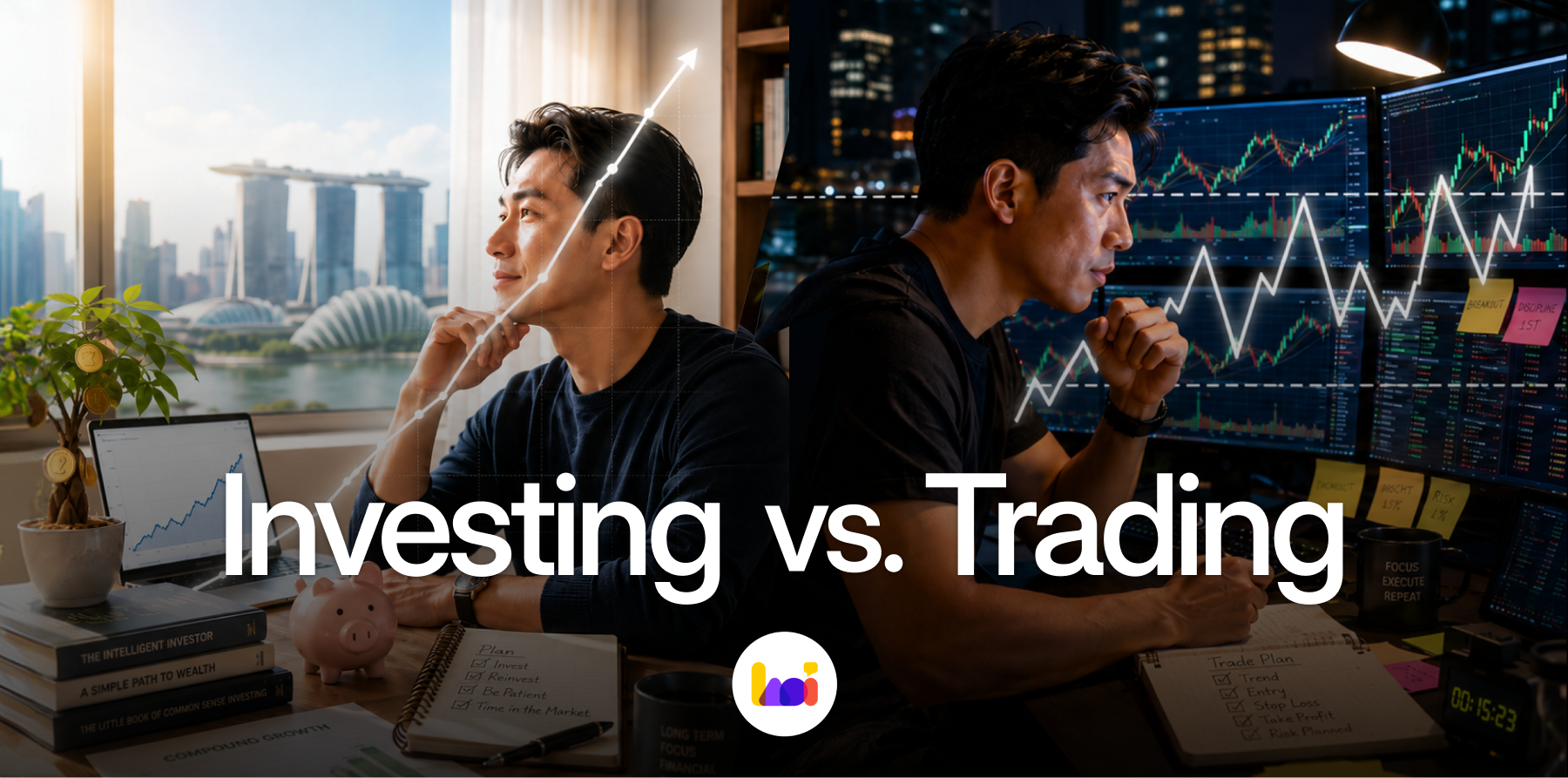
But investing and trading are fundamentally different activities. They operate on different time horizons, use different tools, require different mindsets, and carry different risk profiles. Treating them as the same thing is one of the most common reasons people end up with a strategy that does not actually match their goals.
This guide breaks down exactly what separates investing from trading, where they overlap, and how to figure out which approach, or which combination, makes sense for your situation.
What is Investing?
Investing is the practice of allocating capital into assets, typically stocks, bonds, real estate, or funds, with the expectation of generating returns over a long period of time. The defining characteristic of investing is the time horizon: investors typically hold their positions for years or even decades.
The core idea behind investing is that well-chosen assets will grow in value over time as the underlying businesses or economies they represent expand. Investors are not primarily trying to profit from short-term price fluctuations. They are betting on long-term growth and the power of compounding.
Warren Buffett, one of the most successful investors of all time, famously described his preferred holding period as “forever.” That gives you a sense of the investing mindset: patience, long-term conviction, and a willingness to ride out short-term volatility in pursuit of long-term gains.
How Investors Make Decisions
Investors typically rely on fundamental analysis: the study of a company’s financial health, competitive position, management quality, revenue growth, and broader industry trends. The central question is: “Is this company worth owning for the long term, and am I buying it at a reasonable price?”
Tools commonly used by investors include earnings reports, price-to-earnings (P/E) ratios, dividend histories, balance sheet analysis, and macroeconomic research. The goal is to identify companies or assets that are fundamentally strong and likely to be worth significantly more in the future than they are today.
The Role of Compounding in Investing
One of the most powerful forces in long-term investing is compounding: the process by which returns generate their own returns over time.
A simple example illustrates how significant this is. An initial investment of $10,000 growing at an average annual return of 8% becomes approximately $21,600 after 10 years, $46,600 after 20 years, and just over $100,600 after 30 years. The investor did nothing in years 20 to 30 except stay invested. The compounding did the work.
This is why time in the market is such a central principle of long-term investing. The earlier you start and the longer you stay invested, the more compounding works in your favour.
What is Trading?
Trading is the active buying and selling of financial assets, typically stocks, forex, or derivatives, over shorter time periods, ranging from seconds to weeks, with the goal of profiting from price movements.
Unlike investors, traders are not primarily focused on whether a company is fundamentally sound. They are focused on price behaviour: where a stock is likely to move next, when to enter a position, where to take profit, and how to manage risk if the trade goes against them.
Traders aim to generate returns by consistently finding and executing setups where the potential reward outweighs the potential risk, across a large number of trades over time.
How Traders Make Decisions
Traders rely primarily on technical analysis: the study of price charts, trading volume, and market patterns to forecast short-term price movements. Where fundamental analysts ask “what is this company worth?”, technical analysts ask “where is this price going, and when?”
The tools of trading include candlestick charts, support and resistance levels, trend lines, technical indicators like the RSI and MACD, volume analysis, and chart pattern recognition. The goal is to read market behaviour accurately enough, and manage risk carefully enough, to produce consistent profits over time.
Successful traders also develop a deep understanding of market psychology, risk management, and execution discipline. Technical skill matters, but the psychological and risk management side of trading is equally important, and arguably harder to master.
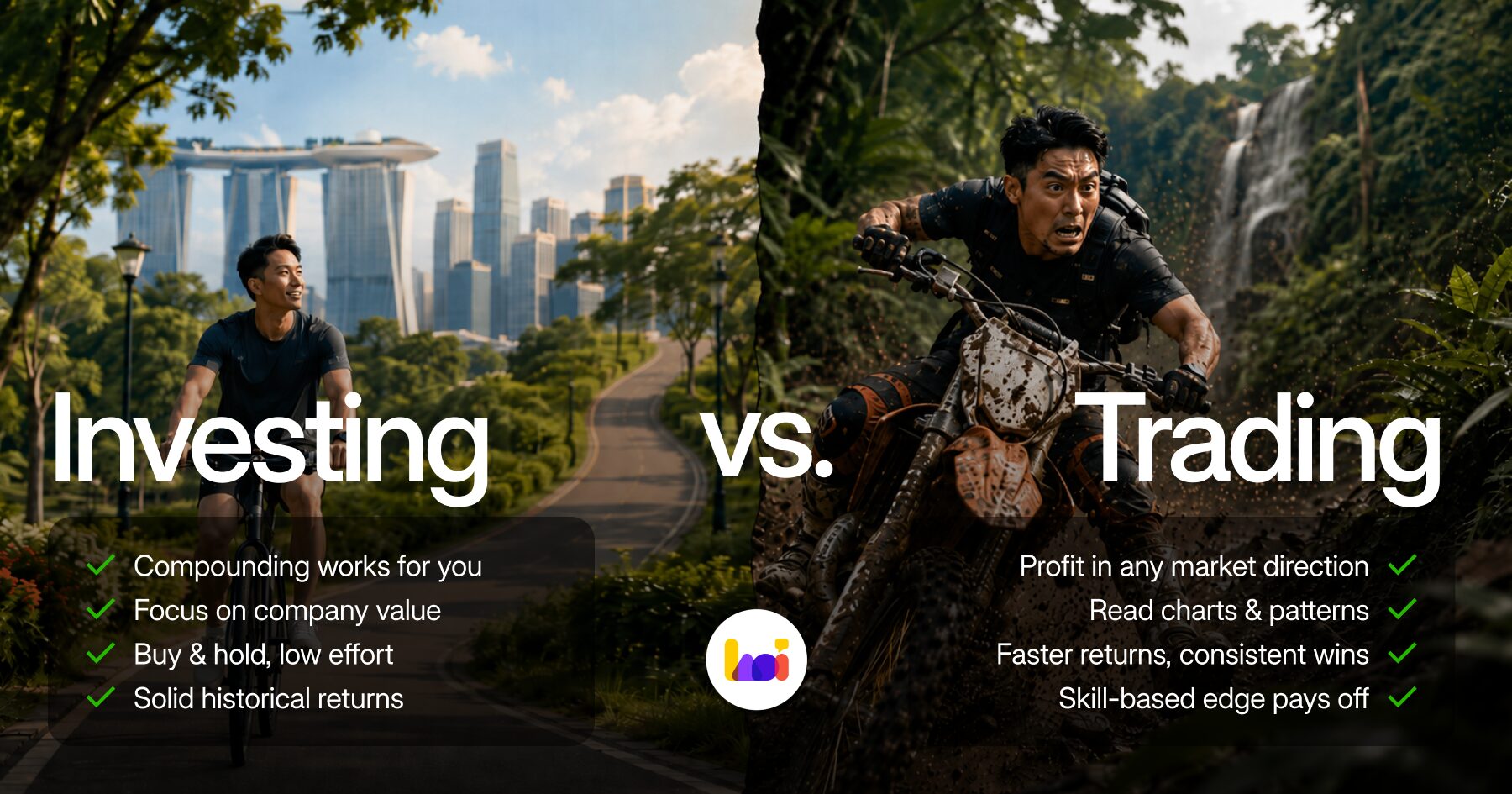
Key Differences Between Investing and Trading
| Investing | Trading | |
| Time horizon | Years to decades | Seconds to weeks |
| Primary method | Fundamental analysis | Technical analysis |
| Core question | Is this worth owning long term? | Where will this price move next? |
| Decision frequency | Low (buy and hold) | High (active management) |
| Income source | Capital appreciation and dividends | Profits from price movements |
| Risk profile | Lower day-to-day volatility exposure | Higher short-term risk |
| Time commitment | Lower once position is established | Higher, requires active monitoring |
| Compounding role | Central to long-term returns | Less relevant, focus is on consistent wins |
The Pros and Cons of Each Approach
Investing: The Pros
Time in the market rewards patience. Historical data consistently shows that long-term investors who stay invested through market cycles tend to generate solid returns. The S&P 500, for example, has delivered an average annual return of approximately 10% over the past century despite multiple crashes, recessions, and global crises.
Lower time commitment. Once you have built a portfolio of quality assets, long-term investing does not require constant monitoring. This makes it accessible to professionals with busy schedules.
Tax efficiency. In many jurisdictions, long-term capital gains are taxed at a lower rate than short-term gains. Singapore currently has no capital gains tax, which makes long-term investing particularly attractive for Singapore residents.
Emotional simplicity. Investing asks you to be patient and stay the course. While this is psychologically challenging during market downturns, the day-to-day decision load is much lower than active trading.
Investing: The Cons
Returns are slow to materialise. The power of compounding takes time to become significant. For someone who needs to generate income in the near term, long-term investing alone may not be sufficient.
Vulnerability to prolonged downturns. Long-term investors ride out market corrections and bear markets, which can last months or years. Depending on when you need to access your capital, a poorly timed downturn can significantly affect your returns.
Limited ability to profit in falling markets. Most long-term investors hold long positions, meaning they profit when prices rise and lose when prices fall. Strategies that allow investors to profit in declining markets (such as short selling or put options) are available but typically not part of a standard long-term investing approach.
Trading: The Pros
Potential for faster returns. A skilled trader can generate returns across both rising and falling markets, and over much shorter time periods than a buy-and-hold investor.
Flexibility across market conditions. Traders can go long when markets are rising and short when they are falling. This flexibility means market conditions do not have to dictate whether you are active or not.
Skill-based edge. Trading rewards those who invest in developing genuine skills: chart reading, risk management, pattern recognition, and psychological discipline. A skilled trader is not at the mercy of market cycles in the same way a passive investor is.
Income generation. For those who develop consistent trading skills, trading can generate active income rather than simply building wealth gradually over time.
Trading: The Cons
Steeper learning curve. Trading requires structured learning, consistent practice, and real market experience before it becomes reliably profitable. The failure rate among underprepared retail traders is high.
Higher time commitment. Active trading requires regular market monitoring, chart analysis, and trade management. This can be demanding alongside a full-time career.
Psychological demands. Trading exposes you to rapid gains and losses in a way that long-term investing does not. Emotional discipline, the ability to stick to your plan when trades go against you and to avoid overtrading when things are going well, is one of the hardest skills to develop.
Transaction costs. Active trading involves more frequent transactions, which means more brokerage fees, spreads, and potential tax implications in markets where short-term gains are taxed differently.
Can You Do Both?
Yes, and many experienced market participants do.
A common approach among financially sophisticated individuals is to maintain a core long-term investment portfolio built on fundamental analysis and compounding, while allocating a separate, clearly defined portion of capital to active trading.
The key is to keep the two activities separate: different accounts, different capital, and different decision frameworks. Mixing them up is where things tend to go wrong. Turning a losing trade into a “long-term investment” because you do not want to take the loss, for example, is one of the most expensive and common mistakes active traders make.
When the two activities are kept properly separated, they can complement each other well. Your long-term portfolio provides stability and compounds quietly in the background. Your trading account gives you the opportunity to develop skills, generate more active returns, and stay engaged with the market.
Investing vs Trading in the Singapore Context
For Singapore residents, there are a few additional considerations worth understanding.
CPF and SRS as investing vehicles. Many Singaporeans already have exposure to long-term investing through their CPF savings, whether through the CPF Investment Scheme (CPFIS) or through the default CPF interest rates. The Supplementary Retirement Scheme (SRS) is another tax-advantaged vehicle commonly used for long-term investing. These are broadly investing structures, not trading ones.
No capital gains tax. Singapore’s tax environment is genuinely favourable for both investors and traders. There is currently no capital gains tax, meaning profits from both long-term investing and active trading are generally not taxed in Singapore (though this can depend on individual circumstances and the frequency of trading activity).
Access to global markets. Singapore-based retail traders and investors have access to a wide range of markets, including SGX-listed stocks, US equities, Hong Kong-listed stocks, forex, and crypto, through a variety of licensed platforms.
IBF-funded education. For Singapore residents looking to build trading skills, courses accredited by the Institute of Banking and Finance (IBF) are eligible for significant subsidies under IBF-STS funding. This makes structured, professional-level trading education significantly more accessible than in many other markets.
How to Decide Which Approach is Right for You

There is no universal answer. The right approach depends on your goals, your personality, your available time, and where you are in your financial journey. Here is a practical framework for thinking it through.
Consider long-term investing if:
You are focused on building wealth steadily over time and are comfortable with a multi-year time horizon. You have limited time to actively monitor markets. You prefer a lower-stress approach that does not require daily decision-making. You are just starting out and want a structured, lower-risk way to grow your capital. You are saving for a specific long-term goal such as retirement, a property, or your children’s education.
Consider trading if:
You want to develop an active skill set that can generate returns across different market conditions. You have the time and commitment to learn properly and practice consistently. You are looking for a potential additional income stream rather than just long-term wealth accumulation. You are intellectually drawn to markets and enjoy analysing price behaviour and chart patterns. You understand and accept that trading involves real risk and requires disciplined risk management.
Consider both if:
You have the capital to separate a long-term portfolio from a dedicated trading account. You are willing to maintain clear boundaries between the two activities and not let one bleed into the other. You want the stability of long-term compounding alongside the active engagement and potential upside of trading.
Frequently Asked Questions About Investing vs Trading
Is trading riskier than investing?
In the short term, trading typically involves more frequent exposure to price volatility and requires active risk management decisions. Long-term investing carries its own risks, including prolonged market downturns, but the extended time horizon gives markets more opportunity to recover. The risk profile of each approach is different rather than one being simply “riskier” than the other.
Can a beginner start trading right away?
Technically yes, but it is not advisable without proper preparation. Starting to trade before you have a solid understanding of technical analysis, risk management, and position sizing is one of the fastest ways to lose capital. Structured learning before real-money trading significantly improves your odds of long-term success.
How much capital do I need to start trading in Singapore?
There is no fixed minimum, but most experienced traders recommend starting with capital you can genuinely afford to lose while you are learning. More important than the amount is having a clear risk management framework that defines exactly how much of your capital you are willing to risk on any single trade.
What is the difference between a trader and a speculator?
A trader uses a systematic, rules-based approach grounded in technical and/or fundamental analysis to make decisions. A speculator makes bets on price movements without a consistent framework. The distinction matters because systematic trading produces repeatable results; speculation depends on luck.
Can you do both investing and trading at the same time?
Yes, but they should be kept strictly separate. Different accounts, different capital allocations, and different decision frameworks. The most common mistake when combining both is letting a losing trade become a long-term “investment” to avoid realising a loss.
Is Singapore a good place to trade stocks?
Singapore is well-positioned for retail traders. There is no capital gains tax, the regulatory environment is clear and well-governed, and residents have easy access to global markets. IBF-funded trading education also makes it one of the more affordable places to develop trading skills properly.
Which approach is better for generating passive income?
Long-term investing through dividend-paying stocks or funds is the more commonly used approach for passive income generation. Trading can generate active income for skilled practitioners, but it requires ongoing time and effort and is better understood as an active pursuit than a passive one.
Ready to Explore the Trading Side?
If you have been considering whether trading is something you want to pursue seriously, the most important first step is learning it properly.
Understanding technical analysis, how to read price behaviour, how to manage risk, and how to build a consistent trading framework is what separates traders who profit over time from those who lose capital without knowing why.
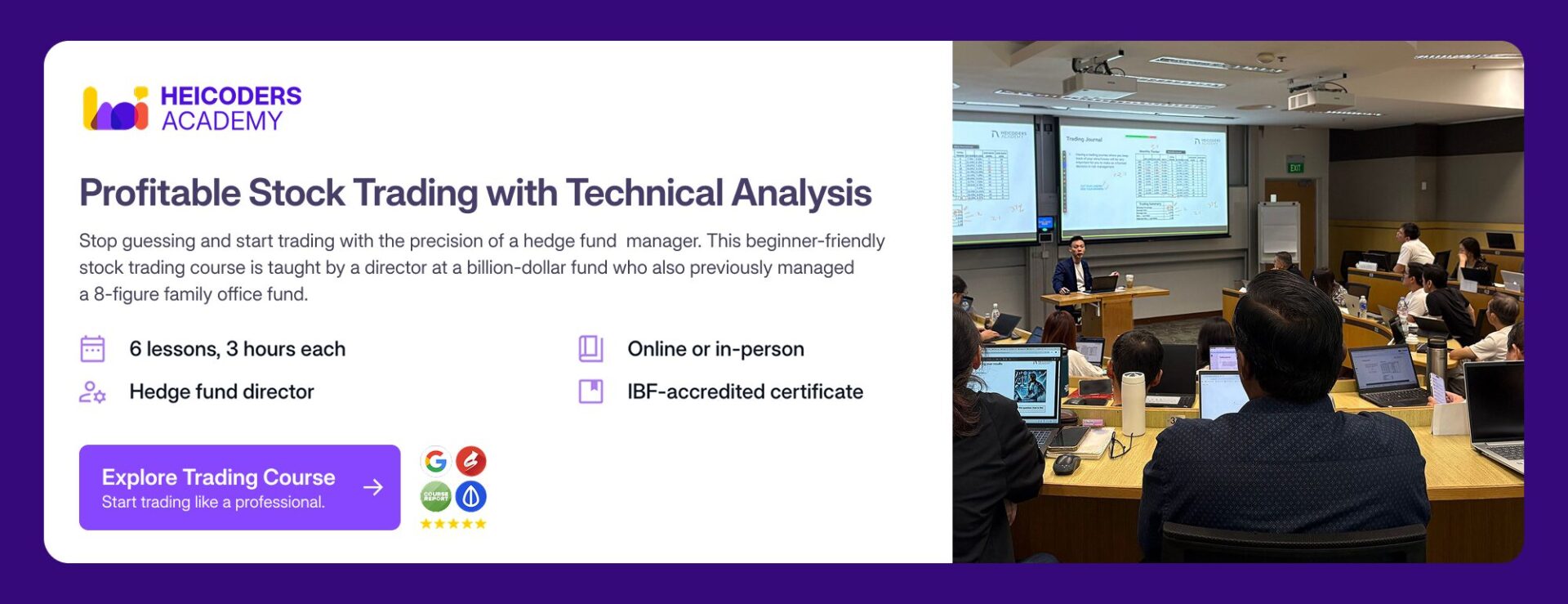
At Heicoders Academy, the Profitable Stock Trading Course with Technical Analysis (PSTTA) is built for exactly this starting point. It covers everything from the foundations of technical analysis and candlestick chart reading to chart pattern recognition, the institutional playbook, and a personalised risk management strategy you can apply from day one.
The course is taught by Gibson Low, a hedge fund director and former family office portfolio manager with over a decade of experience managing eight-figure portfolios. His approach to teaching is grounded in what actually works in real markets, not just theory.
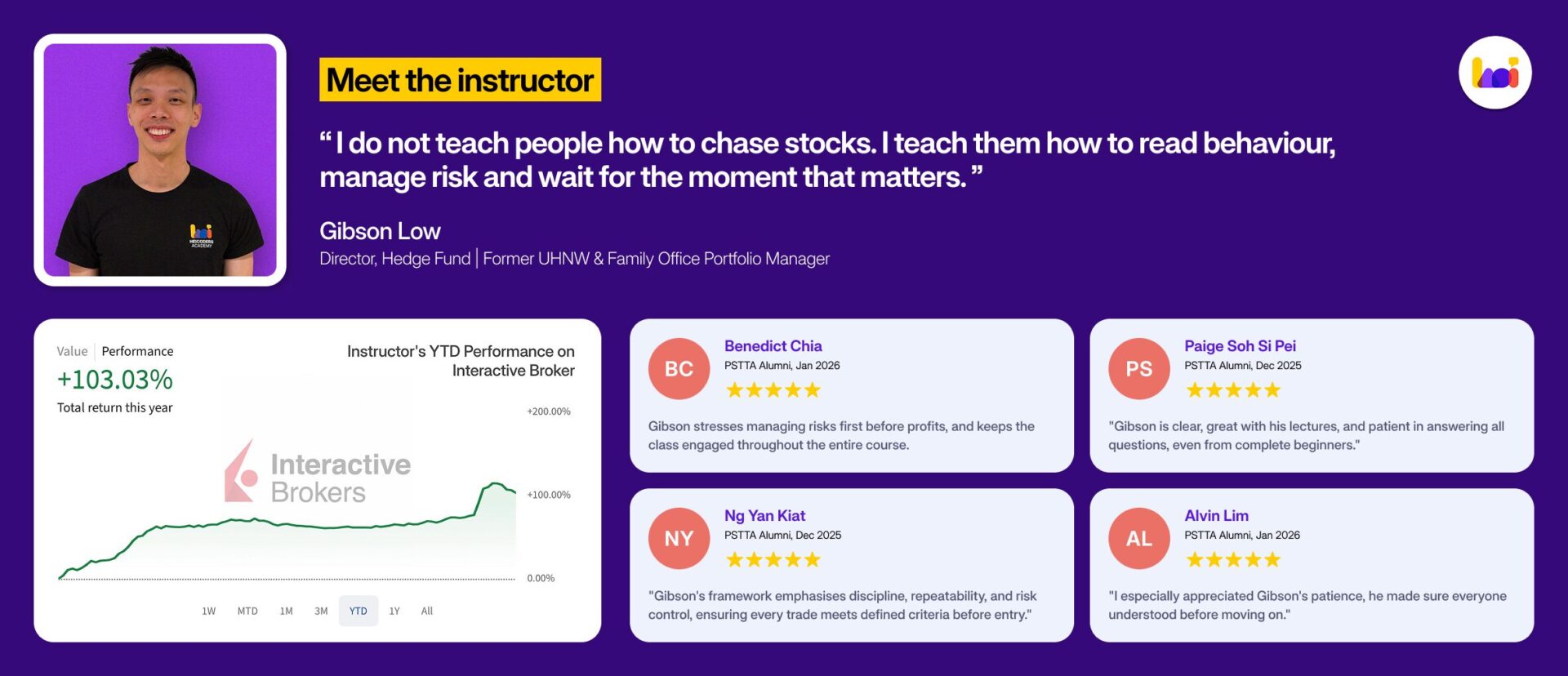
“I do not teach people how to chase stocks. I teach them how to read behaviour, manage risk, and wait for the moment that matters.”
PSTTA is IBF-accredited and eligible for up to 70% subsidy for eligible Singapore residents, making it one of the most accessible ways to build a genuine trading foundation.
Disclaimer: The content discussed is intended for information and educational purposes only and should not be considered investment advice or recommendation. The value of your investments may go up or down. Your capital is at risk. This advertisement has not been reviewed by the Monetary Authority of Singapore.