Quick Summary
- Companies that treat AI adoption as a headcount reduction exercise consistently underperform those that treat it as a capability building exercise.
- ManpowerGroup’s 2026 Global Talent Shortage Survey found AI Literacy and AI Model & Application Development are now Singapore’s two hardest-to-fill skills, displacing traditional IT and Data roles entirely.
- 94% of Singapore employers are responding to talent shortages with upskilling and reskilling as the primary tactic.
- AI-literate teams complete tasks faster, take on higher-value work, and generate measurable productivity gains. The revenue case for corporate AI training is well-supported.
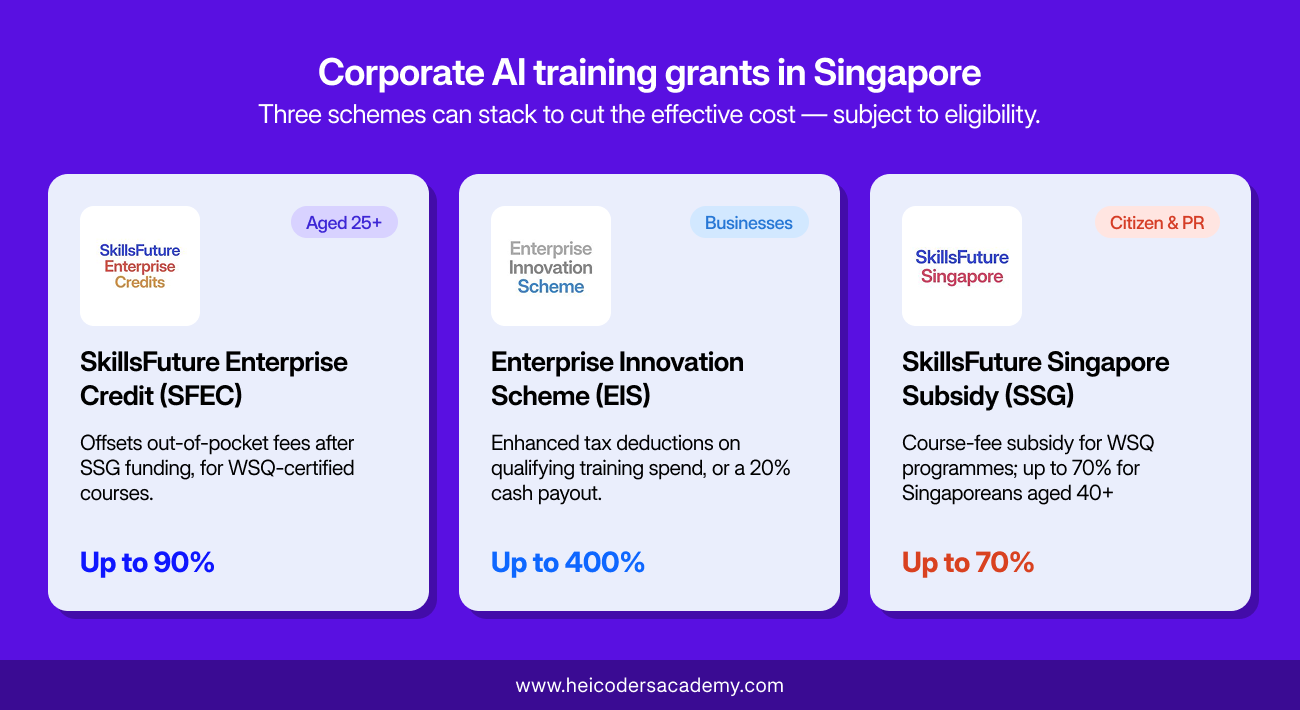
- Singapore companies can significantly reduce the cost of corporate AI training through SkillsFuture Enterprise Credit (SFEC) and the Enterprise Innovation Scheme (EIS), subject to eligibility.
- Practical corporate AI training is workflow-driven and practitioner-led, not awareness-based. There is a significant quality gap between these two types of training.

The Real Question Organisations Are Not Asking
Every week brings another announcement: a major organisation deploying AI, restructuring around it, and framing the decision primarily in terms of what it costs, how much it saves, and how many roles it changes.
The conversation that follows is almost always the same. Leaders talk about efficiency. Analysts talk about headcount. Employees talk about job security. And somewhere in the noise, the most important question gets lost entirely.
Not “how do we use AI to reduce costs?” but “how do we use AI to make our people significantly more capable?”
These are not the same question. They lead to different strategies, different investments, and very different outcomes. And right now, most organisations are answering the first question when they should be answering the second.
This article is about why that matters, what the data shows, what practical corporate AI training in Singapore looks like, and how eligible Singapore companies can fund it.
Two Very Different Versions of AI Adoption
There are two ways organisations are approaching AI right now, and they lead to very different outcomes.
The substitution model: Deploy AI to reduce headcount, automate tasks currently done by humans, and reduce the wage bill. Measure success by how many roles are eliminated.
The augmentation model: Equip your existing workforce with AI skills so each person can do more, do it faster, and do it better. Measure success by how much more effective your teams become.
The organisations generating the most negative headlines from their AI transitions are operating in substitution mode. And the irony is that the substitution model is not only harder to defend publicly, it is also the less effective strategy.
Here is why.
What Goes Wrong With the Substitution Approach
When AI is deployed as a headcount reduction play rather than a capability building play, three things tend to happen.
The tools get underused. AI platforms require skilled users to generate value. When organisations reduce the number of people interacting with these tools rather than developing their capability to use them, they end up with sophisticated technology sitting underutilised. The productivity gains they projected do not materialise. The investment case weakens.
Resistance builds. Employees who feel threatened by AI are significantly less likely to adopt it effectively. Anxiety and productivity do not coexist well. Organisations that position AI as a replacement for people create a cultural environment that actively works against the adoption they need to see.
The capability gap widens. ManpowerGroup’s 2026 Global Talent Shortage Survey found that AI Model and Application Development and AI Literacy are now the two hardest-to-fill skills in Singapore, ahead of Engineering and well ahead of traditional IT and Data roles. The talent scarcity that AI adoption is supposed to address is, in part, being created by the failure to build AI capability inside organisations in the first place.
You cannot solve an AI capability problem by reducing the number of people in your organisation. You solve it by raising the AI capability of the people you have.
What the Research Is Actually Showing
The ManpowerGroup 2026 survey finding is worth sitting with. AI literacy is Singapore’s hardest-to-fill skill. Not software engineering. Not data science. AI literacy, meaning the ability to work with AI tools effectively and apply them in a professional context.
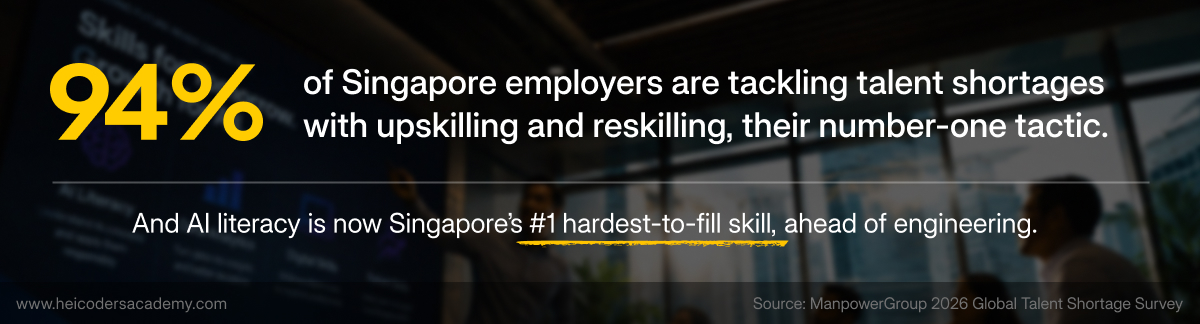
The same survey found that 94% of Singapore employers are already deploying a mix of tactics to address structural talent shortages. Among those tactics, Upskilling and Reskilling ranked as the number one response, cited by 26% of employers.
That is not a values statement. That is a strategic conclusion. Employers who have worked through the numbers on the talent market are landing on the same answer: the most practical path to building the AI capability you need is to develop it in the people already inside your organisation.
This does not mean AI does not change job functions. It does. Some roles change significantly. But the difference between “this role no longer exists” and “this role looks different because the person in it now has different capabilities” is not just a semantic distinction. It is the difference between an organisation that gets stronger through an AI transition and one that simply gets smaller.
What Smart Singapore Organisations Are Doing Differently
The organisations navigating AI adoption most effectively share a common characteristic: they treat it as a learning and development problem, not just a technology procurement problem.
What does this look like in practice?
They deploy AI tools and AI training simultaneously, not sequentially. Buying software licences without building the skills to use them is like equipping a team with specialist tools and no training. The investment underperforms, and the business case deteriorates.
They identify specific workflows before buying generic solutions. The best corporate training courses in Singapore work backwards from what your team actually does, identifying where AI changes those specific workflows and building skills accordingly. That specificity is the difference between training that changes how people work and training that gets forgotten.
They build AI champions at every level, not just in the technology function. When AI capability lives only in a centralised tech or data team, it never reaches the rest of the business. The organisations building durable competitive advantage are creating distributed AI literacy across departments, functions, and seniority levels.
They define AI literacy concretely. General awareness of what AI can do is not the same as being able to use it effectively in a professional context. The gap between knowing what ChatGPT is and knowing how to build a reliable, consistent AI-assisted workflow is significant. Organisations that close that gap see meaningfully better adoption rates and output quality.
The Hidden Costs of Skipping This Step
When organisations deploy AI tools without the corresponding investment in people, what actually happens?
The tools underperform. Technology does not drive value on its own. It drives value when skilled people use it effectively. Skipping the capability building step does not save money. It wastes the technology investment made so far.
Capable people leave. The people with the strongest AI skills inside any organisation are also the most mobile in the current market. If they perceive that their organisation’s AI strategy is about removing people rather than developing them, the most capable people find organisations with a different approach. The ones who stay are the ones with fewer alternatives. The capability distribution of the workforce trends in exactly the wrong direction.
The reputational cost compounds. Organisations competing for talent are competing on culture as much as compensation. How leadership talks about AI sends a signal that is heard clearly by the people they most need to attract and retain.
The Business Case: How Corporate AI Training Affects Revenue
Beyond the talent and retention argument, there is a direct revenue case for investing in AI training in Singapore.
Productivity translates to output capacity. Teams that use AI effectively complete tasks faster and take on higher-value work within the same working hours. In customer-facing functions, this typically means more proposals, faster response times, and more consistent service quality. In analytical roles, it means faster insights and better decision support for leadership.
Error reduction reduces cost. AI-assisted workflows, when designed correctly, reduce the rate of human error in repetitive and high-volume tasks. Finance, operations, and compliance functions that invest in AI capability typically see measurable reductions in rework and correction cycles.
Capability becomes a competitive differentiator. In markets where competitors are also deploying AI tools, the organisations that move faster and use those tools more effectively gain market share. The advantage is not in having the tools. Everyone has access to similar tools. The advantage is in the capability of the people using them.
Retention reduces recruitment cost. The average cost of replacing a skilled employee in Singapore accounts for recruitment fees, onboarding time, and productivity loss during the transition period. Organisations that invest in developing their people’s AI skills experience better retention among their higher-capability employees, reducing this cost materially.
The compounding effect of these factors is significant. Organisations that get AI adoption right are not just more efficient. They are more capable of generating revenue, retaining clients, and outpacing competitors over time.
Corporate Training Grants in Singapore: SFEC and EIS
One of the most underutilised levers available to Singapore businesses investing in corporate AI training is government support. Two schemes in particular are directly relevant.
Subsidy Disclaimer: Information on SkillsFuture Enterprise Credit (SFEC) in this article is based on SkillsFuture Singapore’s official SFEC guidelines at skillsfuture.gov.sg. Information on the Enterprise Innovation Scheme (EIS) is based on the Inland Revenue Authority of Singapore’s (IRAS) official guidelines at iras.gov.sg. Figures, eligibility criteria, and subsidy amounts are accurate as of the date of publication and subject to change. Respective terms and conditions apply. Companies are encouraged to verify eligibility directly with SkillsFuture Singapore and IRAS before submitting any claims.
SkillsFuture Enterprise Credit (SFEC)
The SkillsFuture Enterprise Credit is available to eligible Singapore-registered companies and can be used to offset qualifying training costs, including WSQ-certified programmes. Eligible companies may use their SFEC to offset up to 90% of out-of-pocket course fees after SSG funding, subject to eligibility criteria and availability.
To be eligible, companies must generally be registered or incorporated in Singapore, employ a minimum number of local employees, and meet other qualifying conditions set by SkillsFuture Singapore. Courses must be supported by SSG to qualify.
Heicoders Academy’s GA100 Generative AI Course for Automation and Productivity is WSQ-certified and SkillsFuture-eligible, making it a qualifying programme for SFEC purposes, subject to individual company eligibility.
Companies interested in using SFEC for corporate AI training in Singapore should verify their eligibility and current credit balance directly at skillsfuture.gov.sg before enrolling.
Enterprise Innovation Scheme (EIS)
The Enterprise Innovation Scheme (EIS), administered by IRAS, allows eligible Singapore companies to claim enhanced tax deductions of up to 400% on qualifying expenditure in innovation-related activities. Alternatively, qualifying small businesses may elect for a cash payout of up to 20% of qualifying expenditure, subject to a cap.
Employee training and development activities may qualify under the EIS, subject to IRAS guidelines on eligible expenditure categories. This can significantly reduce the effective cost of investing in corporate AI training courses in Singapore for eligible organisations.
Given the complexity of tax treatment and the eligibility conditions involved, companies considering EIS claims are encouraged to consult a qualified tax professional and verify the current guidelines directly at iras.gov.sg before proceeding.
What This Means in Practice
For eligible Singapore companies, the combination of SSG subsidies, SFEC, and potential EIS benefits can substantially reduce the effective cost of investing in quality AI training for their teams. Corporate training courses in Singapore that are WSQ-certified and SkillsFuture-eligible sit at the intersection of all three schemes.
The net result is that building AI capability in your workforce is not only the strategically correct move. For eligible companies, it is also significantly more affordable than it appears at face value.
What Practical Corporate AI Training Actually Looks Like
It is worth being specific about this, because “AI training” covers a wide range of quality and utility, and not all corporate training companies in Singapore offer the same thing.
A half-day awareness workshop is not AI training. A webinar series on “the future of work” is not AI training. A certificate programme that looks good in a LinkedIn update but does not change how people work is not AI training.
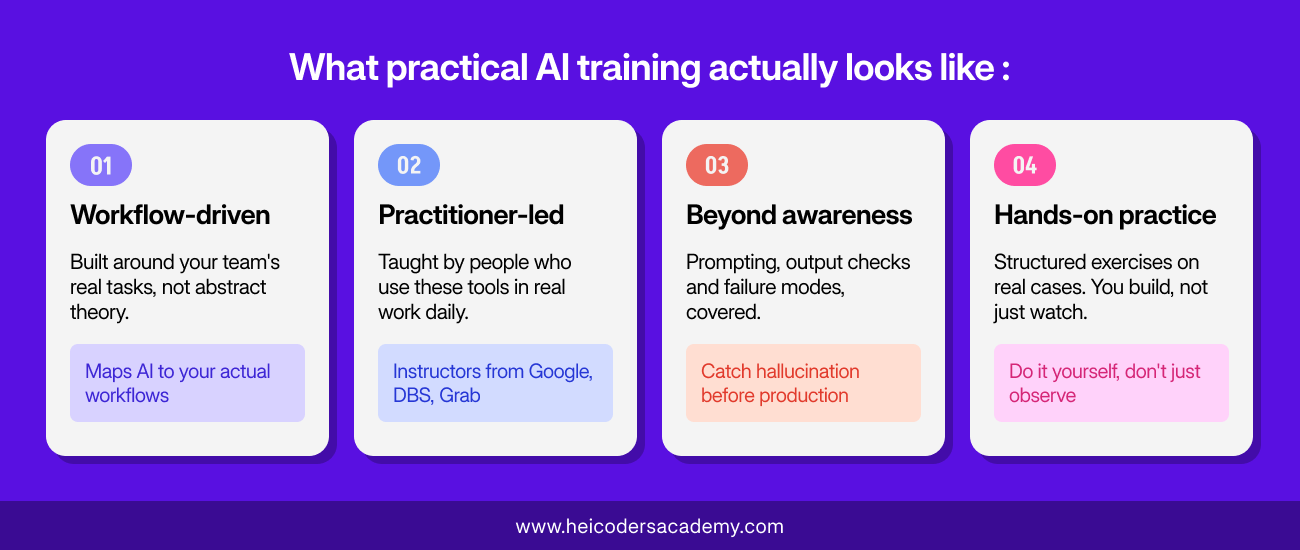
Practical corporate AI training courses in Singapore share several characteristics:
They are workflow-driven. The curriculum starts with the specific tasks and functions that matter to your organisation and builds the skills required to execute those tasks more effectively using AI. This is fundamentally different from a generic course that teaches AI concepts in the abstract.
They are delivered by practitioners, not career educators. The instructors are people who use these tools actively in their own professional work, who understand how AI behaves in real-world conditions, and who can speak from experience rather than from a syllabus.
They cover what awareness programmes skip. How to prompt AI reliably and consistently. How to verify outputs and identify failure modes. How to build team workflows that use AI at scale. How to spot hallucination, drift, and overconfidence before they create problems in production.
They include hands-on practice, not just observation. The gap between watching someone demonstrate a tool and being able to use it yourself in a professional context is significant. Effective AI training closes that gap through structured exercises grounded in real use cases.
The Strategic Decision Every Singapore Company Is Making Right Now
The AI transition is real. The productivity gains are real. The competitive pressure to adopt AI tools is real.
But the strategic choice every organisation makes in the next 12 to 24 months is not “AI or people.” It is “what kind of AI adoption strategy produces the outcomes we actually need?”
Organisations that treat AI as a substitution play will get smaller. Organisations that treat AI as an augmentation play, investing in the AI literacy of their existing workforce through quality corporate training courses, will get more capable. These are different destinations, and the early decisions about training investment set the trajectory.
Singapore companies have a meaningful advantage here: a well-developed infrastructure of government support for workforce upskilling, WSQ-certified training programmes, and a national policy environment that actively encourages AI capability development. The question is not whether the support exists. It is whether organisations choose to use it.
How Heicoders Academy Helps Singapore Companies Build AI Capability
Heicoders Academy is a Singapore-based corporate AI training provider offering WSQ-certified, SkillsFuture-eligible courses in Generative AI, Data Analytics, Digital Marketing, and Software Engineering.
Our GA100 Generative AI Course for Automation and Productivity is built for working professionals who need practical AI skills they can apply immediately. It covers the full AI workflow stack, from prompting through automation to AI agent deployment, with a capstone project grounded in real professional use cases.
We deliver corporate training programmes customised to your organisation’s specific workflows and functions. We have trained teams at Changi Airport Group, Singapore Police Force, and Temasek Trust, among others. Our instructors are active industry practitioners from companies including Google, DBS, Grab, and GovTech.
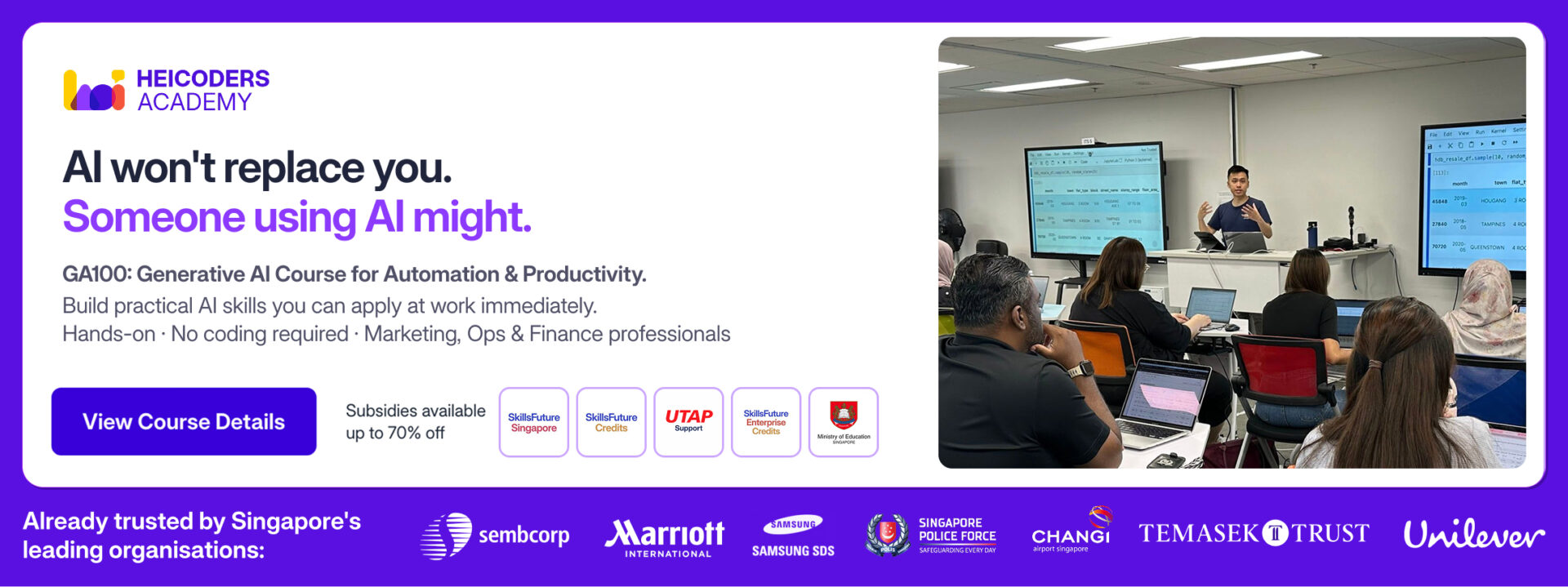
GA100 is WSQ-certified and SkillsFuture-eligible, making it a qualifying programme for SSG subsidies, SFEC, and potentially EIS, subject to company eligibility.
Frequently Asked Questions About Corporate AI Training in Singapore
What is corporate AI training and why do Singapore companies need it?
Corporate AI training equips employees with the practical skills to use AI tools effectively in their day-to-day work. Singapore companies need it because AI literacy is now the hardest-to-fill skill in the local labour market (ManpowerGroup, 2026), and the gap between deploying AI tools and generating value from them is almost entirely explained by the capability of the people using them.
What should companies look for when choosing corporate training companies in Singapore?
Look for providers that deliver WSQ-certified programmes (for subsidy eligibility), use active industry practitioners as instructors (not career educators), build curriculum around your specific workflows rather than generic AI concepts, and include hands-on practice rather than awareness-only content. Heicoders Academy meets all four criteria.
What government grants are available for corporate AI training in Singapore?
Eligible Singapore companies can access the SkillsFuture Enterprise Credit (SFEC) to offset qualifying training costs, and may be able to claim enhanced tax deductions or a cash payout under the Enterprise Innovation Scheme (EIS) for qualifying training expenditure. SSG subsidies are also available for WSQ-certified programmes. All schemes are subject to eligibility conditions. Verify directly with SkillsFuture Singapore at skillsfuture.gov.sg and IRAS at iras.gov.sg.
How much does corporate AI training cost in Singapore?
Costs vary by programme length, content scope, and delivery format. For WSQ-certified programmes like Heicoders’ GA100, eligible Singaporeans aged 40 and above may receive up to 70% SSG subsidy. When stacked with SFEC and potentially EIS, the effective cost to eligible companies can be significantly lower than the list price. Contact Heicoders Academy for a corporate training quote.
What is the difference between AI awareness training and practical AI training?
AI awareness training covers what AI is and what it can theoretically do. Practical AI training builds the specific skills needed to use AI tools reliably in a professional context, including prompting, workflow design, output verification, and failure mode recognition. The two produce very different outcomes. Most employees already have sufficient AI awareness. What they lack is the practical capability to apply it.
How does investing in AI training affect business revenue?
AI-literate teams produce more output in the same time, reduce error rates in high-volume tasks, take on higher-value work, and make faster, better-informed decisions. Cumulatively, these gains improve productivity, reduce operational costs, and create a competitive advantage in markets where AI tool access is broadly equal but capability is not.
Is the Heicoders GA100 course eligible for SFEC and SSG subsidies?
GA100 is WSQ-certified and SkillsFuture-eligible, making it a qualifying programme for SSG subsidies and SFEC, subject to individual and company eligibility conditions. Contact us or verify your company’s eligibility directly with SkillsFuture Singapore at skillsfuture.gov.sg.
References
- ManpowerGroup Singapore, AI Skills Become Singapore’s Hardest-to-Fill Capability Even as Talent Scarcity Eases: ManpowerGroup’s 2026 Global Talent Shortage Survey, published 26 February 2026. Available at: https://www.manpower.sg/en/insights/blogs/2026/02/ai-skills-become-singapores-hardest-to-fill-capability-even-as-talent-scarcity-eases
- SkillsFuture Enterprise Credit (SFEC) — official guidelines: https://www.skillsfuture.gov.sg/sfec
- Enterprise Innovation Scheme (EIS) — IRAS official guidelines: https://www.iras.gov.sg