If Google search results have started looking different to you lately, more conversational, more willing to just answer the question outright, you’re not imagining it. Over the past two years, Google has been quietly rebuilding what “searching” even means, and the biggest piece of that shift is called AI Mode.
This article explains what AI Mode actually is, how it’s different from AI Overviews (the two get confused constantly), what the data says about how it’s changing user behaviour, and what you can actually do about it if visibility in search matters to your work. No jargon, no assumption that you already live in the SEO world.
Quick Summary: What Is Google AI Mode?
Short on time? Here’s the shift in brief.
- What it is: AI Mode is Google’s conversational, AI-powered search experience, built on Gemini, that gives a synthesised answer instead of a list of links, and supports follow-up questions in the same conversation.
- How it differs from AI Overviews: AI Overviews is a summary box shown above ordinary search results. AI Mode is a separate, more capable experience that reasons across multiple sources, carries context forward, and is increasingly able to take action on your behalf.
- The headline data: Pew Research found that only 8% of searches with an AI summary led to a click on a traditional result, compared with 15% when no summary appeared, and just 1% of visits clicked a link inside the summary itself.
- What to do about it: traditional SEO fundamentals still matter most, but content also needs to be structured, specific, and citable to be picked up by AI systems at all.
What Is Google AI Mode?
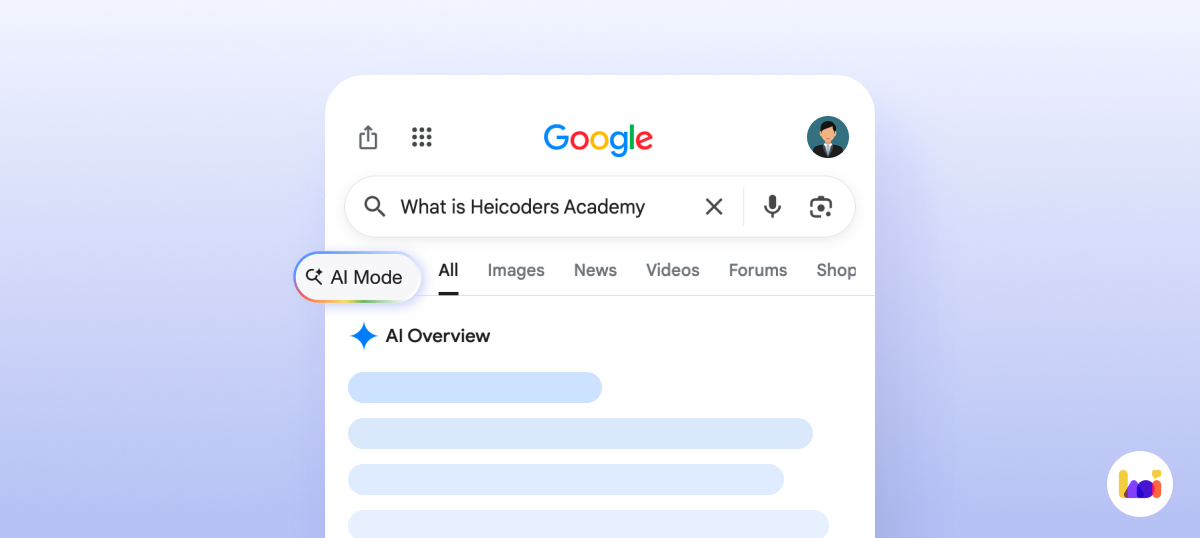
Google AI Mode is a conversational search experience built on Gemini, Google’s AI model, that answers a question directly instead of returning a list of links to click through. It first appeared in the US in May 2025 as an experimental tab, and Google steadily removed the barriers between it and ordinary search from there. By August 2025 it had rolled out more broadly, and by Google I/O in May 2026, the company was calling it the biggest change to Search in over 25 years, now running on a newer Gemini model and reportedly used by more than a billion people every month.
Where a normal Google search shows ten blue links, AI Mode gives a written answer that draws on multiple sources at once, shows supporting links alongside it, and allows a follow-up question without starting over. It behaves less like a search engine and more like a research assistant that happens to sit inside Search.
AI Overviews vs Google AI Mode: What’s Actually Different
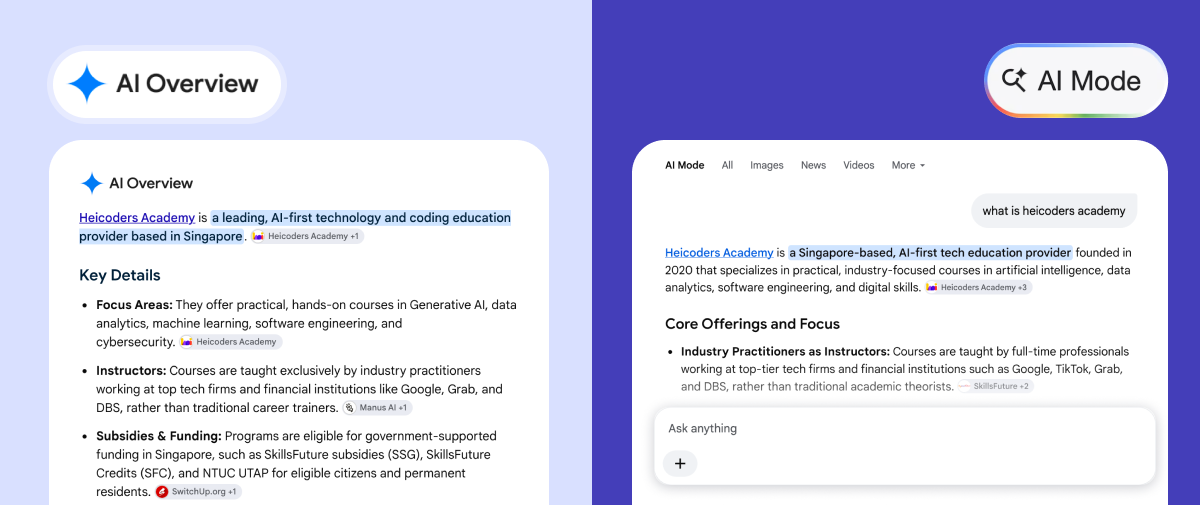
The two get used interchangeably, but they’re not the same thing, and the difference matters if you’re trying to work out where your content actually shows up. AI Overviews is the shorter AI-generated summary that appears above ordinary search results for certain queries; it’s been around since 2024 and remains just one part of a normal results page. AI Mode is a separate, dedicated experience that Google increasingly treats as an alternative to search itself, not a feature bolted onto it. The table below summarises the practical differences.
| Criteria | AI Overviews | Google AI Mode |
|---|---|---|
| Format | Summary box above search results | Dedicated conversational interface |
| Follow-up questions | Not supported | Supported, carries context forward |
| Typical response length | Around 65 to 70 words | Roughly 300 words on average |
| Number of sources shown | Usually around 3 | Usually around 7 |
| Can take action | No | Increasingly yes (shopping, bookings, task completion) |
How Google AI Mode Actually Works
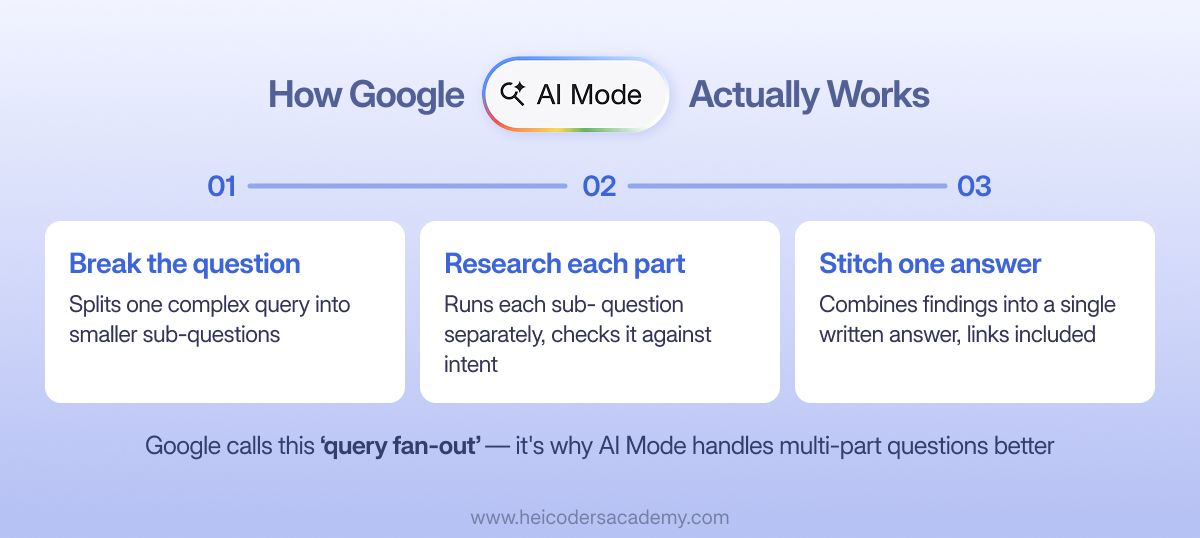
Ask AI Mode a genuinely complicated question, something like “compare noise-cancelling headphones under $200 for a daily commute versus long-haul flights,” and it doesn’t just search for that exact sentence. It breaks the question into smaller sub-questions, researches each one separately, and stitches the results into a single answer. Google calls this “query fan-out,” and it’s the main reason AI Mode handles compound, multi-part questions noticeably better than an ordinary search does.
Underneath that, AI Mode builds a kind of reasoning chain. It works out what you’re actually trying to achieve, what factors matter for that goal, and checks its answer against those factors before responding. With permission, it can also draw on personal context, such as Gmail or Calendar, to make an answer specific to the person asking rather than generic. For genuinely deep research questions, a slower “Deep Search” mode will run many searches in parallel and return a structured report instead of a quick answer, trading speed for thoroughness.
Google has also started giving AI Mode the ability to act, not just answer: researching and comparing options, checking availability, and in some cases starting a booking or purchase, usually with a confirmation step before anything is finalised. That’s part of a much broader shift toward agentic AI, tools that don’t just respond but actually carry out tasks, which is also the trend behind agents like OpenClaw, which we’ve covered separately.
The Data Behind the Shift
The clearest evidence of how AI Mode and AI Overviews are changing search behaviour comes from Pew Research Center, which tracked the actual browsing activity of 900 US adults in March 2025. Their findings: 18% of all Google searches in the study produced an AI summary, and 58% of participants encountered at least one during the month.
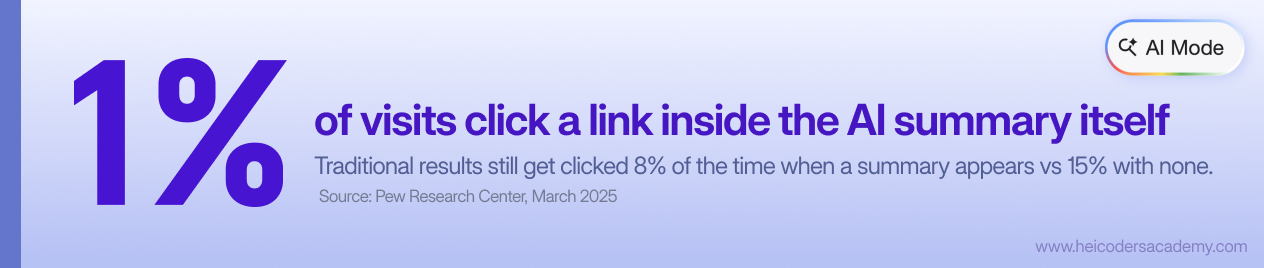
The effect on clicks was stark. When an AI summary appeared, people clicked through to a traditional search result in only 8% of visits, compared with 15% when no summary appeared, nearly double. Clicking a link inside the AI summary itself was rarer still, just 1% of visits. People were also more likely to end their browsing session entirely after seeing a summary, 26% of the time, than after an ordinary search, 16% of the time.
Prevalence has kept climbing since that snapshot. Google itself has said AI Overviews now appear on roughly half of all US searches, though independent trackers report a wide range, anywhere from about 15% to 50%, depending on the tool and methodology used, since there’s no single agreed way to measure it yet. Whatever the precise number, the direction is unambiguous: AI-generated answers are showing up far more often than they were even a year ago, not less.
None of this means organic search traffic is disappearing. It means fewer searches result in a click at all, and the searches that do result in a click increasingly reward being cited inside the AI-generated answer itself, not just ranking highly below it.
How to Optimise Your Content for AI Search
The reassuring part first: Google has been fairly consistent that ordinary SEO fundamentals, useful content, clean technical structure, genuine authority, remain the strongest predictor of showing up in AI-generated answers. Content that already ranks well tends to get cited more often, not less. Beyond that baseline, a few things noticeably improve the odds of being the source an AI system actually cites:
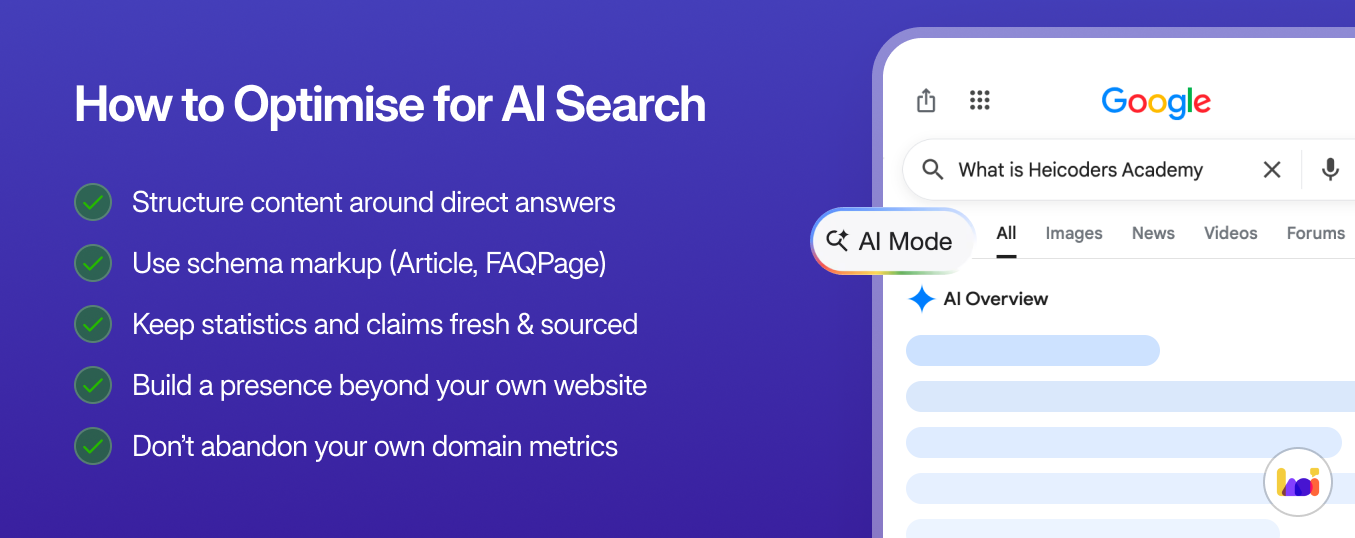
- Structure content around direct answers. Open each section with a plain, one- or two-sentence answer to the question it covers, then explain further. AI systems extract from clearly labelled, self-contained sections far more easily than from a long, wandering paragraph.
- Use schema markup. Structured data, such as Article and FAQPage schema, helps AI systems parse what content actually is and means, reducing ambiguity.
- Keep statistics and claims fresh and sourced. AI systems favour content that cites verifiable, dated information over vague or unattributed claims.
- Build a presence beyond your own website. Community platforms and industry discussion are increasingly cited alongside official sources, so participating credibly in relevant conversations, not just publishing on your own domain, has become part of visibility.
- Don’t abandon your own domain metrics. Clicks and rankings are no longer the whole picture, but they still matter and remain the foundation everything else builds on.
What This Means If You’re Not in Marketing
Even if content strategy isn’t your job, this shift affects how you should personally search and how you should think about your own organisation’s visibility. If you’re in HR, finance, or operations and you rely on Google to research a vendor, a compliance question, or a competitor, expect a direct written answer more often, and remember that answer is a synthesis, not necessarily the single most authoritative source, so it’s worth checking the underlying links for anything that actually matters.
There’s a practical business risk hiding in this too. If a prospective client, job candidate, or partner searches your organisation’s name and Google answers their question with a synthesised summary rather than sending them to your website, your own messaging may never be the thing they actually read. Whether that matters depends on your role, but it’s no longer purely a marketing team’s concern; it’s closer to how a company’s reputation and findability now work by default.
Frequently Asked Questions About Google AI Mode
What is Google AI Mode?
Google AI Mode is a conversational search experience built on Gemini that gives a direct, synthesised answer to a question instead of a list of links, and supports follow-up questions within the same conversation.
Is Google AI Mode the same as AI Overviews?
No. AI Overviews is a shorter AI-generated summary shown above ordinary search results. AI Mode is a separate, more capable, fully conversational experience that Google increasingly treats as an alternative to traditional search.
Does traditional SEO still matter if AI Mode is taking over search?
Yes. Google has consistently said that strong, well-structured, genuinely useful content remains the primary factor in appearing in AI-generated answers. AI Mode adds new considerations on top of SEO fundamentals; it doesn't replace them.
How do I know if my content is being cited in AI Mode or AI Overviews?
Google Search Console reports on some AI-related search data, and third-party tools that track AI citations and mentions can show whether and how often content is appearing inside AI-generated answers.
Will AI Mode replace Google Search entirely?
Not based on anything Google has said so far. AI Mode currently sits alongside traditional search rather than replacing it, and ordinary search results remain the default experience for a large share of queries, particularly short, navigational ones like looking up a specific website.
Is Google AI Mode available in Singapore?
Google has been expanding AI Mode beyond its initial US rollout in stages, and availability by country continues to change as the rollout progresses. Check Google's own Search updates for current availability in a specific region.
Google AI Mode: The Bottom Line
AI Mode isn’t a minor interface tweak; it’s Google actively re-deciding what “search” means, and the shift toward direct, synthesised answers isn’t going to reverse. The businesses and content that adapt fastest aren’t the ones chasing every algorithm rumour. They’re the ones that keep building genuinely useful, clearly structured, well-sourced content, and trust that the fundamentals still carry the most weight even as the format around them changes.
If keeping up with shifts like this feels like a full-time job on top of your actual job, that’s exactly the gap Heicoders Academy’s Digital Marketing Course (DM100) is built to close. It’s a SkillsFuture-eligible course for working professionals in Singapore who want to build AI-driven marketing skills that hold up as platforms like Google keep changing, not just memorise this month’s best practices. Explore the Digital Marketing Course (DM100) and build a content and SEO strategy that’s ready for AI search.