For years, you’ve diligently mastered Search Engine Optimisation (SEO). You’ve built backlinks, optimised meta tags, and chased that coveted number one spot on Google. But recently, something has changed. Your content isn’t showing up in ChatGPT’s answers, it’s absent from Google’s AI Overviews, and your traffic is plateauing despite your best SEO efforts. What is going on?
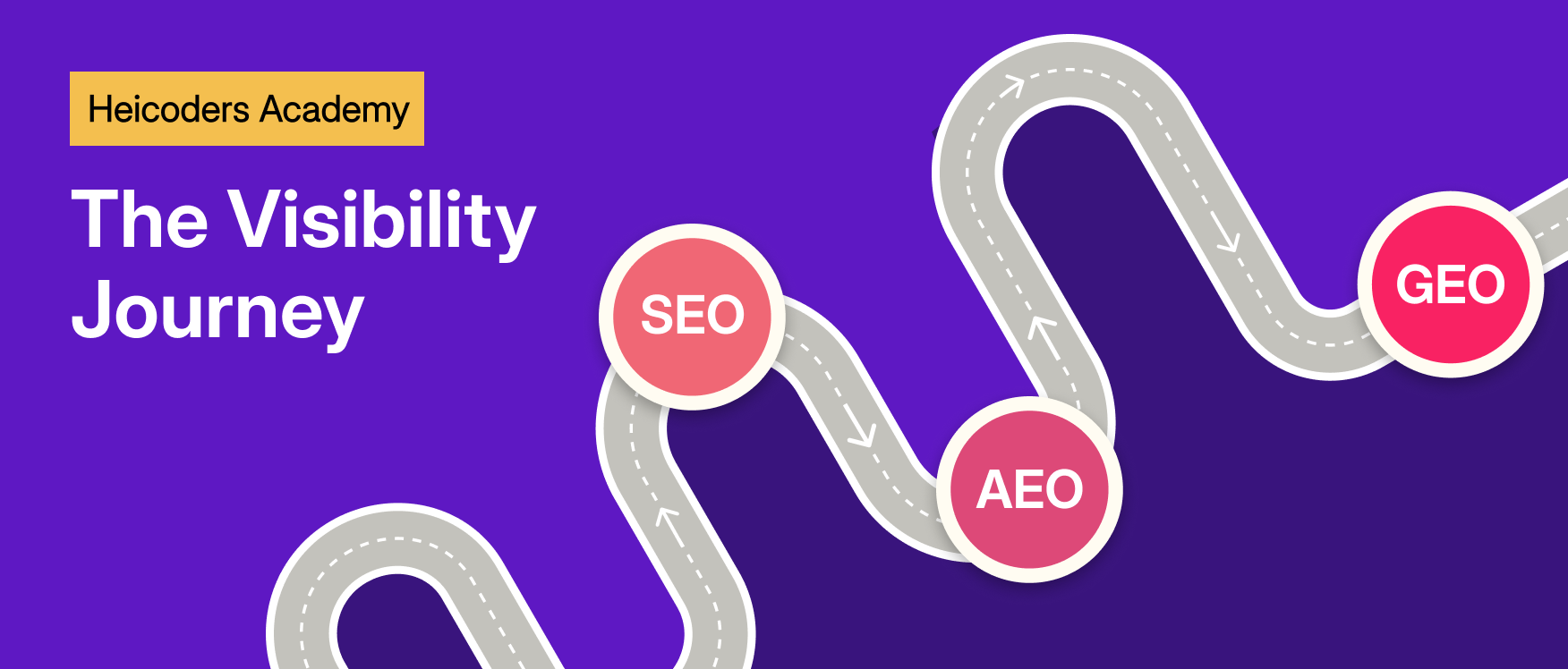
The digital landscape is undergoing its most significant transformation in a decade. The rise of AI-powered search is rewriting the rules of online visibility. Suddenly, three new acronyms have entered the marketing lexicon: SEO, GEO, and AEO. Understanding the difference is no longer optional; it’s essential for survival.
By the end of this guide, you will understand what each of these optimisation strategies means, how they differ, and which ones you need to prioritise to stay ahead in 2026. We will explore their individual goals, target platforms, and success metrics, providing you with a clear roadmap for navigating the future of search.
What is SEO? (The Foundation)
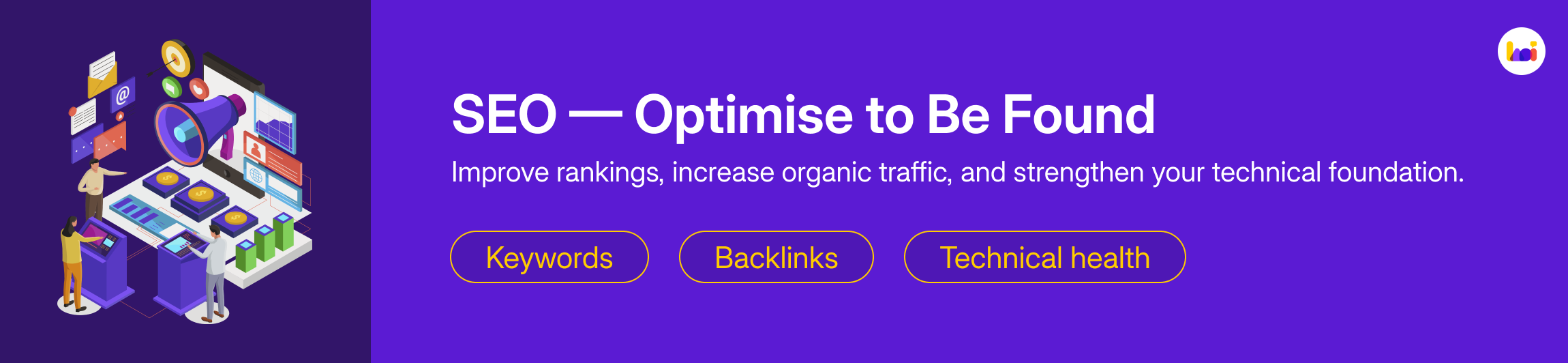
Search Engine Optimisation (SEO) is the traditional practice of optimising a website and its content to rank higher in search engine results pages (SERPs) like Google and Bing. The primary goal of SEO is to increase organic (non-paid) traffic by making your website more attractive to search engine algorithms.
Think of SEO as optimising a physical shop window to attract more foot traffic. You arrange your best products, create an eye-catching display, and ensure your shop’s name is clearly visible. In the digital world, this translates to using relevant keywords, building high-quality backlinks from other reputable websites, and ensuring your website is technically sound (e.g., fast-loading, mobile-friendly).
For years, the core metrics for SEO success have been clear: keyword rankings, organic traffic volume, and click-through rates (CTR). While the rise of AI is changing the game, these foundational principles of SEO remain crucial. A well-optimised website is still the bedrock upon which all other optimisation strategies are built.
What is AEO? (The Answer-First Approach)

Answer Engine Optimisation (AEO) represents the first major evolution from traditional SEO. It is the practice of structuring your content so that search platforms can directly provide answers to user queries, often without requiring a click to your website. This is the driving force behind Google’s featured snippets, “People Also Ask” boxes, and voice assistant responses from Siri and Alexa.
The goal of AEO is not to drive traffic, but to achieve “zero-click” visibility by becoming the direct source of the answer. Instead of just ranking a link, the search engine extracts and displays your content directly on the results page. This requires a shift in content strategy from long-form articles to clear, concise, and well-structured answers.
For example, a blog post with a well-structured FAQ section is more likely to have its answers featured in Google’s search results. AEO focuses on using schema markup (a type of code that helps search engines understand your content), question-based headings, and providing direct, authoritative answers. While SEO aims to get users to your website, AEO aims to get your answers in front of users, regardless of whether they click.
What is GEO? (The AI-Native Strategy)
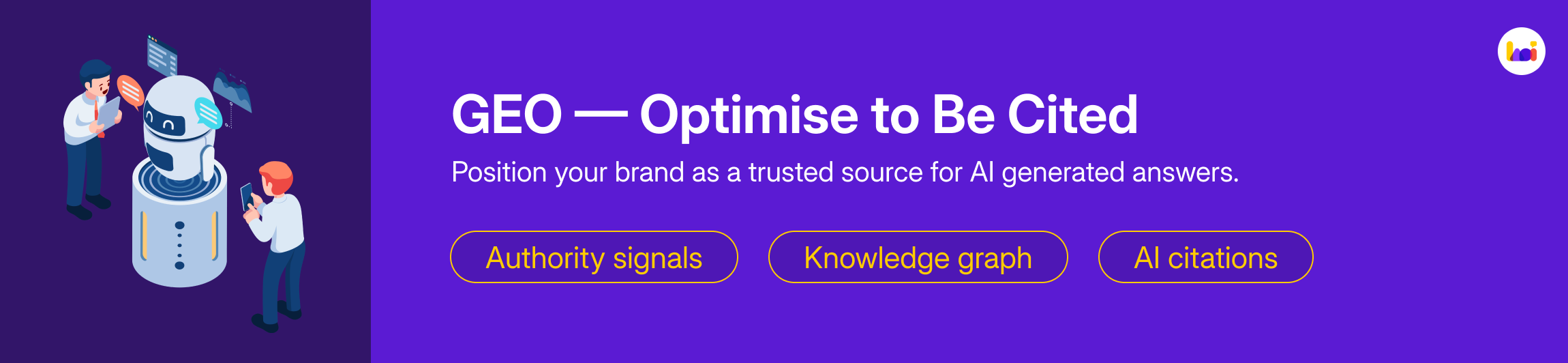
Generative Engine Optimisation (GEO) is the newest and most transformative of the three strategies. It is the practice of optimising your digital presence to be cited, recommended, and accurately represented by generative AI systems like ChatGPT, Perplexity, and Google’s AI Overviews.
Unlike SEO and AEO, the goal of GEO is not to rank a webpage or provide a snippet, but to become a trusted source that AI models use to construct their answers. As Forbes notes, GEO is the “latest evolution in digital strategy, designed to help businesses thrive in the age of generative engines.” [1] This means your success is no longer measured in clicks or rankings, but in brand mentions, citations, and the overall sentiment of your representation within AI-generated responses.
GEO requires a focus on authoritativeness, data accuracy, and narrative clarity. It involves structuring your website’s information in a way that Large Language Models (LLMs) can easily understand and trust. As noted by the venture capital firm Andreessen Horowitz (a16z), GEO is about becoming the “system of record for interacting with LLMs.” [2] In this new paradigm, your website is not just a destination for users, but a knowledge base for AI.
SEO vs AEO vs GEO: Side-by-Side Comparison
To clarify the distinctions between these three strategies, here is a side-by-side comparison of their core components:
| Feature | SEO (Search Engine Optimisation) | AEO (Answer Engine Optimisation) | GEO (Generative Engine Optimisation) |
|---|---|---|---|
| Primary Goal | Rank higher in search results to drive organic traffic | Appear in “zero-click” answers and featured snippets | Be cited and recommended as a trusted source by AI systems |
| Focus Areas | Keywords, backlinks, technical health, user experience | Structured data (schema), FAQ format, direct answers | Authoritativeness, data accuracy, narrative clarity, E-E-A-T |
| Target Platforms | Google, Bing, traditional search engines | Google Featured Snippets, voice assistants (Siri, Alexa) | ChatGPT, Perplexity, Google AI Overviews, Microsoft Copilot |
| Success Metrics | Keyword rankings, organic traffic, click-through rate (CTR) | Featured snippet ownership, zero-click visibility, voice search mentions | Brand mentions, citations in AI answers, sentiment analysis |
| Content Strategy | Long-form articles, keyword-optimised landing pages | Question-based content, concise answers, structured lists | In-depth guides, original research, well-cited data, knowledge graphs |
| Technical Requirements | Site speed, mobile-friendliness, sitemaps, robots.txt | FAQ schema, How-to schema, structured data markup | Knowledge graph integration, clear metadata for AI, LLM crawler access |
| Best For | Driving traffic, lead generation, building a broad audience | Answering common questions, building brand authority, voice search | Becoming a thought leader, influencing AI narratives, building long-term trust |
How SEO, AEO, and GEO Work Together
It is crucial to understand that these three strategies are not mutually exclusive; they are complementary and build upon one another. A successful digital strategy in 2026 will require an integrated approach that leverages all three.
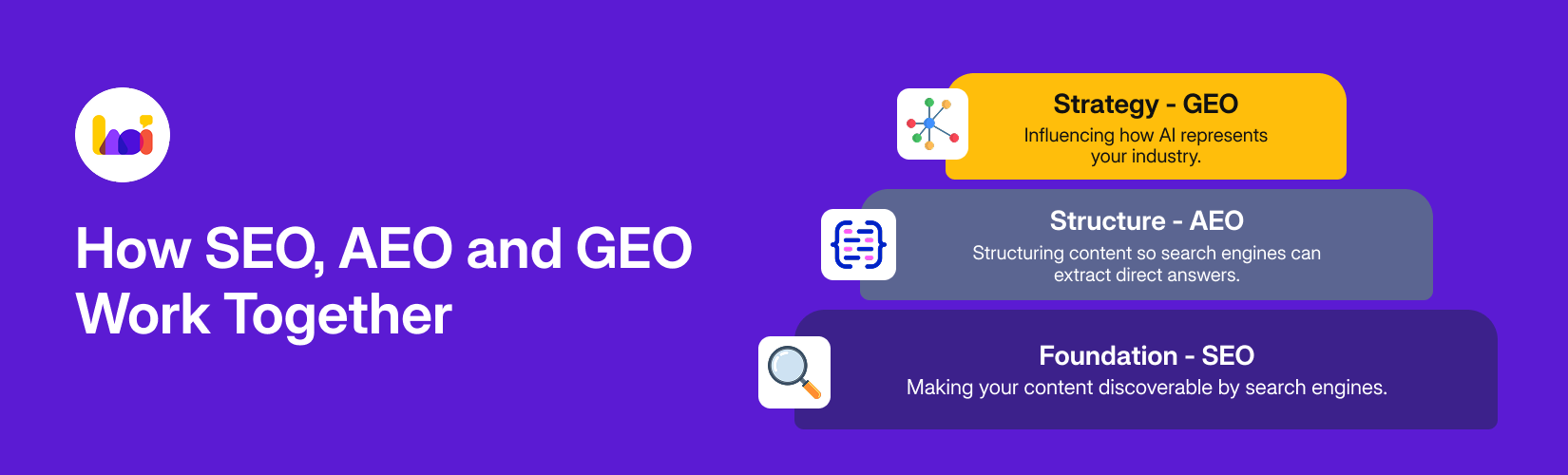
SEO is the foundation. The core principles of SEO—high-quality content, a technically sound website, and strong E-E-A-T (Experience, Expertise, Authoritativeness, Trustworthiness) signals—are essential for both AEO and GEO. Without a solid SEO foundation, your content is unlikely to be considered by either traditional or AI-powered search engines.
AEO is the structural layer. By implementing AEO best practices like schema markup and structured FAQs, you make your content more accessible and understandable to all types of search engines. This not only helps you capture featured snippets but also makes it easier for LLMs to parse and process your information for GEO.
GEO is the strategic layer. GEO builds on the foundation of SEO and the structure of AEO to optimise for the final frontier: AI-generated answers. It focuses on the higher-level concepts of brand authority, narrative control, and becoming a trusted entity in the eyes of AI. A strong GEO strategy ensures that when an AI constructs an answer, it uses your information and cites your brand.
Practical Strategies: How to Optimise for Each
Here are actionable strategies you can implement for each optimisation discipline:
For SEO:
- Conduct thorough keyword research to understand user intent and search volume.
- Build high-quality backlinks from reputable websites in your industry.
- Ensure your website is technically optimised for speed, mobile-friendliness, and crawlability.
- Create high-quality, in-depth content that satisfies user queries and demonstrates your expertise (E-E-A-T).
For AEO:
- Structure your content with clear, question-based headings (e.g., “What is AEO?”).
- Implement FAQ schema markup to help search engines identify questions and answers on your page.
- Provide concise, direct answers to common questions, placing them immediately after the heading.
- Use bulleted lists and numbered steps to make your content more scannable and snippet-friendly.
For GEO:
- Focus on creating authoritative, well-researched content with citations to credible sources.
- Develop a comprehensive knowledge graph for your brand, connecting key entities and concepts.
- Ensure your website does not block LLM crawlers in your robots.txt file.
- Use clear, descriptive metadata and structured data to help AI systems understand the context and meaning of your content.
Want to Master SEO, GEO, and AEO? Here’s How
Understanding these strategies is one thing—implementing them effectively is another. Most marketers are struggling to keep up with the rapid evolution from traditional SEO to the new world of GEO. Reading articles is a good start, but true mastery comes from hands-on, guided learning.
This is where Heicoders Academy’s Digital Marketing Course with AI comes in. It is Singapore’s first AI-native digital marketing course, designed from the ground up to equip you with the skills needed to thrive in the generative AI era.
Why Our Course is the Best Way to Learn:
Comprehensive Coverage: Our curriculum features dedicated lessons on Next-Generation SEO & GEO (Lesson 3) and hands-on GEO mastery with AI tools (Lesson 4). You will learn how to optimise for both traditional search engines and the new wave of AI-powered platforms, covering the complete AI marketing stack from content and SEO/GEO to SEM and analytics.
AI-Native Curriculum: While other courses simply add an “AI module” to a traditional marketing curriculum, we built our course for the AI-powered landscape. Every lesson, every tool, and every strategy is designed to give you a competitive edge in the generative AI era.
Expert Instruction: Our course is taught by expert marketers who are also certified AI practitioners, giving you the rare combination of real-world marketing strategy and hands-on AI implementation skills. Through our partnership with Manus AI, you will train with enterprise-grade AI tools used by Fortune 500 companies.
Practical, Hands-On Learning: Go beyond theory with real-world projects and case studies. You will learn the exact GEO workflow used by leading professionals: Core Entity → Semantic Cluster → Information Gain. The course culminates in a capstone project where you will apply your skills in SEO, GEO, and AI automation.
Proven Results: With a 4.9/5 rating from over 2,560 Google reviews, we are Singapore’s highest-rated AI digital marketing course. Our graduates work at leading companies, and our programme includes an opportunity for a digital marketing internship with the award-winning agency, First Page.
Affordable & Accessible: Our course is WSQ-accredited and eligible for up to 70% SkillsFuture subsidy, making it Singapore’s most accessible path to becoming a certified AI marketing professional. The part-time, online format is designed for busy working professionals and is beginner-friendly, with no prior marketing experience required.

Ready to master the future of search? Explore the AI Digital Marketing Course and gain the skills that companies are hiring for today.
Which Should You Prioritise in 2026?
The right strategy depends on your specific goals and audience. However, for most businesses, a phased approach is most effective:
- Start with SEO: This is non-negotiable. A strong SEO foundation is the price of entry for online visibility.
- Add AEO: If your business answers common questions or if you want to capture voice search traffic, implementing AEO is a logical next step.
- Invest in GEO: As your audience increasingly turns to AI tools for answers, investing in GEO will become critical. For businesses that want to establish thought leadership and long-term brand authority, starting now is a significant competitive advantage.
The future is clear: GEO will soon become as fundamental as SEO is today. The brands that adapt early will be the ones that win the trust of both users and the AI systems that serve them.
The Future of Search: What’s Next?
The era of “10 blue links” is in decline. AI search adoption is accelerating, and zero-click searches are becoming the norm. The brands that will succeed in this new landscape are those that shift their mindset from simply driving traffic to becoming a trusted source of information.
As AI models become more sophisticated, they will increasingly rely on authoritative, well-structured, and clearly articulated content. The future of search is not about tricking algorithms; it is about providing genuine value and becoming an indispensable part of the digital knowledge ecosystem.
Conclusion
The rise of AI has fragmented the world of search optimisation into three distinct but interconnected disciplines: SEO, AEO, and GEO. While SEO remains the foundation, AEO and GEO represent the future of digital visibility. The landscape is changing, and the choice is simple: adapt or be left behind.
Ready to master these strategies? Explore our Digital Marketing Course (DM100) and learn SEO, GEO, and AEO from certified AI practitioners.