Let’s be honest: building a personal brand used to be exhausting. You either spent 15 hours a week writing content, editing videos, and managing social media, or you paid an agency $5,000 a month to do it for you. For busy executives, founders, and consultants, neither option was viable. As a result, brilliant experts remained invisible while less qualified people with more free time dominated the conversation.
Then generative AI came along and levelled the playing field.
Today, you can build a highly leveraged, multi-platform personal brand in just two hours a week by using AI as your personal content team. But there is a catch. In 2026, AI tools can generate endless articles, social posts, images, and videos, meaning the market is flooded with generic, optimised-for-algorithms content that all sounds exactly the same.
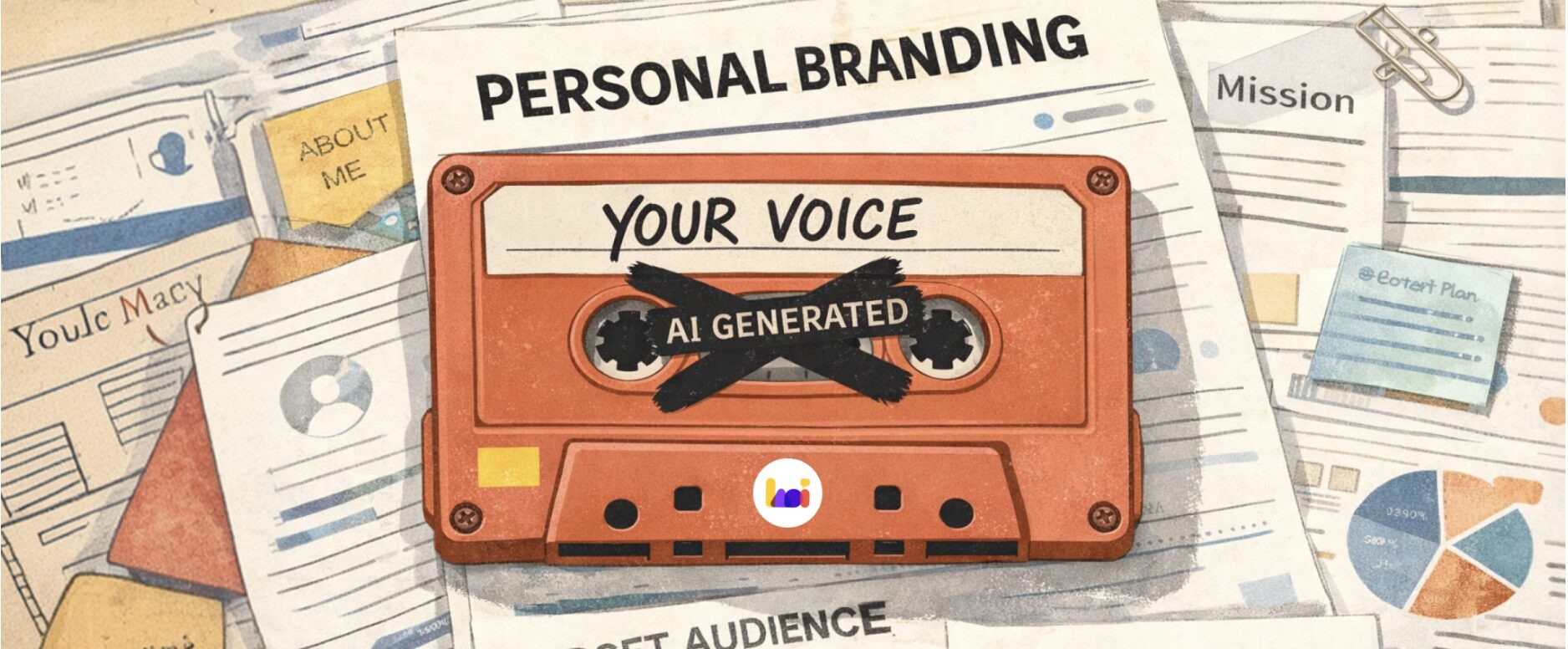
If you rely on AI to generate your ideas, you will blend into this sea of sameness. But if you use AI to format and scale your original ideas, you become impossible to ignore. Here is how to build a personal brand with AI in 2026 without losing your authentic voice.
The Golden Rule of AI Personal Branding
Before we dive into the tools and tactics, you need to understand the golden rule of using AI for thought leadership: AI is an amplifier, not a creator.
If you have no original thoughts, no unique frameworks, and no real-world experience, AI cannot build a personal brand for you. It will simply regurgitate the same generic advice that already clutters the internet. Your job is to provide the Intellectual Capital — the raw ideas, the stories, the frameworks. The AI’s job is to provide the Formatting and Distribution — turning those ideas into LinkedIn posts, newsletters, and video scripts.
When you use AI to format your original ideas, you scale your genius. When you use AI to generate the ideas themselves, you commoditize yourself.
The 4-Step AI Content Engine
To build a sustainable personal brand, you need a system. Think of it as your “AI Content Engine.” It consists of four stages: Ideation, Capture, Generation, and Distribution.

Step 1: AI-Assisted Ideation (The Reverse Interview)
The hardest part of building a brand is staring at a blank page, wondering, “What should I post today?” AI can eliminate writer’s block entirely — but not by writing the post for you. Instead, ask AI to interview you.
Try this prompt in ChatGPT or Claude:
“Act as an expert journalist interviewing me for a major industry publication. My target audience is [Your Audience]. My core expertise is [Your Topic]. Ask me 5 highly specific, challenging questions about my industry that would force me to share a unique perspective, a contrarian opinion, or a specific framework I use. Ask them one at a time, and wait for my answer before asking the next.”
By answering these questions, you generate the raw intellectual capital needed for a month’s worth of content, drawn entirely from your own expertise.
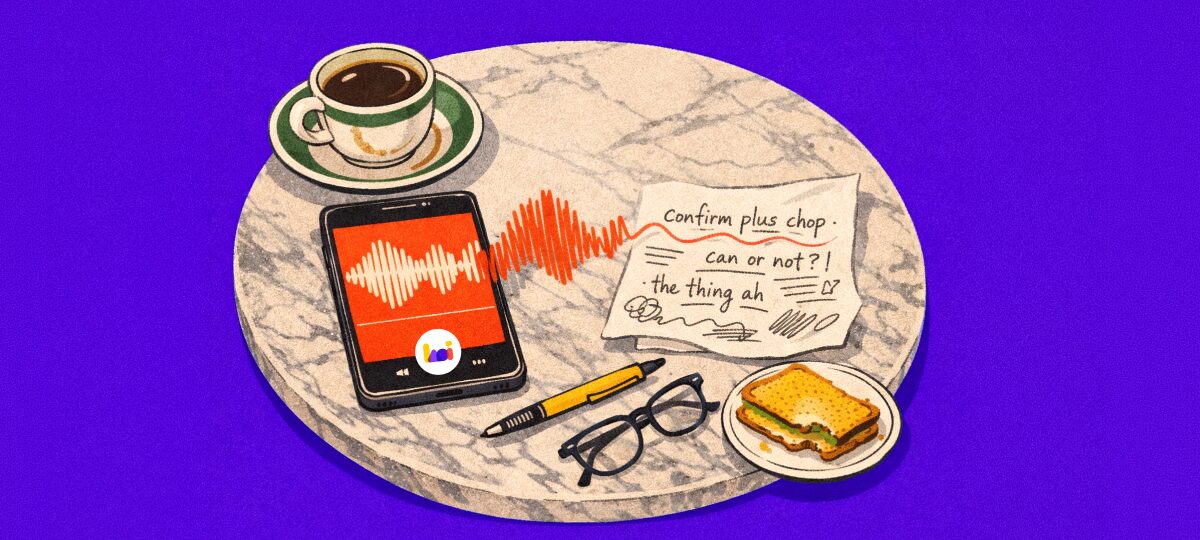
Step 2: The Capture Mechanism (Voice-to-Text)
The biggest bottleneck for busy professionals is typing. You can speak much faster than you can type. The most efficient way to feed your AI Content Engine is through voice capture.
When you finish a client call, solve a complex problem, or have a realization during your commute, pull out your phone and record a 2-minute voice memo. Use an AI transcription tool like Otter.ai, Oasis, or the built-in voice feature on ChatGPT to transcribe your raw thoughts. This messy, unstructured transcript is the perfect input for your AI writer.
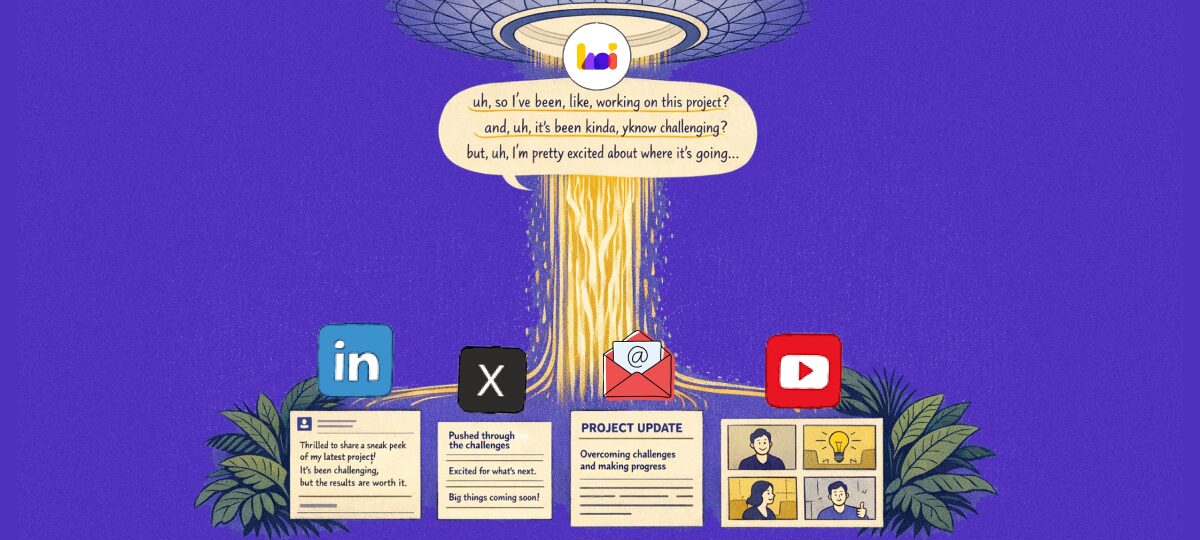
Step 3: The Generation (The Repurposing Waterfall)
This is where the magic happens. You take one piece of raw input (a voice transcript, a recorded keynote, or a podcast interview) and use AI to turn it into multiple formatted assets.
Try this “Voice-to-Post” prompt:
“I am going to provide a raw transcript of my thoughts on [Topic]. I want you to act as my elite ghostwriter. Please turn this transcript into a high-performing LinkedIn post.
Rules:
- Start with a strong, punchy hook (under 10 words).
- Use short paragraphs (1-3 sentences max).
- Maintain my exact core argument and data points.
- Do NOT use words like ‘delve,’ ‘synergy,’ ‘testament,’ or ‘tapestry.’
- Keep the tone conversational, confident, and direct.
Here is the transcript: [Paste Transcript]”
From that single transcript, you can ask the AI to generate a long-form LinkedIn post, three short X (Twitter) posts, an email newsletter draft, and a script for a short-form video.
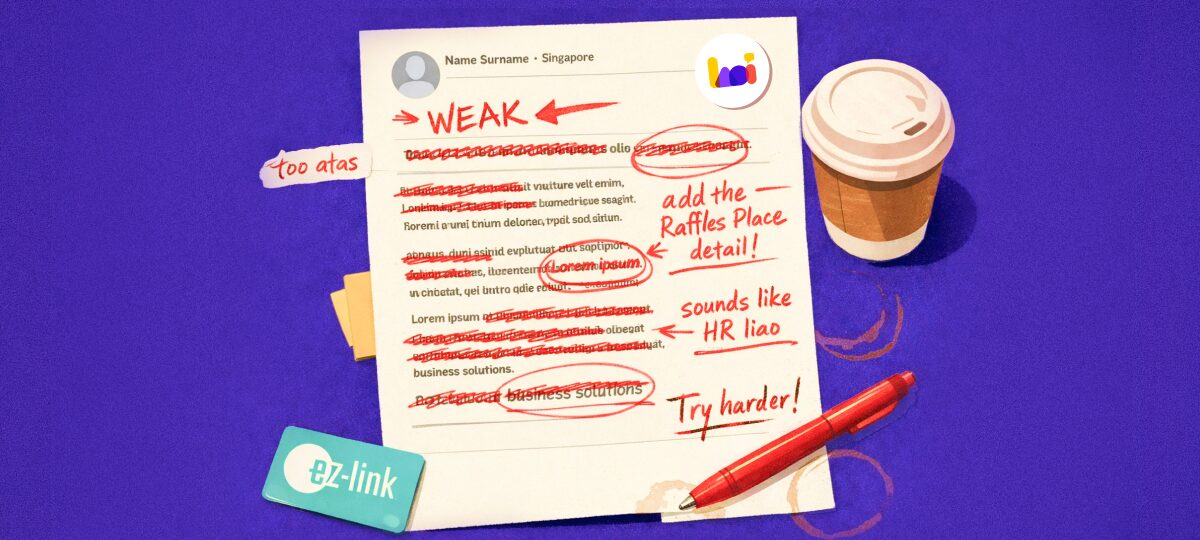
Step 4: The Human Polish
This is the step that separates the amateurs from the professionals. Never publish raw AI output.
Before you post, you must apply the “Human Polish”:
- Check the Hook: Is the first sentence actually interesting, or is it generic? Rewrite it in your own voice.
- Add the “Messy Details”: AI writes very cleanly. Human stories are messy. Add a specific detail (e.g., “I was sitting in a freezing conference room in Chicago when I realized…”) to ground the post in reality.
- Verify the Tone: Read it out loud. If you stumble over a sentence, or if it sounds like something a corporate PR department would write, delete it.
The Best AI Tools for Personal Branding in 2026
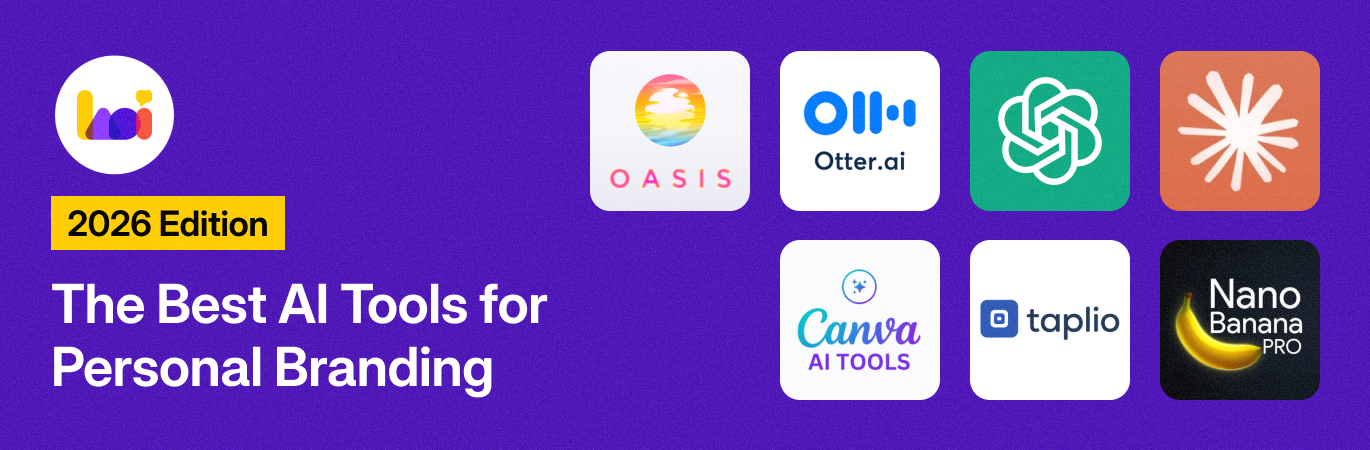
You don’t need a massive tech stack to build a personal brand. Here are the essential AI tools to get you started:
|
Tool |
Best For |
How to Use It |
|---|---|---|
|
ChatGPT / Claude |
Ideation & Ghostwriting |
Use as your interviewer and ghostwriter to format your raw transcripts into social posts and newsletters. |
|
Otter.ai / Oasis |
Voice Capture |
Record your thoughts on the go and turn them into accurate text transcripts. |
|
Canva AI (Magic Media) |
Visual Branding |
Generate on-brand graphics, carousels, and presentation slides without a design background. |
|
Nano Banana Pro |
High-End Visuals |
Create complex, studio-quality hero images for your blog or newsletter headers. |
|
Taplio |
LinkedIn Growth |
Schedule posts, analyze performance, and use AI to generate post ideas based on your past top performers. |
The Risks of AI Personal Branding
While AI is a massive accelerant, it comes with specific risks that can damage your reputation if you aren’t careful.
- The “Sea of Sameness” Because millions of people are now using ChatGPT to write content, the internet is flooding with structurally identical posts. If you rely on AI to generate your ideas, you will blend into this sea of sameness. You must inject your unique perspective.
- The Loss of Authenticity A personal brand is built on trust. If your audience discovers that you are entirely faking your expertise using AI, that trust is broken forever. Use AI to format your real expertise, not to fake expertise you don’t have.
- The Engagement Trap AI can write your posts, but it should not write your comments. When you engage with other creators or reply to comments on your own posts, do it yourself. Automated AI comments (“Great post! I completely agree with your synergistic approach!”) are instantly recognizable and highly annoying.
Frequently Asked Questions (FAQ)
How do I find my unique voice when using AI?
The secret is to train the AI on your past writing. Feed ChatGPT 5-10 of your best emails, articles, or social posts, and ask it to analyze your tone, sentence structure, and vocabulary. Then, instruct it to apply that specific style guide to all future generations.
Which platform should I focus on for personal branding?
Pick ONE platform as your primary home and master it before expanding. For B2B services, professional expertise, and career growth, LinkedIn is the undisputed leader. For tech, media, and quick takes, Twitter/X is best.
Do I need a personal brand if I’m just starting out?
Yes. Your personal brand is what people say about you when you’re not in the room — it exists whether you build it intentionally or not. Taking control of it early gives you a massive advantage in your career.
How long does it take to build a personal brand?
Consistency beats intensity. Spending 10 minutes daily engaging and posting outperforms spending 5 hours once a month. If you stick to a sustainable rhythm, you will start seeing real traction within 3 to 6 months.
The Bottom Line
You no longer have the excuse of “not having enough time” to build a personal brand. By using AI to handle the heavy lifting of formatting, repurposing, and drafting, you can maintain a prolific digital presence while only dedicating a few hours a week to the process.
Provide the genius. Let the AI provide the formatting.
If you want to master these AI tools and build a system that actually works, we teach exactly how to leverage ChatGPT, Nano Banana Pro, and other generative AI tools in Heicoders Academy’s Generative AI course and AI Digital Marketing course. It’s designed for professionals who want to stop experimenting and start executing.