Quick Summary
- This article gives operations and project management professionals in Singapore 20 ready-to-use AI prompts for tasks including SOP writing, project briefs, risk registers, vendor evaluations, meeting documentation, and operational performance reports.
- Each prompt follows the four-part framework (Role + Context + Task + Constraints) used across the Heicoders Corporate AI Prompts Series.
- The prompts are designed for Operations Managers, Project Managers, PMO Leads, Business Analysts, and Operations Directors.
- A dedicated section covers operational compliance considerations in Singapore including the Workplace Safety and Health Act, ISO quality management systems, and MAS operational risk guidelines for the financial sector.
- All prompts can be used with any major generative AI tool including ChatGPT, Claude, or Gemini.
If you work in operations or project management, the documentation never ends.
The processes are designed. The projects are planned. The decisions have been made, the risks assessed, the vendors evaluated, and the stakeholders aligned. Then comes the part that takes almost as long as the work itself: writing it all down in a format that is clear, complete, auditable, and useful to someone who was not in the room when the thinking happened.
SOPs that no one will follow because they are too long and too vague. Status updates that take an hour to write because the format is inconsistent. Risk registers with entries so generic they could apply to any project at any company. Post-mortems that identify lessons no one acts on because the document was never structured to drive action.
The documentation burden in operations and project management is not a small problem. It compounds. Poorly written SOPs create operational errors. Vague project status updates lead to misaligned stakeholders. Missing risk documentation creates audit exposure. The quality of your operational documents directly affects the quality of your operations.
AI does not replace the thinking behind any of these documents. But it does dramatically reduce the time between completing the thinking and producing documentation that is clear, structured, and immediately usable. This article gives operations and project management professionals in Singapore 20 practical prompts that do exactly that.
Why Generic AI Prompts Do Not Work for Operations and Project Management
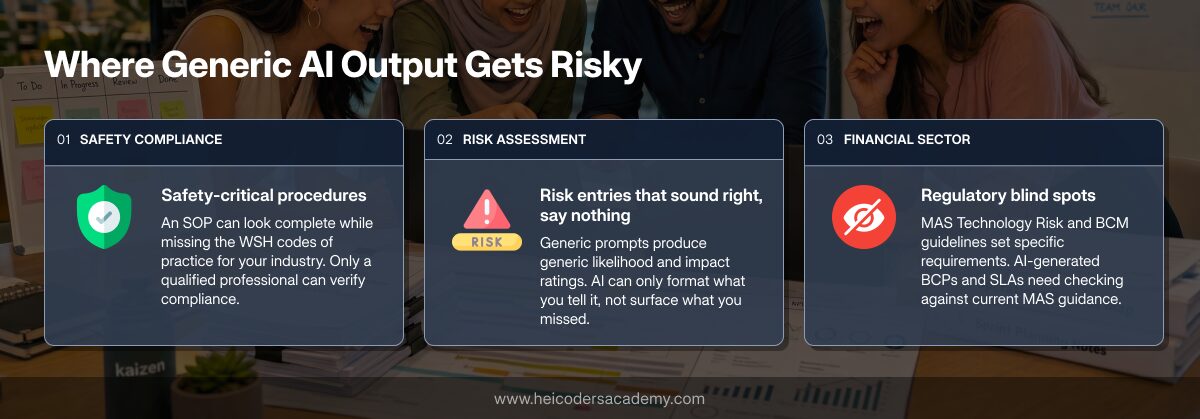
Ask a generic AI tool to “write an SOP for our procurement process” and you will get a document that looks like an SOP, uses SOP language, and is completely unusable for your organisation.
Operations and PM documentation is inherently organisation-specific. Your SOP reflects your systems, your approval hierarchies, your risk appetite, and your regulatory obligations. Your project status update carries real accountability for real deliverables. Your risk register entries need to reflect your actual risk landscape, not a templated list of hypothetical concerns.
Generic prompts also produce generic risk levels. An AI that does not know your industry, your regulator, or your operational context will produce risk register entries that sound professional and miss the point entirely.
In Singapore, the stakes are higher in specific sectors. Financial services firms operate under MAS Technology Risk Management Guidelines. Manufacturing and facilities operations carry Workplace Safety and Health Act obligations. ISO-certified organisations have document control requirements that AI cannot manage on its behalf.
The solution is giving AI enough organisational context to produce something structurally sound and specific enough that your subject matter expertise can close the remaining gap.
The Prompt Framework That Works for Operations and Project Management
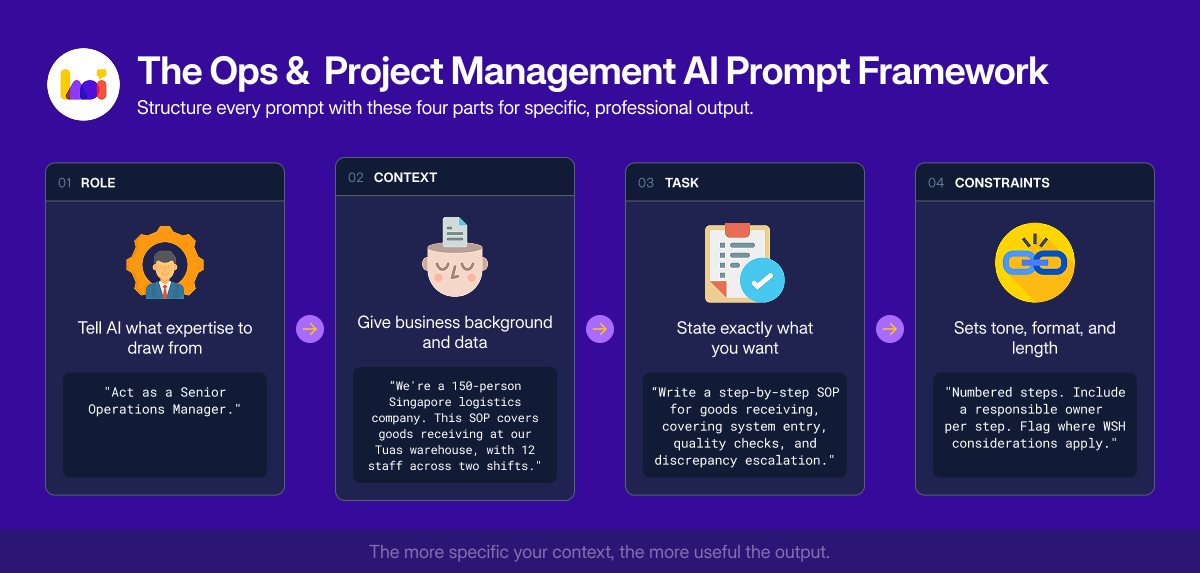
The same four-part formula applies across the series:
Role + Context + Task + Constraints
|
Element |
What It Does |
Operations Example |
|
Role |
Tells AI what expertise to draw from |
“Act as a senior Operations Manager” |
|
Context |
Gives organisational and process background |
“We are a 150-person Singapore logistics company. This SOP covers the goods receiving process at our Tuas warehouse. The team has 12 staff across two shifts.” |
|
Task |
States exactly what you need produced |
“Write a step-by-step SOP for the goods receiving process including system entry, quality checks, and discrepancy escalation” |
|
Constraints |
Sets format, compliance notes, and structure |
“Numbered steps. Include responsible owner for each step. Include decision points as clear if/then statements. Flag where MOM or WSH considerations apply.” |
The more specific your context, the more usable the output. AI has no access to your ERP system, your organisational chart, your approval matrix, or your regulatory obligations unless you provide them. Your job is to bridge that gap with specificity.
20 AI Prompts for Operations and Project Management Professionals
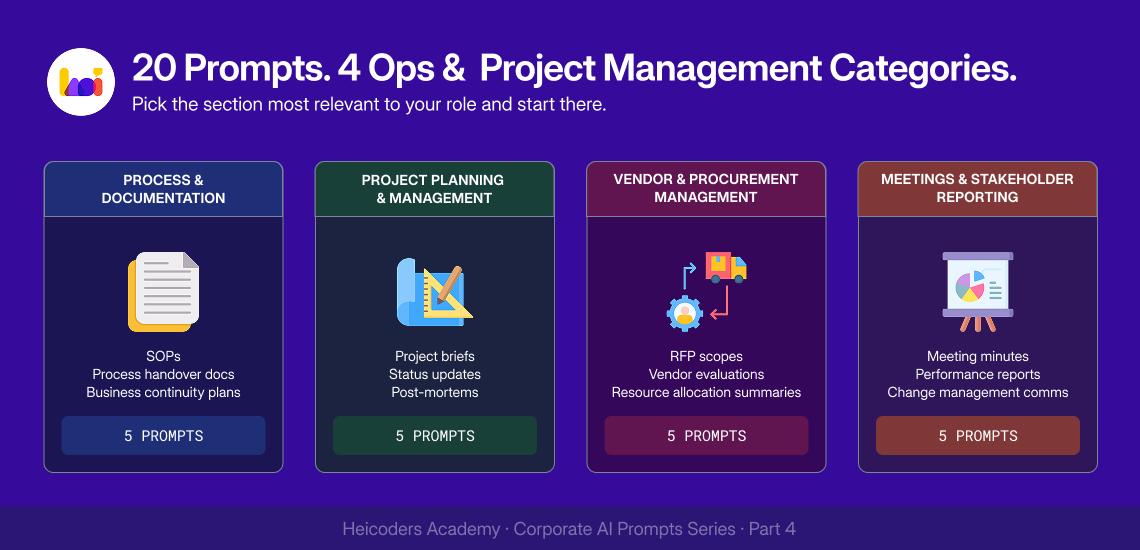
AI Prompts for Process and Documentation
- Writing a Standard Operating Procedure (SOP)
“Act as a senior Operations Manager. I need to write an SOP for the monthly supplier invoice reconciliation process at a Singapore-based retail company with 8 stores. The process involves 3 staff in the Finance Operations team, uses Xero for accounting, and requires reconciliation of supplier invoices against purchase orders within 5 working days of month-end. Common failure points include missing PO references and duplicate invoices. Write a step-by-step SOP with numbered steps, responsible owner for each step, decision points written as if/then statements, and a section on common errors and how to handle them. Include a document control header with version, date, and approver fields.”
- Documenting a Process for Handover or Succession
“Act as an Operations Manager. I need to document a critical operational process for succession purposes. The process is the weekly operations reporting cycle for a Singapore-based manufacturing company. The current process owner is leaving in 3 weeks. The process involves: pulling data from 4 systems, compiling a dashboard in Excel, preparing a written commentary, and distributing to 12 stakeholders by 9am every Monday. Write a process handover document clear enough for someone unfamiliar with the role to execute without assistance. Include: step-by-step instructions, system access requirements, key contacts for data queries, common issues and fixes, and a checklist the new owner can use for the first 4 weeks.”
- Writing a Business Process Improvement Proposal
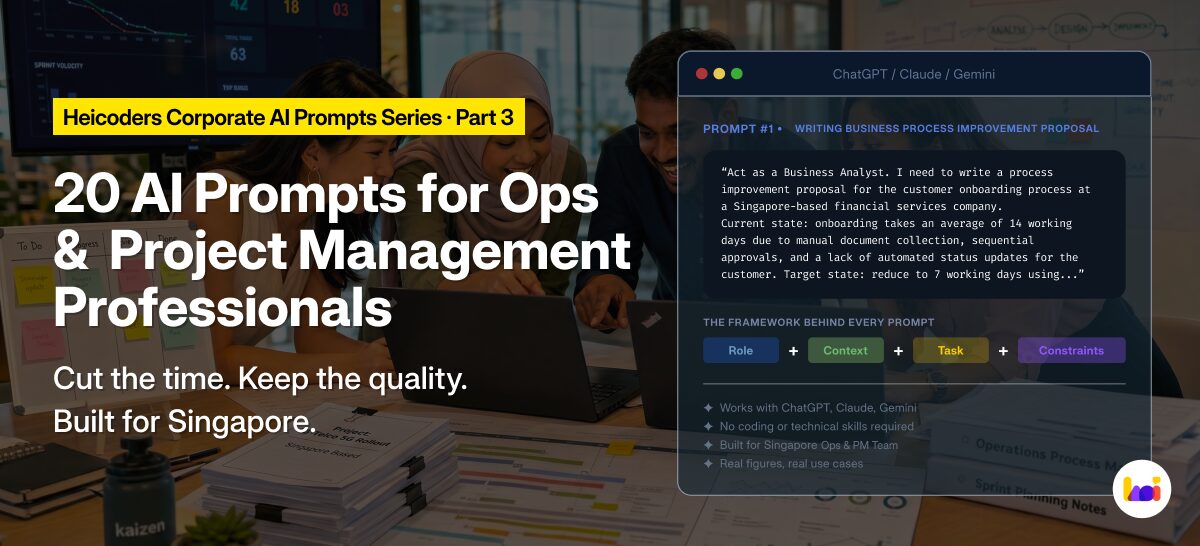
“Act as a Business Analyst. I need to write a process improvement proposal for the customer onboarding process at a Singapore-based financial services company. Current state: onboarding takes an average of 14 working days due to manual document collection, sequential approvals, and a lack of automated status updates for the customer. Target state: reduce to 7 working days using digital document collection, parallel approvals, and automated customer notifications. Write a business process improvement proposal covering: current state summary, problem statement, proposed solution, expected outcomes (measurable where possible), implementation steps, resource requirements, and risks. Format suitable for a COO sign-off.”
- Creating a Risk Register Entry
“Act as a Risk Manager. I need to create a risk register entry for the following operational risk: our company relies on a single third-party cloud provider for all customer data storage and processing with no documented failover arrangement. The risk has been flagged by our internal audit team. We are a 200-person Singapore fintech company regulated by MAS. Write a complete risk register entry including: risk ID, risk description, risk category, likelihood rating with rationale (1 to 5 scale), impact rating with rationale (1 to 5 scale), inherent risk rating, current controls in place, residual risk rating, proposed mitigating actions with owners and target dates, and risk owner. Format consistent with a standard enterprise risk register.”
- Drafting a Business Continuity Plan Section
“Act as a Business Continuity Management professional. I need to draft the business continuity plan section for the Finance function of a Singapore-based insurance company. The function has 25 staff and is responsible for monthly financial reporting, accounts payable, payroll, and regulatory submissions. Key dependencies: Oracle Financials ERP, SWIFT banking connectivity, and a team in Malaysia that handles payroll processing. Recovery Time Objective: 4 hours for payroll and SWIFT. Recovery Time Objective: 24 hours for financial reporting. Write the BCP section covering: function overview, critical processes ranked by RTO, single points of failure, recovery strategies for each critical process, alternate operating procedures, and contact escalation path. Note where MAS Business Continuity Management Guidelines considerations apply.”
AI Prompts for Project Planning and Management
- Writing a Project Brief
“Act as a Project Manager. I need to write a project brief for an ERP system upgrade at a Singapore-based manufacturing company with 400 employees. The project involves upgrading from SAP ECC to SAP S/4HANA. Timeline: 12 months. Budget: SGD 1.8M. Key stakeholders: CFO (project sponsor), Operations Director, IT Director, and 6 department heads. The project will affect 120 system users across Finance, Operations, Procurement, and HR. Write a project brief covering: project background and objective, scope (in scope and out of scope), key milestones, RACI matrix for core team roles, success criteria, key risks at initiation, and governance structure. Format suitable for steering committee approval.”
- Creating a Project Status Update for Stakeholders
“Act as a Project Manager. Write a project status update for the steering committee of a 9-month digital transformation project at a Singapore financial services firm. We are at the end of month 5. Overall status: Amber. Timeline status: Amber (2 weeks behind schedule on the data migration workstream). Budget status: Green (SGD 420K spent of SGD 780K budget). Key achievements this month: UAT completed for modules 1 and 2, vendor integration signed off. Key issues: data quality issues in the legacy system are taking longer to resolve than planned. Next month priorities: complete data cleansing, begin parallel run for module 1. Write the update in a standard RAG format with an executive summary under 150 words followed by detail sections. Tone: transparent and action-oriented.”
- Drafting a Project Risk and Issues Log Narrative
“Act as a Project Manager. I need to write the risks and issues narrative section of a monthly project report for a Singapore government-linked corporation. The project is a procurement system implementation. Current open risks: (1) Key vendor resource assigned to our project has flagged a potential leave period in month 7, creating a delivery risk. (2) Pending regulatory guidance from a government agency may require a scope change if issued before go-live. Current open issues: (1) Integration testing environment has been unavailable for 6 days due to infrastructure issues, causing a 1-week delay to the testing schedule. Write a narrative covering all three items with clear descriptions, impact assessments, owners, and current mitigation or resolution actions. Tone: factual and professionally measured.”
- Writing a Change Request Proposal
“Act as a Project Manager. I need to write a change request for a scope addition to an ongoing warehouse management system implementation project. The requested change: add a real-time inventory dashboard visible to store managers across 12 locations, which was not in the original scope. Estimated additional effort: 3 weeks of developer time, SGD 28,000. Impact on timeline: 3-week extension to go-live. The change was requested by the Operations Director 4 weeks before the planned go-live date. Write a change request document covering: change description, reason for change, alternatives considered, impact on scope, timeline and budget, risks of implementing and not implementing, recommendation, and sign-off fields.”
- Preparing a Project Post-Mortem
“Act as a Project Manager facilitating a post-mortem for a completed CRM implementation project at a Singapore-based B2B company. The project delivered on time but 15% over budget. The system went live successfully but adoption in the first 6 weeks was significantly lower than planned, with only 40% of the sales team actively using it. Key contributing factors: training was delivered in a single 2-hour session 2 weeks before go-live, the system was configured without adequate input from end users, and the project communication plan did not include a feedback loop. Write a structured post-mortem covering: what was delivered, what went well with specific evidence, what did not go well with root cause analysis, what we would do differently, and what process changes are being implemented for the next project. Tone: constructive and forward-looking.”
AI Prompts for Vendor, Procurement, and Resource Management
- Writing a Request for Proposal Summary
“Act as a Procurement Manager. I need to write a scope of work and evaluation framework for an RFP for a workplace management software solution for a Singapore company with 5 office locations and 800 staff. Key requirements: desk booking, meeting room management, visitor management, and integration with our existing Microsoft 365 environment. Budget range: SGD 80,000 to SGD 120,000 per year including implementation. Evaluation criteria: functional fit (40%), implementation capability and Singapore presence (25%), total cost of ownership (25%), and security and data compliance (10%). Write the RFP scope of work section and evaluation criteria framework in a format that can be sent to 4 shortlisted vendors.”
- Drafting a Vendor Evaluation Summary
“Act as a Procurement Manager. I have completed an evaluation of 3 vendors for a Singapore company’s new HR information system. Vendor A: strongest on functional fit, highest cost at SGD 180,000 per year, Singapore-based support team. Vendor B: strong on integration capability, mid-range cost at SGD 130,000, support based in Australia. Vendor C: weakest on functional fit but lowest cost at SGD 95,000, Singapore-based but limited implementation track record locally. Write a vendor evaluation summary for the approval authority covering: evaluation methodology, individual vendor assessments against each criterion, comparison table, recommended vendor with rationale, and a note on the risks of the recommended choice. Recommendation: Vendor A.”
- Writing a Procurement Justification
“Act as an Operations Manager. I need to write a procurement justification for the purchase of an AI-powered document processing tool for our Singapore-based legal firm. The tool costs SGD 42,000 per year (excluding GST) and will automate the extraction and categorisation of data from client contracts, currently done manually by 2 paralegals who spend approximately 30% of their time on this task. Write a procurement justification covering: business need, current state and its cost, proposed solution, expected efficiency gain (quantified where possible), total cost of ownership over 3 years, alternatives considered, and recommendation. Format suitable for CFO sign-off.”
- Drafting a Service Level Agreement Checklist
“Act as a Vendor Manager. I need to prepare a key terms checklist for reviewing a managed IT services agreement for a Singapore company. The vendor will manage our network infrastructure, service desk, and cybersecurity monitoring. Critical metrics to include: service desk response times, system uptime SLAs, cybersecurity incident response times, monthly reporting requirements, and escalation procedures. Write a structured SLA key terms checklist covering: service scope, performance metrics and targets, measurement methodology, reporting cadence, remedies for SLA breaches, termination provisions, and data handling obligations under PDPA. Format as a checklist the legal and operations team can use to review the vendor’s draft agreement.”
- Writing a Resource Allocation Summary
“Act as a Resource Manager at a Singapore professional services firm. I need to produce a resource allocation summary for the next quarter. We have 3 active projects: Project Alpha (60% of capacity required, 4 months remaining), Project Beta (30% capacity required, 2 months remaining), and Project Gamma launching next month requiring 50% capacity. Our current team has 8 consultants at full capacity and 2 at 70% capacity. We have 1 contractor available from month 2. Write a resource allocation summary identifying the capacity gap clearly, the peak pressure months, options for resolving the gap (including trade-offs), and a recommendation for the Operations Director. Include a simple capacity vs demand table.”
AI Prompts for Meetings, Reporting, and Stakeholder Communications
- Writing a Meeting Agenda
“Act as a Project Manager. Write a 90-minute steering committee agenda for a digital transformation project at a Singapore government-linked company. The meeting has 8 attendees including the project sponsor, 4 business unit heads, the IT Director, the external programme manager, and a project coordinator. Key agenda items: project status update, decision required on a proposed scope change (budget impact SGD 85,000), risk escalation requiring sponsor awareness, and preview of next quarter’s milestones. Format the agenda with: time allocation per item, owner for each item, pre-read materials required, and a clear note on which items require a decision versus which are for information only.”
- Drafting Meeting Minutes and Action Items
“Act as a Project Coordinator. I need to produce meeting minutes for a project steering committee meeting. The meeting covered 4 topics: (1) Status update: project is on track, no major issues. (2) Scope change approved: additional reporting module approved at SGD 28,000, 3-week timeline extension granted. (3) Risk escalation: vendor resourcing risk acknowledged, sponsor has agreed to raise with vendor CEO directly. (4) Q3 milestones previewed: no concerns raised. 6 action items were agreed. Write structured meeting minutes including: attendees, agenda items with summary of discussion and decisions, and a clearly formatted action items table with owner, action description, and due date. Tone: formal and precise.”
- Writing an Operational Performance Report for Leadership
“Act as an Operations Director. Write a monthly operational performance report for the CEO and Board covering a Singapore-based logistics company’s June 2026 results. Key metrics: on-time delivery rate 94.2% (target 96%, down from 95.8% in May due to port congestion), warehouse utilisation 87% (target 85%, on track), cost per shipment SGD 18.40 (target SGD 18.00, 2.2% above target due to fuel surcharges), customer complaint rate 1.2% (target under 1.5%, on track), and staff overtime hours 12% above standard (driven by 3 unplanned absences). Write a 1-page executive report covering performance highlights, areas of concern with root cause, actions being taken, and outlook for July. Tone: direct and accountable.”
- Drafting a Change Management Communication
“Act as a Change Manager. I need to write a communication to all staff at a 300-person Singapore manufacturing company announcing the transition from manual timesheets to a digital time and attendance system launching in 6 weeks. The change affects all production floor staff (200 people), most of whom are not regular computer users. The new system uses a biometric terminal on the shop floor, not a computer. Write an all-staff communication that: explains what is changing and when, explains what is not changing, addresses the most likely concern (data privacy for biometric data), describes what support is available during the transition, and states who to contact with questions. Tone: clear, direct, and reassuring. Avoid technical language. Under 300 words.”
- Writing a Quarterly Operations Review Presentation Outline
“Act as an Operations Director. I need to prepare a quarterly business review presentation structure for Q2 2026 for the Board of Directors of a Singapore-based financial services company. The review covers: operational performance against KPIs, technology and infrastructure update, regulatory and compliance highlights, people and capacity update, and priorities for Q3. The Board has 45 minutes allocated. Write a presentation outline including: slide-by-slide structure with suggested title and key message for each slide, data required for each slide, speaking time allocation, and 3 questions the Board is most likely to ask with suggested talking points for each. Format as a brief the Operations Director can use to build the deck.”
A Note on Operations and PM Compliance in Singapore
Operations documentation carries regulatory weight in ways that other professional content does not. Before any AI-generated operational document is implemented, shared with auditors, or distributed to employees, apply your professional judgement against the following.
Workplace Safety and Health (WSH) Act Operational SOPs and procedures in Singapore must comply with the Workplace Safety and Health Act administered by MOM. For higher-risk industries including manufacturing, construction, logistics, and food and beverage, specific codes of practice apply. AI can produce a structurally sound SOP but cannot verify whether it meets the WSH requirements specific to your industry and operational context. All safety-critical procedures must be reviewed by a qualified WSH professional before implementation. Visit mom.gov.sg for current WSH codes of practice.
ISO Quality Management Systems Many Singapore companies hold ISO 9001 (quality management), ISO 27001 (information security), or ISO 14001 (environmental management) certifications. These frameworks impose specific requirements on document control including version numbering, approval workflows, document review cycles, and change history. AI-generated documents do not come with document control built in. Your QMS requirements must be applied manually before any AI-generated operational document enters your QMS-controlled document library.
MAS Technology Risk Management and BCM Guidelines For Singapore financial sector companies, the MAS Technology Risk Management Guidelines and Business Continuity Management Guidelines set specific requirements for operational documentation, incident reporting, recovery time objectives, and vendor risk management. AI-generated risk registers, BCPs, and vendor SLA frameworks must be reviewed against current MAS guidelines before use. Visit mas.gov.sg for current guidance.
GST and Procurement Documentation Procurement documents referencing costs in Singapore must correctly account for the current Goods and Services Tax rate. AI may not apply the current GST rate accurately or may omit it entirely. All cost figures in AI-generated procurement documents must be verified before submission for financial approval.
The practical rule: AI structures the document and produces the first draft. Subject matter experts, compliance owners, and where relevant, qualified professionals must review before any operational document is implemented, audited, or distributed.
How to Get Better Results from AI Prompts as an Operations or Project Management Professional
Three habits separate operations and PM professionals who get consistent value from AI and those who find the output too generic to be useful.
Give it your organisational specifics upfront. Operations documentation that lacks organisational context produces generic output that cannot be implemented. Before prompting, identify the three to four pieces of information that make your process or project unique: the systems involved, the team structure, the regulatory context, and the key constraints. Build these into the prompt before you ask for anything. The output will be significantly more usable.
Use it to standardise, not just to draft. One of the highest-value uses of AI in operations is standardising documentation that currently exists in inconsistent formats across teams and locations. Rather than prompting AI to write a document from scratch, prompt it to take your existing documentation and restructure it into a consistent format. This produces better quality output and builds a more maintainable documentation library.
Always have a subject matter expert review before implementation. This matters more in operations than in almost any other professional context. An AI-generated SOP that contains an error is not just a writing problem. It is an operational risk. An AI-generated risk register entry that misses a key control gap is not just a documentation gap. It may affect your audit outcome. Use AI to produce faster first drafts. Use qualified people to verify them before they are acted on.
Why AI Matters for Operations and Project Management Professionals in Singapore
Singapore’s role as a regional operations hub means that many operations and project management teams here carry responsibility for processes, systems, and projects that span multiple countries and regulatory environments. The documentation requirements that come with that scope are significant.
At the same time, operations functions are consistently under pressure to do more with the same team. Process improvement, cost reduction, and operational excellence are standing mandates. The time spent on documentation is time not spent on the analysis, the process design, and the stakeholder management that actually drives improvement.
ManpowerGroup’s 2026 Global Talent Shortage Survey found that AI literacy is now Singapore’s hardest-to-fill skill, with organisations across every sector struggling to find professionals who can apply AI tools effectively in a working context. For operations and project management, this creates a dual opportunity: using AI to improve the efficiency of your own function, and being the person in your organisation who can lead others through the same transition.
The operations and project management professionals who will have the most impact over the next five years are not the ones who produce the most documentation. They are the ones who have built systems, including AI-assisted documentation workflows, that allow their organisations to operate with greater clarity, consistency, and speed.
Frequently Asked Questions About AI Prompts for Ops and Project Management Professionals
What are AI prompts for operations and project management professionals?
AI prompts for operations and project management professionals are structured instructions given to a generative AI tool such as ChatGPT, Claude, or Gemini that specify a role, organisational context, task, and output constraints. A well-structured prompt produces documentation that is specific to your organisation and processes rather than generic templates that require significant rewriting before they can be used.
Can operations professionals in Singapore use AI to write SOPs and process documentation?
Yes, with important caveats. AI can produce well-structured SOPs and process documentation significantly faster than writing from scratch. However, all safety-critical procedures must be reviewed against the Workplace Safety and Health Act and relevant codes of practice by a qualified WSH professional. ISO-certified organisations must apply their document control requirements to any AI-generated document before it enters the QMS-controlled library.
Which operations and project management tasks benefit most from AI prompts?
The tasks that benefit most are those with a high drafting and structuring component: SOP writing, project briefs, status update reports, risk register entries, meeting minutes, vendor evaluation summaries, procurement justifications, and stakeholder communications. Tasks that require on-site knowledge, regulatory expertise, or interpersonal judgement still require a qualified professional.
How do I ensure AI-generated risk register entries are accurate?
AI can produce a well-formatted risk register entry using the information you provide. It cannot identify risks you have not mentioned, assess their likelihood accurately for your specific operational context, or verify whether your current controls are adequate. Risk register entries produced with AI must be reviewed by the risk owner and validated against your organisation’s risk framework before being accepted into the register.
What should I watch out for when using AI for procurement documentation in Singapore?
Key considerations include: verifying that all cost figures correctly account for the current GST rate, ensuring that any vendor claims are based on verifiable and current information, confirming that evaluation criteria reflect your organisation’s actual priorities rather than generic best practice, and checking that SLA terms are consistent with your legal team’s requirements and current Singapore contract law. AI produces plausible procurement documentation. Procurement and legal professionals must verify the specifics.
Do operations professionals need technical skills to use AI prompts effectively?
No. Using AI prompts for operations and project management does not require coding or data science skills. The skill is in providing specific, accurate organisational context and applying professional judgement to the output. Operations professionals who understand their systems, processes, and regulatory obligations are already well-positioned to use these tools effectively. The barrier is not technical. It is the discipline to use the tools systematically.
Take Your AI Skills Further
Heicoders Academy’s Generative AI Course (GA100) is built for working professionals in Singapore across every function. Whether you are looking to upskill individually or bring practical AI capability to your operations or project management team, the course covers prompt engineering, AI workflow automation, and AI agent deployment in a structured, hands-on format. WSQ-certified and SkillsFuture-eligible.
References
- ManpowerGroup Singapore, AI Skills Become Singapore’s Hardest-to-Fill Capability Even as Talent Scarcity Eases: ManpowerGroup’s 2026 Global Talent Shortage Survey, published 26 February 2026. Available at: https://www.manpower.sg/en/insights/blogs/2026/02/ai-skills-become-singapores-hardest-to-fill-capability-even-as-talent-scarcity-eases
- Ministry of Manpower Singapore, Workplace Safety and Health Act and Codes of Practice. Available at: https://www.mom.gov.sg/workplace-safety-and-health
- Monetary Authority of Singapore, Technology Risk Management Guidelines and Business Continuity Management Guidelines. Available at: https://www.mas.gov.sg
Part of the Heicoders Corporate AI Prompts Series Part 1: Finance and FP&A | Part 2: HR and People Ops | Part 3: Marketing and Comms | Part 4: Operations and Project Management