Last updated: 28 October 2026. Covers the Singapore Digital Economy Report 2026, released by IMDA on 5 October 2026.
Almost everyone around you at work is now using AI. Far fewer have been taught how to use it well. That is one of the clearest messages in the latest Singapore Digital Economy Report from the Infocomm Media Development Authority (IMDA).
The report found that around 86% of workers in Singapore use AI at work, up from 78% a year earlier. Only 37%, though, attended any AI-related training in the past year.
This article breaks down the five findings that matter most for working professionals. For each one, you’ll see what the numbers say and what they mean for your day-to-day work.
Key Findings at a Glance
The Singapore Digital Economy Report is IMDA’s annual analysis of how digital technology shapes the economy, enterprises and workers. The 2026 edition is the fourth. Here are the headline numbers.
| Finding | Latest figure | Previous figure |
|---|---|---|
| Digital economy share of GDP | 19.3% (S$144.1 billion, 2025) | 18.8% (2024) |
| Workers using AI at work | Around 86% (2026) | 78% (2025) |
| Workers who see a need to build AI skills | Around 68% | Not compared |
| Workers who attended AI training in the past year | 37% | Not compared |
| SMEs adopting AI | 23.4% (2025) | 14.5% (2024) |
| Non-SMEs adopting AI | 70.4% (2025) | 62.5% (2024) |
Source: IMDA, Singapore Digital Economy Report 2026.
Finding 1: AI Use at Work Is Now the Norm
AI is no longer something only early adopters use. Around 86% of workers in Singapore now use AI at work, up from 78% the year before.
Workers who use AI reported gains in productivity, work quality and problem-solving. Most said it saved them up to an hour a day.
What it means for your work: using AI is quickly becoming a baseline part of most office roles. The difference between colleagues is no longer whether they use AI, but how well they use it. That covers how clearly they write prompts, how carefully they check outputs, and whether they apply AI to the tasks that matter most.
Finding 2: The Training Gap Is the Real Story
The biggest gap in the report isn’t between companies. It’s between how many workers use AI and how many have been trained to use it. Around 68% of workers said they needed to build AI skills, but only 37% attended AI training in the past year. 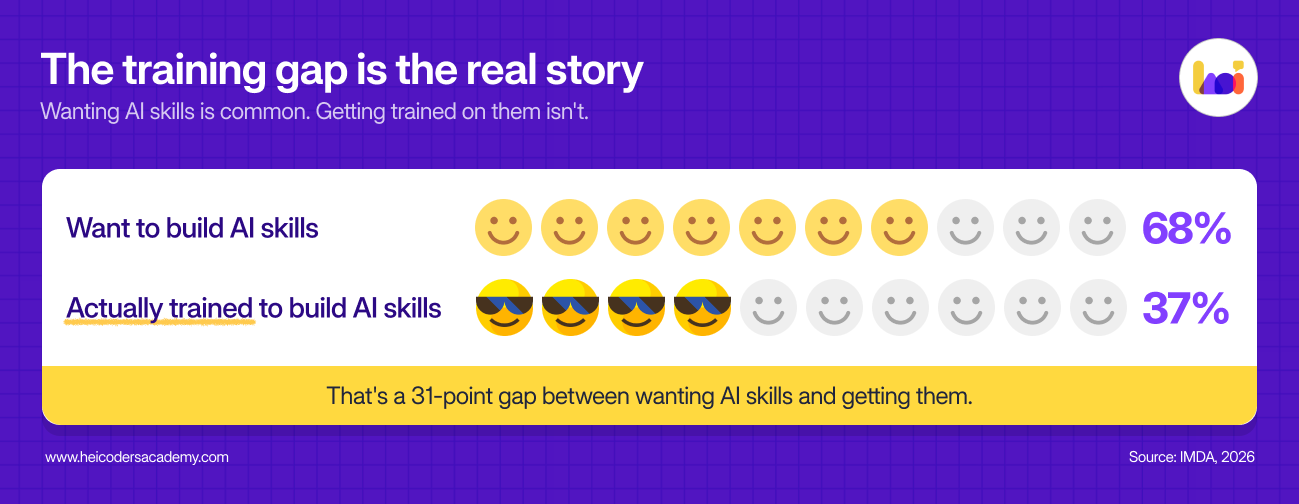
That means most people are teaching themselves through trial and error. Self-taught habits can work, but they often leave gaps, such as relying on outputs without checking them, or using AI only for simple tasks when it could help with more.
What it means for your work: if you’re one of the many self-taught users, structured practice is the fastest way to close those gaps. If you manage a team, it’s worth planning training around real workflows rather than leaving everyone to experiment alone. Our guide on how to plan AI training for your team walks through how to do this.
Finding 3: SMEs Are Catching Up Fast
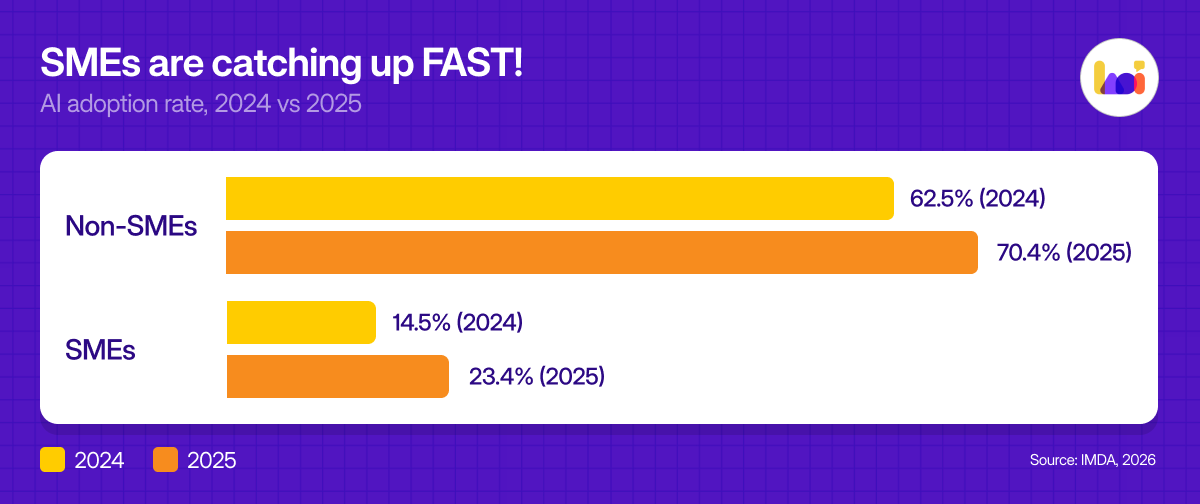
AI adoption grew most sharply among smaller companies. The share of SMEs using AI rose from 14.5% in 2024 to 23.4% in 2025. Among non-SMEs, adoption rose from 62.5% to 70.4%.
Large companies still lead by a wide margin. The pace of change at SMEs, though, means AI is reaching workplaces that hadn’t used it much before.
What it means for your work: if you work at an SME, expect AI tools to show up in more of your workflows soon, if they haven’t already. Building the skills early puts you in a better position to help shape how your company uses them.
Finding 4: Most Companies Use Ready-Made AI Tools
Most companies that use AI rely on off-the-shelf tools rather than building their own. About two in five are expanding their use of AI or fully integrating it into how they work.
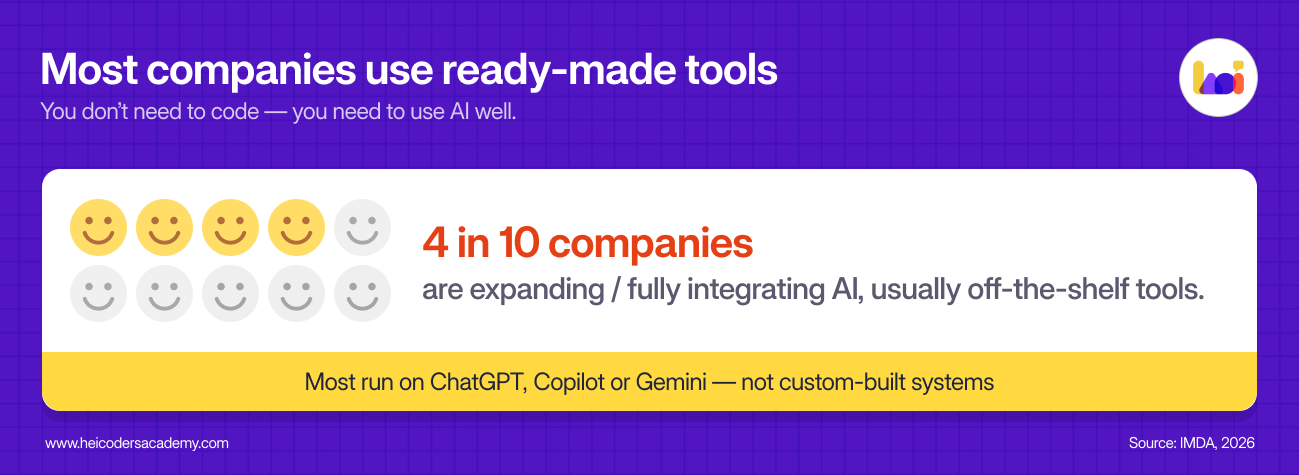
What it means for your work: you probably don’t need to learn how to build AI systems. The most useful skills are applying widely used tools well, such as ChatGPT, Microsoft Copilot or Google Gemini. As companies move from trying AI to integrating it, skills such as designing AI-assisted workflows and working with AI agents become more valuable. Our explainer on AI agents vs traditional automation covers the difference.
Finding 5: Growth Is Coming From Outside the Tech Sector
The digital economy isn’t driven by tech companies alone. Sectors outside information and communications contributed more than two-thirds of Singapore’s digital economy. Their contribution grew 3.6% to S$97 billion, while the information and communications sector grew 6.1% to S$47.1 billion.
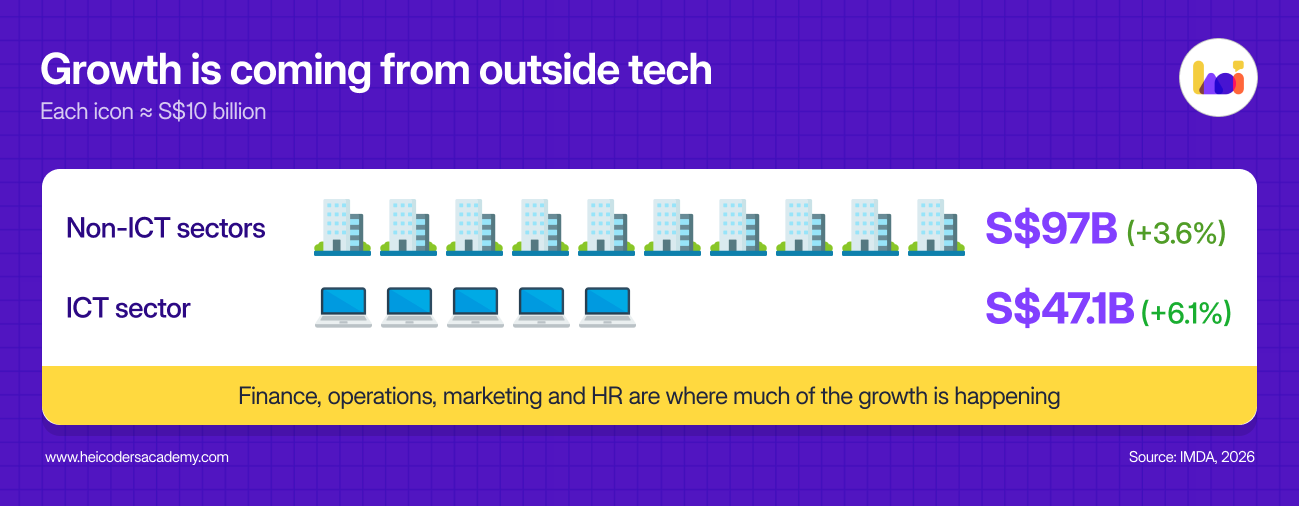
What it means for your work: digital and AI skills matter well beyond tech roles. Finance, operations, marketing and HR teams are where much of the change is happening. For examples by role, see our guides to AI prompts for marketing and comms professionals and AI prompts for operations and project management professionals.
What You Can Do Next
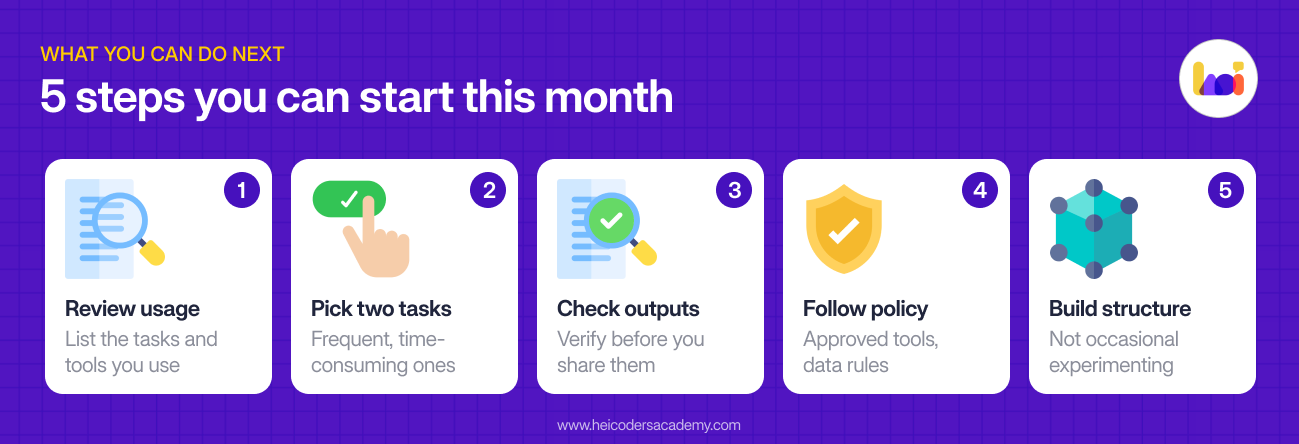
The report points to a simple conclusion: using AI is common, but using it well isn’t yet. Here are practical steps you can take this month:
- Review how you use AI today. List the tasks you already use AI for and the tools you use.
- Pick two tasks to improve. Choose tasks that are frequent and time-consuming, such as drafting reports, summarising documents or preparing presentations.
- Practise checking outputs. Make verifying facts, figures and sources part of your routine, especially for anything you share with others.
- Follow your organisation’s AI policy. Check which tools are approved and what information you shouldn’t enter into them.
- Build skills with structure. Short, hands-on practice on real tasks tends to stick better than occasional experimenting.
What’s Being Done to Close the Gap
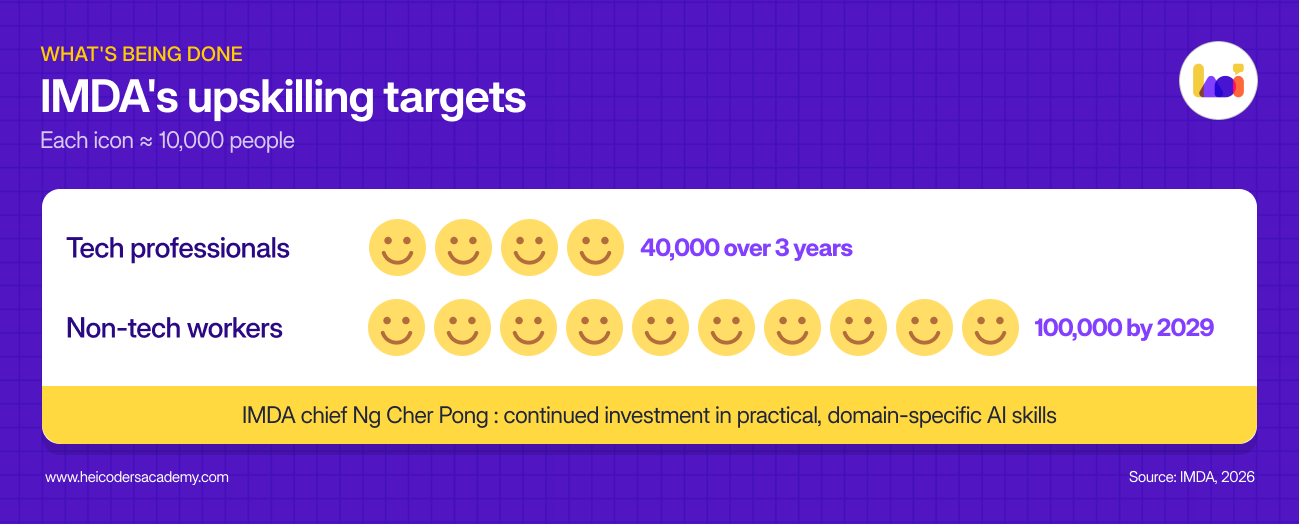
IMDA has said it will expand AI training to close the gap between AI use and AI skills. Its plans include upskilling 40,000 technology professionals over three years and 100,000 non-tech workers in AI by 2029. Its chief executive, Ng Cher Pong, said the agency would keep investing in practical, domain-specific AI skills.
Frequently Asked Questions About the Singapore Digital Economy Report
What is the Singapore Digital Economy Report?
It's an annual report from the Infocomm Media Development Authority (IMDA) that analyses the size of Singapore's digital economy and how enterprises and workers are adopting digital technology and AI. The 2026 edition, released on 5 October 2026, is the fourth.
How many workers in Singapore use AI at work?
Around 86% of workers in Singapore use AI at work, according to the Singapore Digital Economy Report 2026. That's up from 78% a year earlier.
What percentage of Singapore SMEs use AI?
According to IMDA, 23.4% of SMEs used AI in 2025, up from 14.5% in 2024. Among non-SMEs, adoption rose from 62.5% to 70.4%.
Do I need technical skills to use AI at work?
No. Most companies use ready-made AI tools, and everyday tasks such as drafting, summarising and analysing information need no coding. Technical skills become useful mainly for advanced automation.
Where can I read the full report?
The full Singapore Digital Economy Report 2026 is available on IMDA's website.
Turning AI Use Into AI Skill
The latest Singapore Digital Economy Report shows that AI is already part of most people’s working day. The opportunity now is to move from occasional, self-taught use to confident, reliable use on the tasks that matter.
Using AI well is a skill, and like any skill, it improves with structured practice. Heicoders Academy’s Generative AI for Automation and Productivity course (GA100) is designed for working professionals in Singapore who want to apply AI practically in their roles, from writing better prompts to automating repetitive workflows. Explore the GA100 Generative AI Course and turn everyday AI use into a reliable part of how you work.
Sources
- IMDA, Singapore Digital Economy Report 2026 (5 October 2026)
- IMDA, Singapore Digital Economy Report 2026 press release