Quick Summary
- This article gives Finance professionals in Singapore 20 ready-to-use AI prompts for tasks including monthly variance commentary, board narratives, rolling forecasts, audit preparation, and stakeholder communication.
- Each prompt follows a four-part framework (Role + Context + Task + Constraints) that produces specific, professional output rather than generic text.
- The prompts are designed for FP&A analysts, Finance Business Partners, Controllers, and CFOs.
- They can be used with any major generative AI tool such as ChatGPT, Claude, or Gemini.
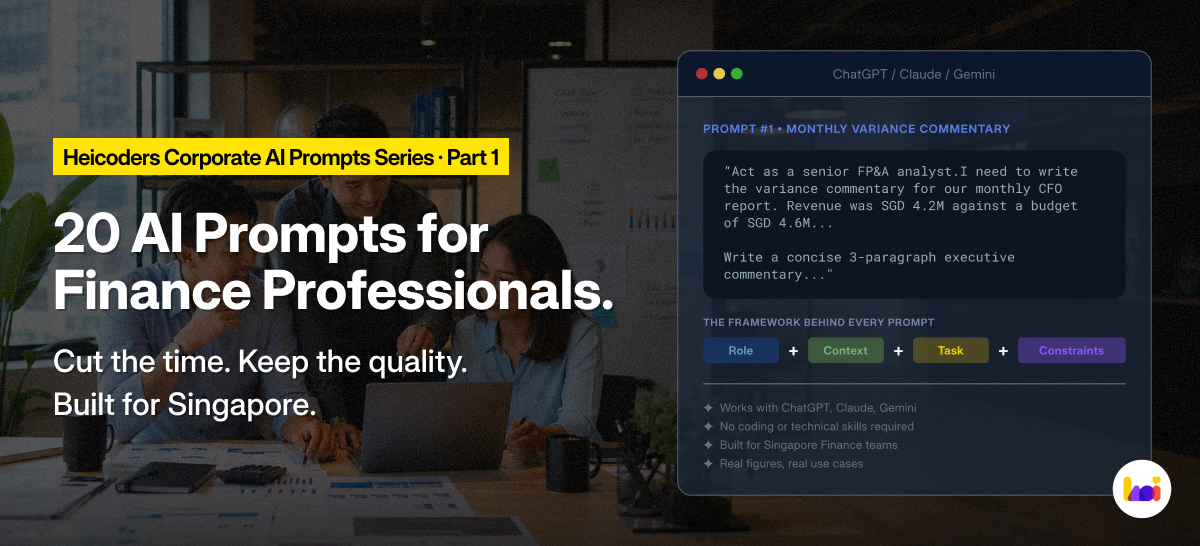
If you work in Finance, you already know that the bulk of your day is not spent on high-value analysis. It is spent on producing it: writing commentary, chasing numbers, formatting reports, summarising variances, and preparing decks that explain what the numbers mean.
AI will not replace Finance professionals. But Finance professionals who know how to use AI effectively will have a significant edge over those who do not. The gap is not about coding or technical knowledge. It comes down to one skill: knowing how to ask AI the right questions. That skill starts with understanding what an AI prompt for finance actually is.
An AI prompt for finance is a structured instruction that tells a generative AI tool exactly what role to play, what context to use, and what output to produce so the result is specific, professional, and immediately usable rather than generic and vague.
This article gives you a practical framework and 20 real-world AI prompts for finance professionals in Singapore. Whether you are an FP&A analyst, a Finance Business Partner, a Controller, or a CFO, these prompts are designed to cut the time you spend on recurring tasks without sacrificing the quality of your output.
Why Generic AI Prompts Do Not Work for Finance
Most AI prompt guides hand you something like: “Summarise this financial report.”
That is not a prompt. That is a vague instruction. And vague instructions produce vague outputs.
Finance work has specificity baked into it. Your stakeholders have context. Your reports follow internal conventions. Your commentary needs to reflect business logic, not just numbers. When you treat AI like a search engine, you get generic answers. When you treat it like a well-briefed analyst, you get something genuinely useful.
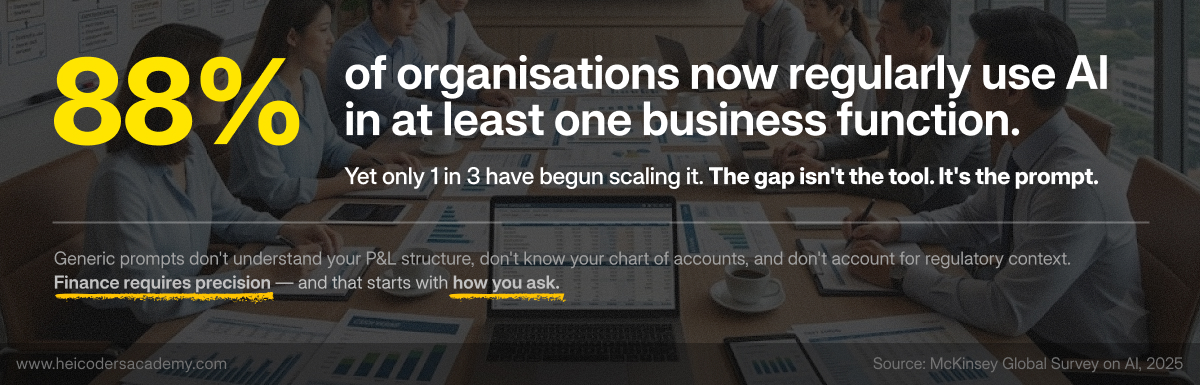
The difference is in how you structure your prompt. According to the McKinsey Global Survey on AI (2025), 88 percent of organisations are now regularly using AI in at least one business function. But the same research finds that most are still in the experimentation or piloting phase, and only one-third have begun scaling AI across the enterprise. The gap between those seeing real value and those still running pilots comes down to one thing: how well people are using the tools they already have. The quality of the input determines the quality of the output.
The Prompt Framework That Works for Finance Professionals
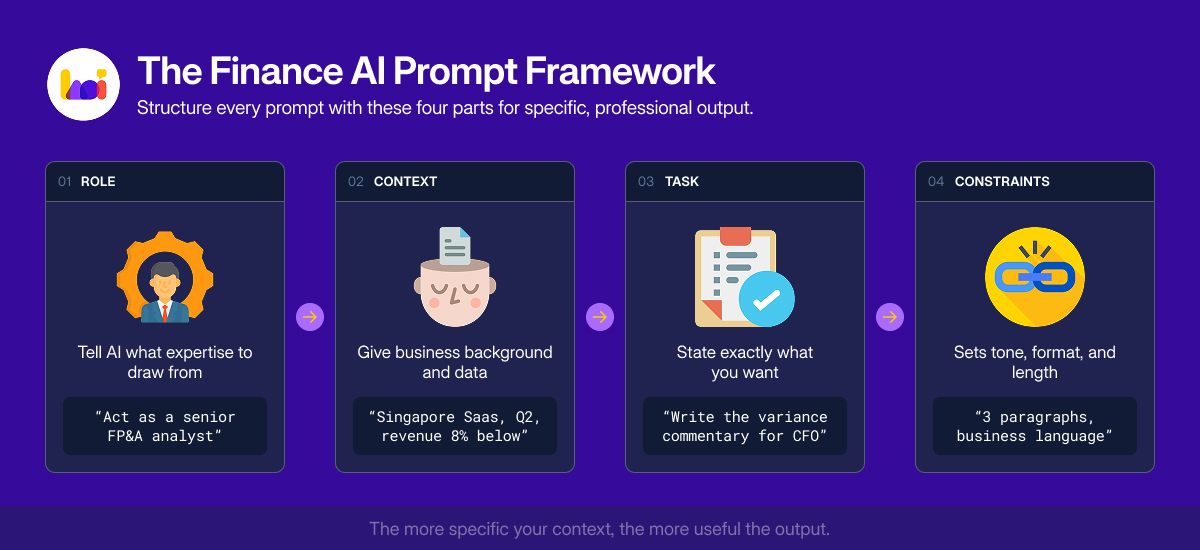
Before the prompts, understand the structure behind them. Use this four-part formula:
Role + Context + Task + Constraints
|
Element |
What It Does |
Example |
|---|---|---|
|
Role |
Tells AI what expertise to draw from |
“Act as a senior FP&A analyst” |
|
Context |
Gives business background |
“We are a Singapore-based SaaS company, Q2 just closed, revenue came in 8% below budget” |
|
Task |
States exactly what you want |
“Write the variance commentary for the CFO’s monthly review deck” |
|
Constraints |
Sets tone, format, length |
“Keep it to 3 paragraphs, use business language, do not speculate on causes without flagging uncertainty” |
The more specific your context, the more useful the output. AI does not know your business. You do. Your job is to bridge that gap.
20 AI Prompts for Finance Professionals
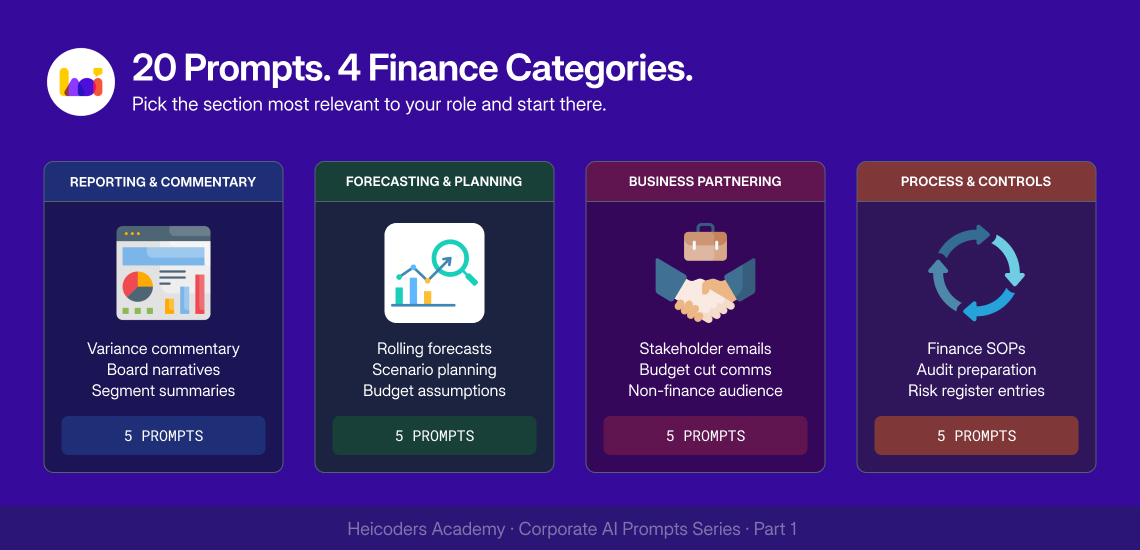
AI Prompts for Financial Reporting and Commentary
- Monthly Variance Commentary
“Act as a senior FP&A analyst. I need to write the variance commentary for our monthly CFO report. Revenue was SGD 4.2M against a budget of SGD 4.6M, a negative variance of SGD 400K or 8.7%. The shortfall was driven by delayed enterprise deal closures in our Singapore and Malaysia segments. Operating expenses came in 3% under budget due to slower-than-planned headcount growth. Write a concise 3-paragraph executive commentary. Use precise business language. Flag areas where further investigation is needed rather than stating causes definitively.”
- Board-Level Financial Narrative
“Act as a CFO preparing a board pack narrative. Our company delivered SGD 18.3M in revenue for H1, representing 12% YoY growth. Gross margin improved from 61% to 64% due to product mix shift. EBITDA was SGD 2.1M, below our plan of SGD 2.8M due to accelerated investment in sales headcount. Write a 4-paragraph narrative summary for a board of directors audience. Tone should be confident and measured, acknowledging shortfalls without over-explaining.”
- Segment Performance Summary
“Act as a Finance Business Partner. I need to summarise the performance of three business segments for our internal leadership meeting. Segment A: SGD 6.2M revenue, 15% above budget. Segment B: SGD 3.8M, on budget. Segment C: SGD 2.1M, 22% below budget due to project delays. Write a single-page summary with a short paragraph on each segment, followed by 3 key risks and 3 opportunities going into Q3.”
- Budget vs Actuals Table Interpretation
“I will paste a budget vs actuals table below. Act as an FP&A analyst and identify the top 3 variances that require immediate management attention, explain the likely business implication of each, and suggest one question the Finance team should be asking the relevant business unit. [Paste table here]”
- Rewriting Dense Financial Commentary
“Rewrite the following financial commentary to make it clearer and more concise for a non-Finance executive audience. Remove jargon where possible. Keep all numbers intact. Target length: half of the original. [Paste original commentary here]”
AI Prompts for Forecasting and Planning
- Rolling Forecast Narrative
“Act as a senior FP&A analyst. Based on the following assumptions, write a narrative summary for our Q3 rolling forecast: Revenue expected at SGD 5.1M based on confirmed pipeline coverage of 1.8x. Headcount costs will increase by SGD 280K due to 4 new hires joining in August. Marketing spend will step up by SGD 120K for a product launch campaign in September. Write a concise forecast narrative suitable for a Finance leadership review. Highlight the key assumptions and sensitivities.”
- Scenario Planning Summary
“Act as an FP&A analyst preparing a scenario analysis. I have three scenarios for FY2025 revenue: Base case SGD 42M, Upside SGD 47M assuming enterprise pipeline converts at 70%, Downside SGD 37M assuming two key accounts churn in Q4. Write a one-page scenario summary for the leadership team explaining each case, the key drivers, and what early indicators we should monitor to know which scenario we are tracking toward.”
- Annual Budget Assumptions Documentation
“Act as a Finance Manager preparing the assumptions section of our annual budget. Our key assumptions are: 10% revenue growth driven by 3 new enterprise accounts and 15% growth in existing accounts. Headcount growing from 85 to 102 FTEs. Average salary increase of 4%. Office costs flat. Marketing spend increasing 20% to support two new market entries. Write this as a structured assumptions narrative, formatted for inclusion in a board budget presentation.”
- Sensitivity Analysis Explanation
“Act as an FP&A analyst. I need to explain the results of a sensitivity analysis to a non-Finance business leader. The analysis shows that a 1% change in gross margin has a SGD 420K impact on EBITDA. A 5% change in revenue volume impacts EBITDA by SGD 680K. Write a plain-English explanation of what these sensitivities mean for our business and why they matter for decision-making. Keep it under 200 words.”
- Headcount Cost Forecast Narrative
“Act as a Finance Business Partner supporting the HR function. We are forecasting headcount costs for Q4. We plan to hire 8 new staff at an average cost of SGD 72,000 per annum, starting at different points across the quarter. Total incremental headcount cost impact in Q4 is estimated at SGD 144,000. Write a short narrative explaining this forecast to the CHRO, including a note on the timing assumptions and the risk if hiring is delayed by one month.”
AI Prompts for Finance Business Partnering and Stakeholder Communication
- Finance Business Partner Update to a Business Leader
“Act as a Finance Business Partner. Write a concise email update to the Head of Sales summarising Q2 financial performance for the Sales division. Revenue: SGD 8.4M, 6% above target. Sales operating costs: SGD 2.1M, 4% over budget due to higher travel and entertainment spend. Commission payouts: SGD 640K, in line with plan. Keep the tone collaborative, not critical. End with two questions to align on for the Q3 planning process.”
- Explaining a Budget Cut Decision
“Act as a Finance Manager. I need to communicate a budget reduction to the Marketing team. Their Q3 budget has been reduced by 15% due to a company-wide cost review. Write a professional email explaining the decision, acknowledging the impact, and offering to work with them to reprioritise spend. Tone: direct but empathetic. Avoid corporate jargon.”
- Preparing for a Budget Challenge Meeting
“Act as an FP&A analyst preparing me for a budget challenge meeting with the Operations team. Their budget submission is 18% above last year with limited justification for three cost lines: facilities (up 25%), IT (up 30%), and external consultants (up 40%). Prepare 8 specific, probing questions I should ask to pressure-test their numbers. Frame the questions as collaborative rather than adversarial.”
- Translating Finance Insights for a Non-Finance Audience
“Act as a Finance Business Partner. Take the following financial analysis and rewrite it for a General Manager who does not have a Finance background. Focus on business implications, not accounting mechanics. Use plain language and short sentences. Avoid terms like EBITDA, amortisation, or accruals without explaining them first. [Paste analysis here]”
- Writing a Finance Update for an All-Hands Meeting
“Act as a CFO preparing a 3-minute verbal update for a company all-hands meeting. The key messages are: we delivered a strong Q2, revenue grew 14% YoY, we are on track for full-year targets, and we are investing ahead of plan in two growth areas. Tone: confident, transparent, and energising for the broader team. Write this as a spoken script, not a formal report.”
AI Prompts for Finance Process, Controls, and Documentation
- Drafting a Finance SOP
“Act as a Finance Controller. Write a standard operating procedure for the month-end close process for a 100-person Singapore-based company. Include: key steps, responsible owners, timeline relative to month-end, common error points, and escalation protocol. Format as a numbered checklist with brief descriptions.”
- Audit Preparation Checklist
“Act as a Finance Manager preparing for an external audit. Create a preparation checklist for a Singapore-based company undergoing its first statutory audit under SFRS. Include documentation required, common auditor queries to anticipate, and internal review steps the Finance team should complete before the auditor arrives.”
- Summarising a Finance Policy for Staff
“Act as a Finance Manager. Take the following expense policy and rewrite it as a short, plain-English summary for non-Finance staff. The summary should cover: what is claimable, what requires pre-approval, submission deadlines, and consequences of non-compliance. Use simple language and bullet points where helpful. [Paste policy here]”
- Drafting a Finance Risk Register Entry
“Act as a Finance Controller. Write a risk register entry for the following risk: our company relies on a single ERP system with no documented disaster recovery plan. The risk has been flagged by our internal audit team. Include: risk description, likelihood rating rationale, impact rating rationale, current controls, and proposed mitigating actions. Format consistent with a standard enterprise risk register.”
- Preparing Post-Mortem Commentary on a Missed Forecast
“Act as an FP&A analyst preparing a post-mortem on a missed revenue forecast. We projected SGD 5.2M for Q2 and delivered SGD 4.7M, a miss of SGD 500K or 9.6%. The primary drivers were: two enterprise deals that slipped to Q3, and lower-than-expected upsell from the existing base. Write a structured post-mortem for the Finance leadership team covering: what happened, what assumptions were wrong, what we would do differently in our next forecast cycle, and what process changes we are implementing.”
How to Get Better Results from AI Prompts as a Finance Professional
Three habits separate Finance professionals who get consistent value from AI and those who give up after a few tries.
Treat the first response as a draft, not a final output. AI rarely nails it in one attempt. The real skill is in the follow-up. If the tone is off, say so. If the structure needs to change, ask for it. If you need more precision on a specific point, prompt again. A two-minute follow-up often produces something genuinely usable.
Paste your actual data and context. The prompts above use placeholder numbers. Replace them with your real figures. The more specific your context, the more specific and credible the output. AI cannot read your ERP. You have to bring the data to it.
Always apply your professional judgement. AI produces plausible, well-structured text. It does not understand your company’s politics, your CFO’s preferences, or the nuances behind your numbers. You do. Use AI to cut the time you spend on the first draft. Use your expertise to make the final output credible.
Why AI Matters for Finance Professionals in Singapore
The Finance function is under real pressure to do more with less. Reporting cycles are compressing. Stakeholders expect faster insights. Business Partnering expectations have risen while team sizes have not always kept pace.
AI does not solve all of that. But it does meaningfully reduce the time Finance professionals spend on the mechanical parts of their role: drafting, summarising, structuring, and communicating. That time can be redirected toward the work that actually requires human judgement: interpreting, challenging, advising, and deciding.
The Finance professionals who will thrive over the next five years are not necessarily the ones who know the most about AI. They are the ones who integrate it most effectively into how they already work.
This series continues with Part 2: AI Prompts for HR and People Operations Professionals.
Frequently Asked Questions
What are AI prompts for finance professionals?
AI prompts for finance professionals are structured instructions given to a generative AI tool (such as ChatGPT, Claude, or Gemini) that specify a role, business context, task, and output constraints. A well-structured prompt produces output that is specific, professional, and immediately usable for Finance tasks such as variance commentary, forecasting narratives, and stakeholder communications.
Can Finance professionals in Singapore use AI tools like ChatGPT for their work?
Yes. Finance professionals in Singapore can use generative AI tools for drafting, summarising, and structuring financial content. These tools are most effective when given specific business context and clear output requirements. They do not replace professional judgement on interpretation, compliance, or strategic decisions.
What is the best AI prompt framework for Finance?
The most effective framework for Finance AI prompts is Role + Context + Task + Constraints. Specifying the role (e.g., “Act as a senior FP&A analyst”) tells the AI what expertise to draw from. Providing business context (actual figures, company type, audience) ensures the output is relevant. Defining the task and constraints (length, tone, format) prevents generic responses.
Which Finance tasks benefit most from AI prompts?
The Finance tasks that benefit most from AI prompts are those with a high drafting component: monthly variance commentary, board narratives, forecast summaries, stakeholder emails, SOPs, and audit preparation checklists. Tasks that require proprietary data interpretation, regulatory judgement, or strategic decision-making still require human expertise.
How do I get started with AI prompts for Finance in Singapore?
Start with one recurring task that takes you more than 30 minutes per cycle, such as monthly variance commentary or a budget update email. Use the Role + Context + Task + Constraints framework, paste in your real figures, and treat the first output as a draft to refine. Building the habit on a single use case is more effective than trying to apply AI across everything at once.
Do I need technical skills to use AI prompts for Finance work?
No. Using AI prompts for Finance does not require coding, data science, or technical skills. The skill is in structuring clear, specific instructions and applying professional judgement to the output. Finance professionals who understand their domain deeply are already well-positioned to prompt effectively.
Take Your AI Skills Further
Want to go deeper? Heicoders Academy’s Generative AI Course (GA100) is built for working professionals in Singapore. Whether you are looking to upskill individually or bring AI capability to your Finance team, the course covers practical AI application, prompt engineering, and AI agent workflows in a structured, hands-on format.
Part of the Heicoders Corporate AI Prompts Series Part 1: Finance and FP&A | Part 2: HR and People Ops | Part 3: Marketing and Comms | Part 4: Operations and Project Management (coming soon)