When Min Yan and I started Heicoders Academy, we were both still working full-time, teaching machine learning to small cohorts on weekends. There was no team. Every enrolment email, every scheduling headache, every piece of admin ran through the two of us, on top of our actual jobs.
If you’re running something on your own right now, you already know that wall. It isn’t the work itself that gets you. It’s the sheer volume of small, unglamorous tasks sitting between you and the work that actually matters.
This isn’t a piece about Heicoders. It’s the playbook I wish someone had handed me back then, for using AI agents to get that time back, without needing to learn to code.

Quick Summary: How to Use AI Agents as a Solopreneur
Short on time? Here’s the playbook in brief.
- The core distinction: a tool helps you do a task faster. An agent finishes the task and reports back. Knowing which one you actually need saves you from over-building.
- Start manually: do the task yourself several times first, so you know exactly what to hand over.
- Real tools that don’t require code: Manus and n8n are what we actually use at Heicoders. Gemini Spark and OpenClaw are worth knowing about too, covered here as general landscape options, not tools we’ve personally used ourselves.
- Expect a rough few weeks: agents get genuinely useful after two to three weeks of correction, not on day one.
- Watch for excessive agreeableness: agents default to agreeing with you, and solo operators don’t have a colleague in the room to catch that.
AI Tools vs AI Agents: The Distinction That Matters
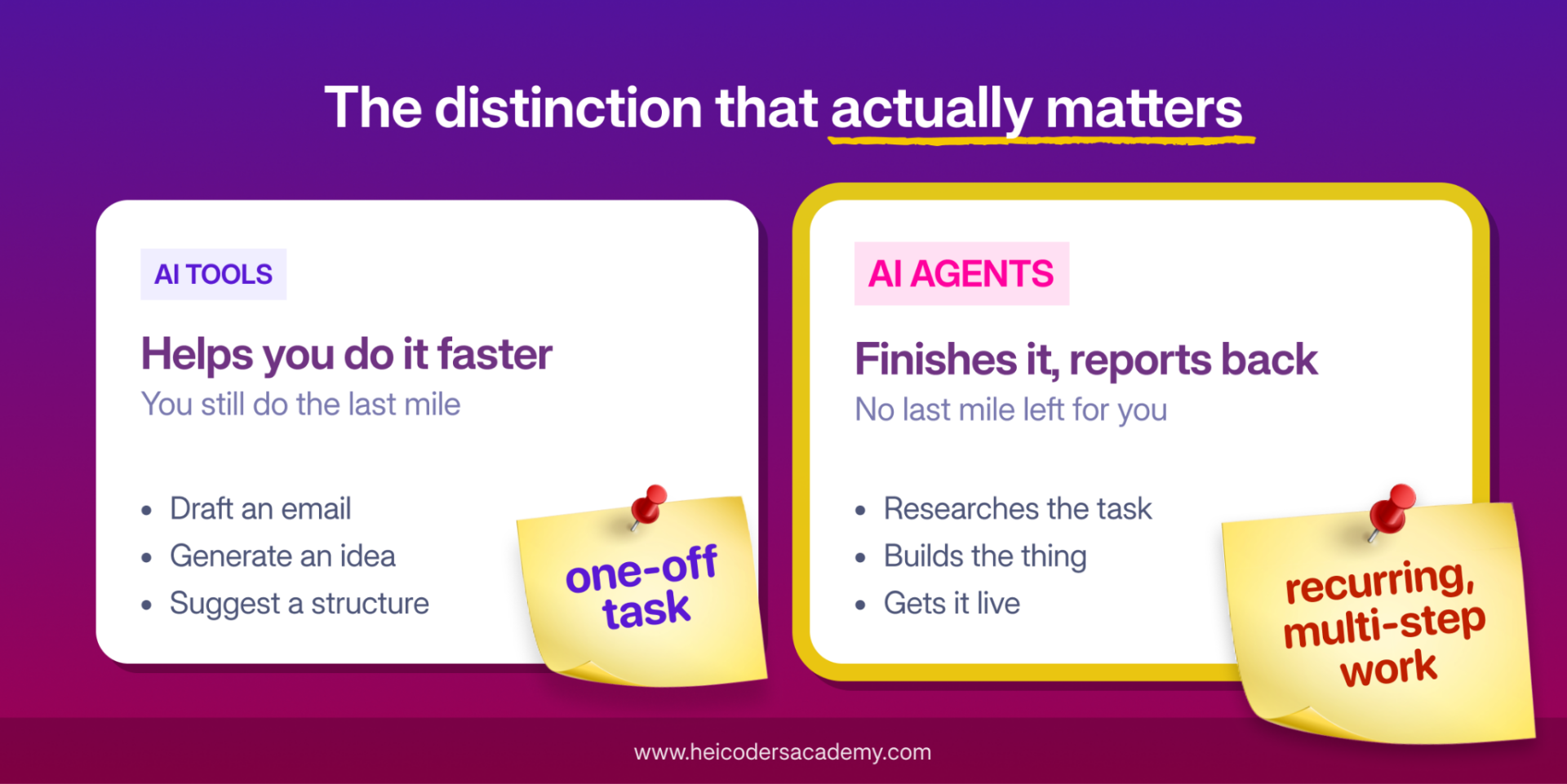
I’d used AI tools for months before anything changed. They were useful for drafting an email or generating an idea, but they all shared the same limitation: I still had to do the final work. A tool could suggest how to structure something, but I still had to build it. It could draft a reply, but I still had to send it.
The shift happened when I started using tools that could complete the work instead of just assisting with it: research something, build the thing, and get it live, without me doing the last mile myself.
That’s the test worth applying before you automate anything. If a task is a one-off, writing an email, summarising a document, a good prompt to any AI chatbot is enough; you don’t need an agent. If it’s something you do on a recurring schedule, or it involves multiple steps across different tools, or it should trigger automatically when something happens, that’s agent territory. Most solopreneurs over-invest in the first category and under-invest in the second, because tools are more visible and easier to try.
Day to day, we still use plenty of tools in that first category too: Claude Code for development work, Claude Design and Gemini Pro for visual and design tasks, ChatGPT for general drafting and research. They’re genuinely useful, and none of them are what this article is actually about. This is about the second category, the recurring, multi-step work that used to need a person and doesn’t need to any more.
Before You Automate Anything, Do the Task Manually First
Whatever you’re thinking of handing to an agent, do it yourself a handful of times first, and write down every step. It feels slow, but it’s the only way to turn something you do on autopilot into instructions specific enough for software to follow.
Break each step into two categories: the ones that need your judgement, and the ones that don’t. The “don’t” steps are what you hand to the agent. The “need judgement” steps either stay with you, or the agent does them and you review the output before anything goes out.
Skipping this step is the single most common reason a first attempt at automation feels disappointing: the task was never actually mapped out clearly enough to automate in the first place.
What We Automated, and What Any Solopreneur Can
At Heicoders, once the administrative load started threatening to bury the team, we rebuilt our operations around this idea, without a single dedicated software engineer. Here’s the specific detail, because the specifics are what make this useful rather than inspirational.
The hiring portal replaced reviewing applications one by one as they landed in an inbox. Now every posting and applicant sits in one system, tracked through each stage automatically. The support system does something similar for learner queries: instead of requests scattered across email, everything routes into one ticketing workflow with an internal board the team works through, which also happens to help us meet the government’s service-level requirements for how quickly certain requests need a response.
The HR portal handles onboarding and compliance sign-offs, and includes its own digital signature system, which quietly replaced a separate paid e-signature tool we no longer need. The instructor scheduling inside it checks availability and assigns people automatically, instead of the manual back-and-forth scheduling usually involved.
The feedback dashboard takes raw survey exports and turns them into visual, quarter-by-quarter performance reports, and goes one step further by having AI summarise each instructor’s strengths and suggest specific coaching points, rather than someone reading through spreadsheets and drawing conclusions by hand.
None of those are unique to running a training academy. Strip away the specifics and every solopreneur has a version of each one. An inbox that needs triage. A scheduling back-and-forth that eats your afternoon. Compliance or admin paperwork that has to happen but adds no value when you’re the one doing it. Some kind of feedback or performance data you should be reviewing regularly but rarely get to. Those are exactly the tasks worth handing to an agent first.
A Worked Example: Automating Client Intake From Scratch
Frameworks are easy to nod along to and hard to actually apply, so here’s what the process looks like end to end, using a task almost every solopreneur has: a new client or lead enquiry landing in your inbox. This is illustrative, not a description of a specific Heicoders system, but it follows exactly the same steps outlined above.
Start by watching yourself do it manually, five or six times. You’ll likely notice the same shape every time: you read the enquiry, pull out the name, what they’re asking for, and any deadline mentioned, check whether you already have a file or record for that person, create one if not, reply with a standard set of questions or next steps, and add the enquiry to whatever list or spreadsheet you track leads in. Write that sequence down exactly as you actually do it, including the parts that feel too obvious to mention.
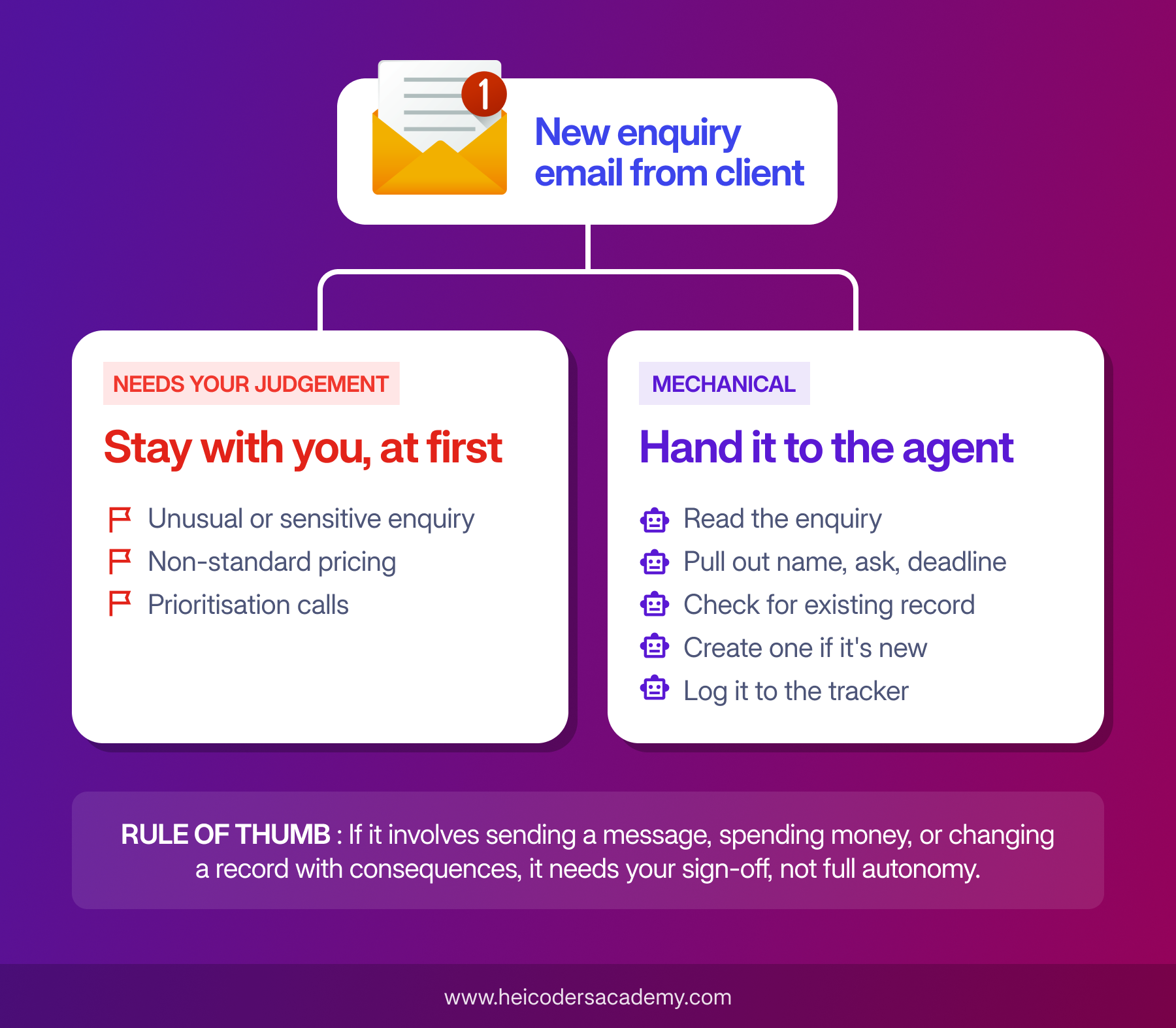 Now sort those steps into the two piles from earlier. Reading the enquiry, extracting the key details, checking for an existing record, creating a new one, and logging it to your tracker are entirely mechanical: an agent can do all of that without your input. Deciding how to respond to an unusual or sensitive enquiry, quoting a non-standard price, or judging whether someone is worth prioritising is not; that stays with you, at least at first.
The first version you build should only handle the mechanical half, and should draft the reply for your review rather than send it automatically. That’s a deliberately small scope. Once you’ve corrected its drafts for a couple of weeks and it’s consistently getting the routine cases right, that’s the point to consider letting it send routine replies on its own and only flag the unusual ones for you. Trying to build the full version, automatic detection of sensitivity, automatic sending, on day one is the most common way this kind of project stalls before it starts.
No-Code Tools to Start With
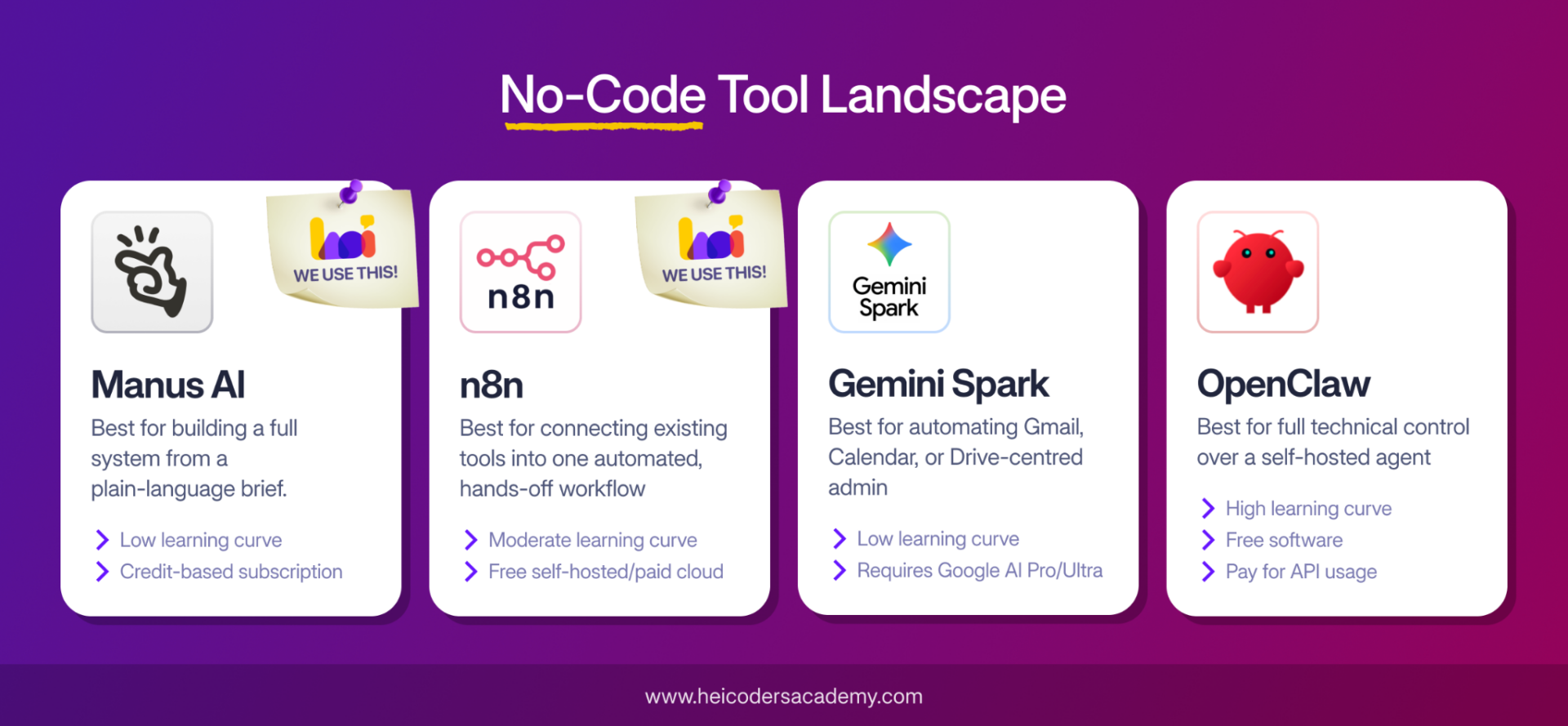
The tool that changed things for us was Manus, a cloud-based agent that takes a plain-language instruction and builds and runs the actual thing, a working system, not just a draft of one. It’s the tool behind everything described above, and it’s genuinely usable without any coding background. Every new hire at Heicoders learns it from their first week, and some become more confident with it than the founders within a few weeks.
We also use n8n quite a bit alongside Manus, particularly for stitching several existing tools and services together into one workflow rather than building something new from scratch. Between the two, that covers most of what we automate day to day.
The two below, we haven’t personally used at Heicoders, so take them as landscape awareness rather than a recommendation from experience. The table is a rough guide, not a ranking.
| Tool | Best for | Learning curve | Cost model |
|---|---|---|---|
| Manus | Building and running a complete system from a plain-language brief | Low | Credit-based subscription |
| n8n | Connecting several existing tools into one automated workflow | Moderate | Free self-hosted, or a paid cloud plan |
| Gemini Spark | Automating tasks already centred on Gmail, Calendar, or Drive | Low | Requires Google AI Pro or Ultra |
| OpenClaw | Full technical control over a self-hosted agent | High | Free software; you pay only for API usage |
Manus and n8n are the two we actually rely on ourselves. Gemini Spark is worth watching, though it’s genuinely new, Google only launched it this year, well after we’d already built everything described above, so it simply wasn’t an option at the time. It’s aimed at exactly the kind of Gmail, Calendar, and Drive-centred admin a lot of solopreneurs deal with, and may be worth trying once it’s had more time to mature. For anyone comfortable with more technical setup and wanting full control over how an agent runs, OpenClaw is worth knowing about too, though it asks more of you upfront than any of the others, including managing your own security.
The Trust Question: Staying in Control
The instinct to resist this is usually “I don’t want to lose control of my own business.” That’s a reasonable instinct, and it doesn’t have to be true. Good agent tools are built around approval steps for anything consequential: sending a message, spending money, changing a record. They keep an audit trail of what happened and when, and let you step in and take over at any point. You’re not handing over judgement. You’re removing yourself from the steps that never needed your judgement in the first place, while staying the one who signs off on anything that does.
AI Agents Default to Agreeing With YouHere’s something worth knowing before you rely on one heavily: AI agents (just like their LLM counterparts) tend to agree with you by default. In a team, someone usually pushes back on a bad idea before it goes far. Working alone, that check doesn’t exist unless you build it in deliberately.
Some solo founders have started explicitly instructing their agents to challenge their thinking and flag disagreement rather than simply comply, treating pushback as a feature to configure rather than something that happens naturally. In practice, that can be as direct as adding one line to how you brief an agent: before it agrees with a plan you’ve proposed, ask it to list at least two concrete reasons the plan might fail, or two ways a client could reasonably push back on it. That single instruction noticeably changes the kind of output you get, from validation to something closer to an actual second opinion.
If you only take one thing from this section, it’s this: an agent that always says yes isn’t helping you make better decisions. It’s just helping you move faster in whatever direction you were already headed.
Set Realistic Expectations
An agent’s first attempt at a task is rough. Expect to correct a large share of its output in the first couple of weeks. That’s normal, not a sign it isn’t working. Give it two to three weeks of actual use and correction before judging whether it’s worth keeping, since that’s typically when quality improves enough to be genuinely useful rather than a novelty.
Once the administrative load actually lifts, the value shows up somewhere you might not expect. It’s not in the hours saved on any single task, but in what you do with attention that used to be split across dozens of small things. We noticed that once real automation was in place, the team had noticeably more room to think. Questions like how to serve clients better, or which partnerships to pursue, rather than just the operational mechanics of keeping things running.
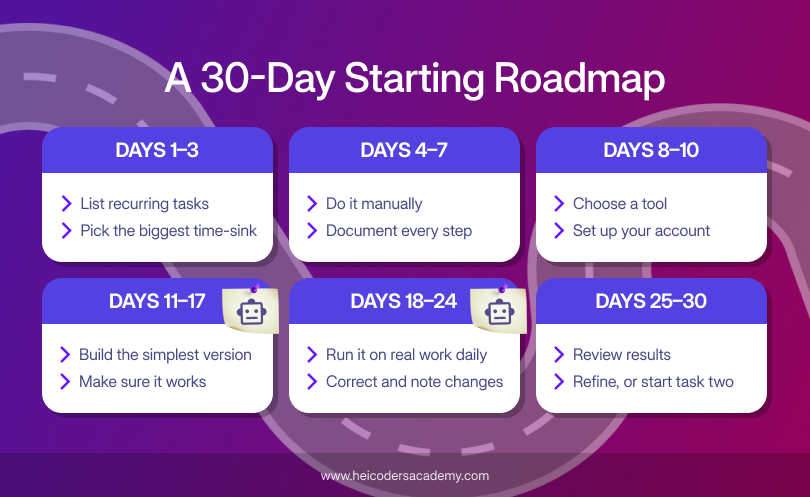
A 30-Day Starting Roadmap
- Days 1 to 3: List your recurring, repetitive tasks and pick the one that eats the most time.
- Days 4 to 7: Do that task manually several times, documenting each step.
- Days 8 to 10: Choose a no-code tool based on what you’re automating and set up an account.
- Days 11 to 17: Build the simplest possible version that produces output, even if imperfect.
- Days 18 to 24: Run it on real work daily, correcting it and noting what you change each time.
- Days 25 to 30: Review the results and decide whether to refine it further or start a second task.
What This Could Save You
At Heicoders, digital and AI tools now save the company roughly more than $200,000 a month, a figure we’ve shared publicly, across a team that’s grown well past just the two of us.
Your own number will look completely different depending on the size and shape of your business, but the categories are usually the same. There are the hours you’d otherwise spend on admin, and the assistant or contractor you’d otherwise need to hire for that same work. There’s also the opportunity cost of spending your own attention somewhere other than the work that actually grows the business.
That last one is the part solopreneurs tend to undercount. The direct cost of a tool subscription is easy to see. The cost of spending your best hours on inbox triage instead of the thing only you can do is much larger, and much easier to ignore until you fix it.
Common Mistakes to Avoid
- Starting with something too complex.
Don’t try to automate your entire operation at once. It’s tempting because the biggest, messiest process is usually the one causing the most pain, but that’s exactly why it has the most edge cases. Pick one narrow task, get it working, then expand. - Automating a task that’s too vague.
“Handle my client communication” isn’t specific enough to hand to an agent, because it’s not specific enough for you to check whether it did a good job. “Draft a reply to any email asking about pricing, using this template” is something you can actually verify. - Not tracking what you change.
Every correction you make to an agent’s output is information about where its default behaviour and your actual preferences diverge. Write it down, or you’ll be re-teaching the same lessons every few weeks instead of the agent actually improving. - Giving up too early.
The first week’s output is rarely good, and judging it then is like judging a new hire’s performance on their first afternoon. Give it a real month of actual use and correction before deciding.
Frequently Asked Questions About AI Agents for Solopreneurs
Do I need to know how to code to use AI agents in my business?
No. Manus and n8n, which we use at Heicoders, along with other agents like Gemini Spark, are all built to be used through plain-language instructions rather than code. Coding helps if you want maximum flexibility, but it isn't a requirement to get started.
How much does it cost to start using AI agents as a solopreneur?
It varies by tool, but most no-code options start in the range of a standard software subscription, and cost typically scales with how much you actually use them. It's worth comparing that ongoing cost against what you'd otherwise pay for a contractor or assistant doing the same task.
How long does it take before an AI agent is actually useful?
Expect a rough first one to two weeks, with meaningful improvement by the third or fourth week of regular use and correction. Judging an agent after only a day or two rarely gives an accurate picture.
What tasks should I automate first as a solopreneur?
Start with recurring, well-defined tasks that don't require much judgement, things like inbox triage, scheduling, or routine status updates, rather than your most complex or highest-stakes work.
Can AI agents replace hiring an assistant entirely?
For some solopreneurs, yes, for a meaningful share of administrative work. For anything requiring nuanced judgement, relationship management, or high-stakes decisions, most people find a hybrid approach works better: agents for the repeatable work, their own or a human's judgement for the rest.
The Bottom Line
Nobody starts a business to spend their best hours on scheduling and admin. AI agents won’t run your business for you, and treating them like they will is how people end up disappointed. But for the specific, repeatable work that fills up a solopreneur’s day without ever moving the business forward, they’re the closest thing to hiring help that I’ve found, without the overhead of actually hiring.
Start with one task, do it manually first, and give the agent a real few weeks before deciding whether it’s earned a permanent place in how you work.

If this resonates and you want to build this kind of AI fluency properly, rather than piecing it together alone, that’s exactly the gap Heicoders Academy’s Generative AI Course (GA100) is built to close. It’s a SkillsFuture-eligible course for working professionals in Singapore that covers AI agents and automation hands-on, including tools like Manus and n8n. Explore the Generative AI Course (GA100) and build the same fluency into your own work.
About the Author
Kong Yu Ning is Co-Founder and Chief of Growth at Heicoders Academy. He and co-founder Beh Min Yan bootstrapped the company on weekends while both working full-time, before growing it into a company whose learners now range from Fortune 500 board members to political leaders, training around 12,000 students a year.