If your business is investing in training, research, or new technology, the Singapore government wants to help foot the bill.
Introduced in Budget 2023, the Enterprise Innovation Scheme (EIS) is designed to encourage businesses to engage in Research & Development, innovation and capability development. It offers a massive 400% tax deduction on qualifying expenses, or the option to convert those expenses into a non-taxable cash payout of up to $20,000 per year.
But like any government grant or tax scheme, the rules around eligibility, qualifying activities, and application deadlines can be complex. In this guide, we will break down exactly what the EIS is, who qualifies, what activities you can claim for, and how to submit your application correctly.
What is the Enterprise Innovation Scheme (EIS)?

The Enterprise Innovation Scheme (EIS) is a tax enhancement measure administered by the Inland Revenue Authority of Singapore (IRAS). It is available for qualifying expenditure incurred from Year of Assessment (YA) 2024 to YA 2028.
The scheme gives eligible businesses two ways to benefit from their investments in innovation:
- Enhanced Tax Deductions: Businesses can claim 400% tax deductions or allowances on up to $400,000 of qualifying expenditure per year for each of the four main activities (and up to $50,000 for innovation projects with select institutes and also qualifying AI expenditures).
- Cash Payout Option: In lieu of tax deductions, businesses can opt to convert up to $100,000 of their total qualifying expenditure into a non-taxable cash payout at a conversion rate of 20%. This means a maximum cash payout of $20,000 per YA.
This option to either opt for enhanced tax deduction or receive cash payout makes the EIS highly flexible:
- Profitable companies can use the 400% deduction to significantly lower their corporate tax bill,
- while growing startups or SMEs that may not yet be profitable can opt for the cash payout to improve their immediate cash flow.
Who Qualifies for the EIS?
To participate in the Enterprise Innovation Scheme, your business must be registered and operating in Singapore. Eligible entities include:
- Companies (including registered business trusts)
- Sole proprietorships
- Partnerships
- Registered branches or subsidiaries of a foreign parent company
Conditions for the Cash Payout Option
If you choose the cash payout option instead of the tax deduction, there are three additional strict conditions you must meet:
- Active Business Operations: You must be conducting an active trade or business in Singapore at the time the cash payout is disbursed.
- Minimum Expenditure: You must have incurred a minimum qualifying expenditure of $400 during the basis period.
- The 3 Local Employee Rule: You must have made Central Provident Fund (CPF) contributions for at least three full-time local employees (Singapore Citizens or PRs earning at least $1,400/month) for at least six months during the basis period.
Note: Investment holding companies, charities, and entities that have ceased operations are not eligible for the cash payout.
What Activities Are Covered Under the EIS?
The EIS covers five specific categories of innovation and capability-building activities.
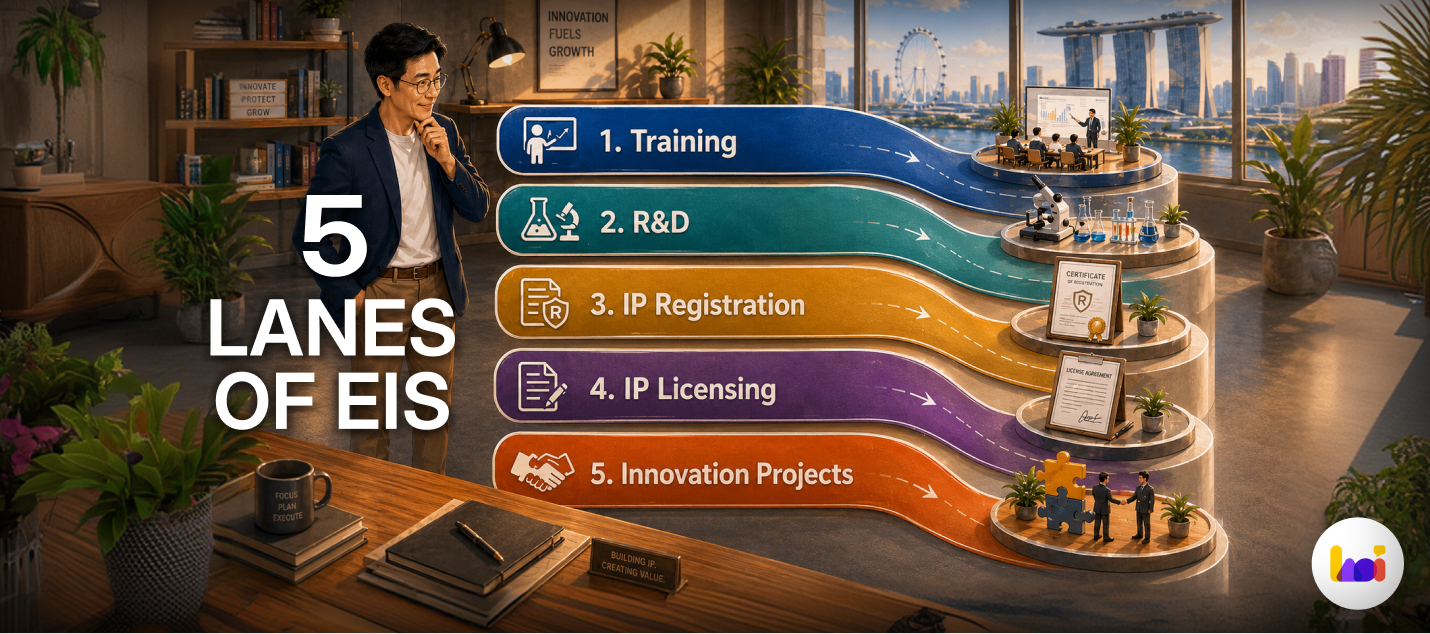
1. Qualifying Training
This is often the most accessible category for SMEs. You can claim course fees and assessment costs for training courses that are eligible for SkillsFuture Singapore (SSG) subsidy and aligned with the Skills Framework. This includes corporate training programmes in high-demand areas like Data Analytics, Generative AI, and Digital Marketing. The deduction is as such:
- 400% tax deduction on the first $400,000 of qualifying training expenditure (per YA)
- 100% tax deduction on the balance of qualifying training expenditure in excess of $400,000 and all other training expenditure (per YA)
2. Research & Development (R&D) in Singapore
If your business is conducting R&D in Singapore to create new products or improve existing processes, you can claim for staff costs, consumables, and even outsourced research fees. This category is capped at $400,000 per YA.
3. Registration of Intellectual Property (IP)
You can claim the official and professional fees incurred when registering patents, trademarks, or designs. The IP must be legally and economically owned by your Singapore business. This is capped at $400,000 per YA.
4. Acquisition and Licensing of IP Rights (IPRs)
Businesses with an annual group revenue of under $500 million can claim the costs of acquiring or licensing IP rights (excluding software) that are used for their trade. This is capped at $400,000 per YA.
5. Innovation Projects with Qualified Partners
If you collaborate on an innovation project with a polytechnic, the Institute of Technical Education (ITE), or other qualified partners, you can claim deductions on the project fees. This category has a lower cap of $50,000 per YA.
Tax Deduction vs. Cash Payout: Which Should You Choose?

The choice between the 400% tax deduction and the 20% cash payout depends entirely on your company’s current financial situation.
|
Feature |
400% Tax Deduction |
20% Cash Payout |
|---|---|---|
|
Best For |
Profitable companies with high taxable income |
Startups or SMEs needing immediate cash flow |
|
Maximum Benefit |
“up to $1.6 million for each $400,000-capped activity, and up to $200,000 for the $50,000-capped categories.” |
Up to $20,000 non-taxable cash per YA |
|
Employee Requirement |
None |
Must have 3 full-time local employees with 6 months CPF |
|
Flexibility |
Can be carried forward if unutilised |
Immediate cash injection |
Crucial Rule: You cannot claim both a tax deduction and a cash payout on the exact same expenditure. Once you elect to convert an expense into cash, that decision is irrevocable.
How to Apply for the EIS Cash Payout
If you are opting for the cash payout, timing is critical. You must submit your application after you have filed your Income Tax Return, but before the income tax filing due date for the relevant YA.

Here is the step-by-step process:
- File your Income Tax Return: Companies should file Form C-S, Form C-S (Lite) or Form C; sole-proprietorships and partnerships should file the relevant income tax returns.
- Log in to myTax Portal: Access the IRAS digital services using your CorpPass.
- Submit the Application: Use the “Apply for EIS Cash Payout” digital service.
- Provide Documentation: Depending on the activity, you may need to upload supporting documents such as invoices, training certificates, or CPF contribution records.
IRAS typically disburses approved cash payouts within three months via GIRO or PayNow Corporate.
Frequently Asked Questions (FAQs)
Can I claim the EIS cash payout if I don’t have 3 local employees?
No. The three full-time local employee rule (with at least 6 months of CPF contributions) is a strict requirement for the cash payout. However, you can still claim the 400% enhanced tax deductions even if you do not meet this headcount requirement.
Do I need to deduct other government grants before claiming EIS?
Firstly, absentee payroll funding is not a grant or subsidy to subsidise training expenditure hence the amount received need not be deducted from the company’s EIS claim.
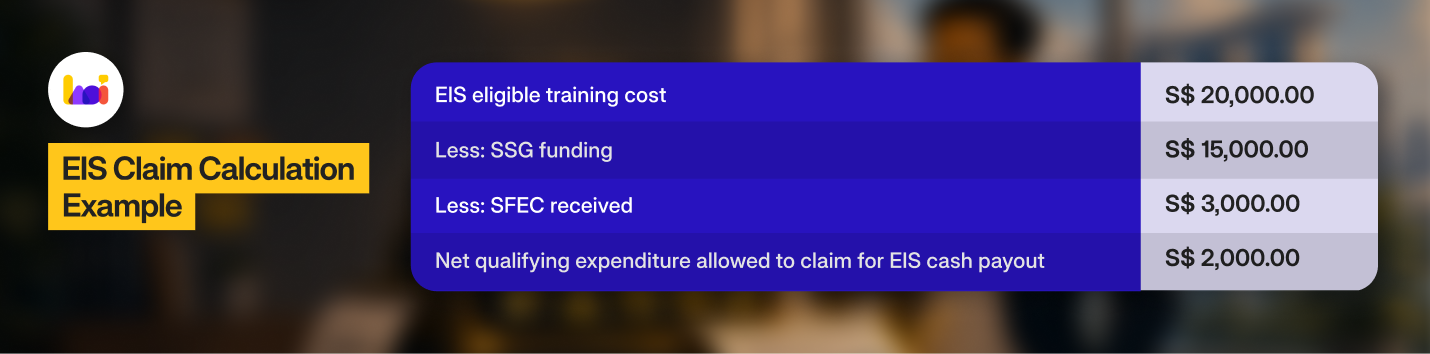
However for grants for SkillsFuture Enterprise Credit (SFEC) and SSG subsidies,you must deduct the grant amount first. You can only claim EIS benefits on the net out-of-pocket expenditure incurred by your business.
Here is an example:
- EIS eligible training cost was $20,000,
- the company received SkillsFuture Singapore (SSG) funding of $15,000 and Skills Future Enterprise Credit (SFEC) of $3,000 from Enterprise Singapore.
- The company can only claim the net qualifying expenditure after deducting the government grants as follows:
Can I claim EIS for training conducted overseas?
No. To qualify under the training category, the course must be eligible for SkillsFuture Singapore (SSG) subsidy and aligned with the Skills Framework, which typically requires the training to be conducted by an approved provider in Singapore.
Maximise Your EIS Training Claims with Heicoders Academy
Upskilling your workforce is one of the most straightforward ways to leverage the Enterprise Innovation Scheme. By investing in your team’s capabilities, you not only future-proof your business but also qualify for significant tax savings or cash payouts.
Heicoders Academy offers a range of industry-aligned corporate training programmes in high-demand fields such as Data Analytics, Artificial Intelligence, and Software Development. Our courses are designed to deliver practical, immediate value to your business operations.
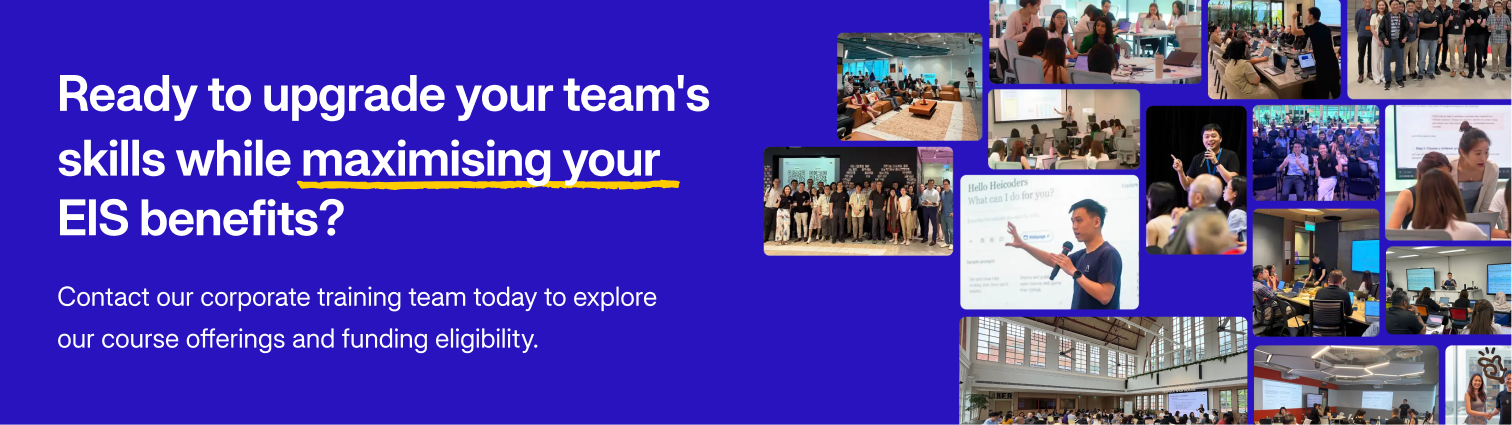
Ready to upgrade your team’s skills while maximising your EIS benefits? Contact our corporate training team today to explore our course offerings and funding eligibility.